15 Minutes
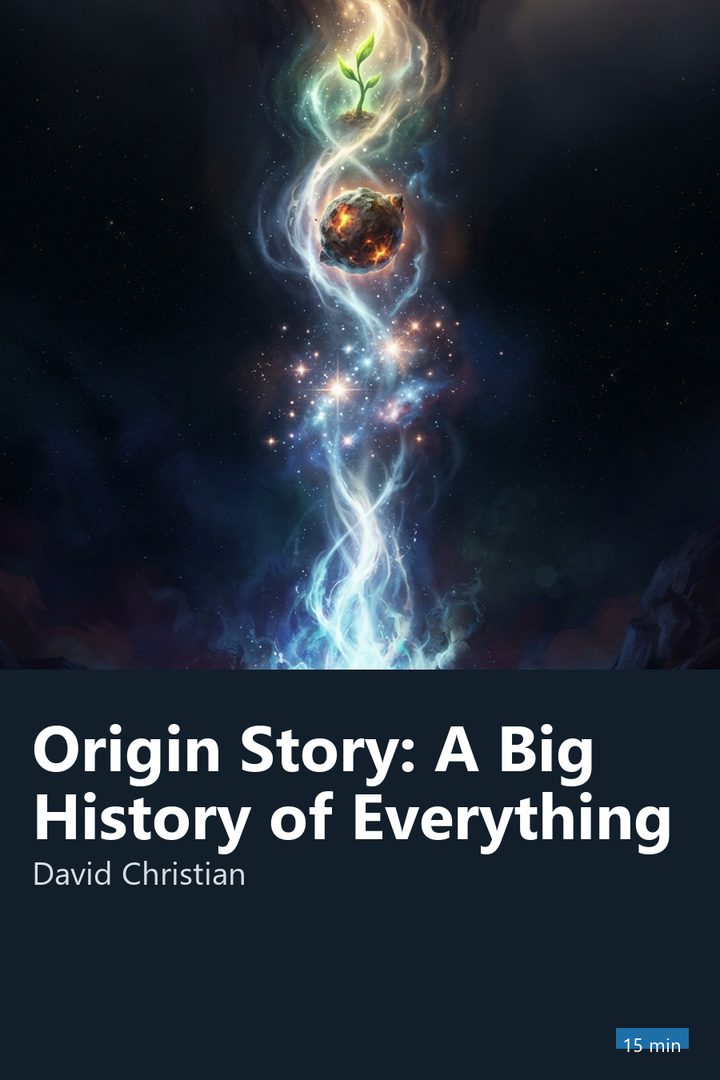
Cover of Origin Story: A Big History of Everything

Science · 17 min

Origin Story: A Big History of Everything

David Christian · 2018

Who it's for

For anyone who has ever wondered how stardust turned into the people reading this right now, and who wants a panoramic view that links physics, biology, and history into one chain, without needing to be an expert in any of the three.

Read it in the app

⚡ Free to download • 🎁 One full book free every day

🎧 Audio coming soon in the app

Narration for the English summaries is on its way. Meanwhile you can read the full summary in the app.

3 ideas to take with you

1

For Christian, telling the story of the universe as a science-based origin myth helps give a shared sense of meaning to peoples who once each had their own narrative.

2

In the book, life is just one more threshold of complexity: once the first cell appeared, natural selection took over the job of testing, generation after generation, which forms adapted best to their environment.

3

According to the book, humanity has become a force capable of changing the planet on a geological scale, and the Anthropocene calls for decisions that no earlier generation ever had to make.

“
For Christian, a star, a cell, and an economy only grow while a flow of energy meets the right range of conditions, neither too weak nor too violent.
An idea from Origin Story: A Big History of Everything, in the words of 15 Minutes

Preview

Start reading now

An origin myth for the age of science

Almost every human culture, before any telescope or microscope, told itself an origin story: where the world came from, where we came from. African peoples, Aboriginal Australians, Native American peoples, and so many others created rich narratives to explain the beginning of everything, and those stories deserved respect long before modern science existed.

The historian David Christian starts from that same human need, only with a different tool in hand. He brings together discoveries from physics, chemistry, biology, geology, and history into a single timeline, the way science understands it today. He named this field of study Big History, an attempt to tell the story of everything, the whole universe, in one sequence.

The central idea of the book is simple to state: the history of the universe can be divided into eight great thresholds, moments when a new kind of complexity appeared that hadn't existed before. Each threshold depends on the one before it, like the steps of a staircase that runs from the Big Bang to the internet.
Threshold 1: the moment space, time, and matter were born together

About 13.8 billion years ago, according to current scientific consensus, the entire observable universe was concentrated in one extremely hot, dense point. That point began to expand in what physicists call the Big Bang, and that expansion has never stopped.

It wasn't just space that was born there: time also started running at that instant, and the simplest matter in the universe, hydrogen and helium, appeared in the first minutes of that expansion. Practically everything that came after, stars, planets, people, is that same material rearranged into ever more complex forms.

It's a strange invitation to think that there was a first instant for everything, including time itself. But that is exactly the starting point the book uses as threshold 1: the moment when existing, quite simply, became possible.

Goldilocks: the recipe that repeats at every threshold

One of the most useful findings in the book isn't about any specific threshold, it's about the pattern that repeats in all of them. Every time a new kind of complexity appears, you can find two ingredients together: a flow of energy passing through that system, and conditions that can't be too extreme or too weak. Christian calls these Goldilocks conditions, a nod to the children's tale that gives the term its name.

A star only forms if the gas cloud has enough mass to collapse under its own gravity without turning into a black hole. A cell only survives within a narrow range of temperature and acidity, and an economy only grows within certain limits of stability. The principle repeats from particle physics all the way to human society.

Understanding this pattern changes how you look at any complex system: instead of asking only what happened, it's worth asking what flow of energy sustained it, and what conditions had to line up so that it neither stalled nor blew up.

12 more sections and the quiz

Continue in the app

Read the whole summary, finish with the Origin Story: A Big History of Everything quiz and follow the guided Journeys. No ads in the app.

About David Christian

David Christian is a British-American historian based in Australia, where he teaches at Macquarie University. He is the creator of the field of study known as Big History, which brings together astronomy, geology, biology, and human history in a single continuous narrative. With support from Microsoft co-founder Bill Gates, he co-founded the Big History Project, a free educational initiative aimed at schools. Origin Story is the book in which he gathers, in one volume accessible to the general public, the material he had been developing in the classroom for decades.

Explore

Category:
Science
Part of the Journeys:
Science Curiosity