15 Minutes
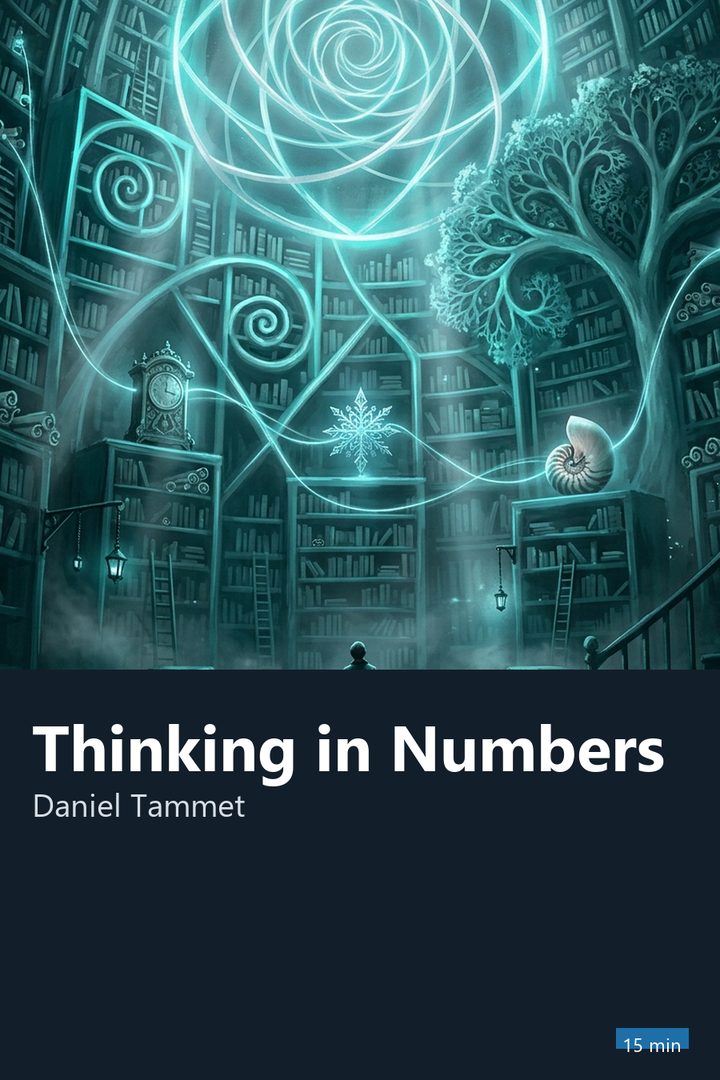
Cover of Thinking in Numbers

Science · 15 min

Thinking in Numbers

Daniel Tammet · 2012

Who it's for

For readers who want to overcome the trauma of cold formulas and discover mathematics as a living language of imagination, poetry, literature, and everyday beauty.

Read it in the app

⚡ Free to download • 🎁 One full book free every day

🎧 Audio coming soon in the app

Narration for the English summaries is on its way. Meanwhile you can read the full summary in the app.

3 ideas to take with you

1

Mathematics becomes less intimidating when we understand that numbers are a language of imagination and beauty, not just mechanical formulas.

2

The way a culture counts and names quantities profoundly shapes its perception of time, space, and social relationships.

3

Fear of math and science grows out of teaching based on lifeless rote memorization, which obscures the curiosity and pleasure of creative exploration.

“
Great historical transformations depend not only on the will of rulers but on the invisible sum of the daily decisions of millions of anonymous people.
An idea from Thinking in Numbers, in the words of 15 Minutes

Preview

Start reading now

A Synesthetic View of Numbers

For the overwhelming majority of people, mathematics brings back uncomfortable school memories of dry formulas, lifeless rote memorization, and tests taken against the clock. Daniel Tammet offers the opposite perspective. Diagnosed with Asperger's syndrome and gifted with extraordinary synesthesia, he perceives numbers not as abstract symbols but as living entities filled with colors, textures, shapes, and personalities of their own.

When Tammet publicly recited more than twenty-two thousand decimal digits of pi in Oxford without a mistake over five hours, he was not performing an exercise in mechanical memorization. For him, recalling pi was a contemplative walk through a rich geometric landscape, where each digit unfolded into colors and volumes in the theater of the mind.

The central aim of Thinking in Numbers is to invite readers to shed the prejudice that mathematics is a mechanical discipline reserved for cold minds and unfeeling hearts. Tammet shows that numerical thinking is a legitimate extension of poetic imagination, in constant conversation with world literature, philosophy, social history, and the deepest human feelings that shape our existence in the cosmos.

The Poetry and Texture of Counting

In Tammet's perception, every number possesses a unique dignity. Prime numbers appear to him as smooth, polished stones beside a stream, irreducible in their structural purity. Composite numbers, on the other hand, display complex, faceted surfaces, ready to be broken down into smaller components in perfect harmony.

This vision reveals a tangible dimension of arithmetic, reaching back to civilization's childhood, when counting was not an exercise in pure abstraction but the physical act of stacking pebbles, tying knots in cords, or examining grooves in prehistoric bones. Human beings began quantifying the world by touching matter, and that bodily foundation remains alive beneath the equations.

By bringing numbers closer to aesthetics, the book suggests that mathematical beauty is accessible to anyone willing to contemplate it without rushing. We do not need to be composers to be moved by a piano sonata, or hold degrees in math and science to appreciate the elegance of a numerical progression or the infinite mystery of a perfect circle.

The Languages and Cultures of Quantity

One of the fascinating subjects explored in the book is the connection between the structure of languages and the ways different societies count. Far from being an unchanging universal standard, numerical vocabulary reflects the ecological, historical, and philosophical choices of each cultural group.

Tammet examines how Icelandic retains intricate grammatical inflections for quantities depending on the nature of the objects involved. He also investigates the vigesimal system preserved in French, where eighty is expressed as four twenties, a Celtic legacy of counting on fingers and toes in pre-Roman Europe.

The author also examines surprising ethnographic cases, such as the Indigenous Pirahã people of the Brazilian Amazon, whose language has no words for exact numbers, using only relative notions of a little and a lot to organize daily life. These linguistic variations show that counting is a living, changing cultural phenomenon: the way a community speaks about and categorizes the world profoundly shapes how it perceives the passage of time, distributes material resources, and builds bonds of collective cooperation.

10 more sections and the quiz

Continue in the app

Read the whole summary, finish with the Thinking in Numbers quiz and follow the guided Journeys. No ads in the app.

About Daniel Tammet

Daniel Tammet is a British writer, linguist, and essayist with Asperger's syndrome and exceptional synesthetic abilities. He gained worldwide recognition for memorizing and reciting more than twenty-two thousand digits of pi in 2004 and for his memoir Born on a Blue Day. He speaks more than ten languages and was elected a fellow of the United Kingdom's Royal Society of Arts.

Explore

Category:
Science
Part of the Journeys:
The Universe Made Simple