15 Minutes
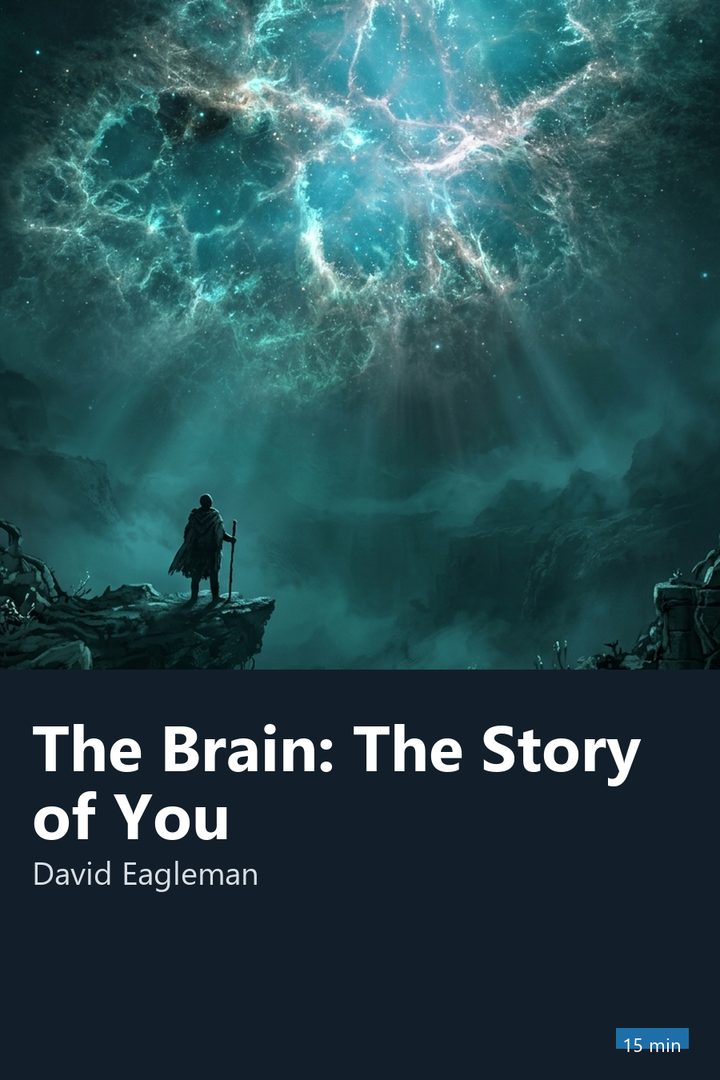
Cover of The Brain: The Story of You

Science · 17 min

The Brain: The Story of You

David Eagleman · 2015

Who it's for

For anyone curious about how memory, emotion, decision-making, and identity are born in the brain, explained in accessible language. It is ideal for readers who want to dive into neuroscience without the jargon.

Read it in the app

⚡ Free to download • 🎁 One full book free every day

🎧 Audio coming soon in the app

Narration for the English summaries is on its way. Meanwhile you can read the full summary in the app.

3 ideas to take with you

1

Autopilot brings efficiency to everyday life, but it lets biases slip through unnoticed until someone pays attention to them.

2

Being around other people is part of brain health, and being excluded from the group activates regions linked to physical pain.

3

Brain technologies are already helping patients, but the debate around access and privacy will become just as important as the breakthroughs themselves.

“
Two people can walk away from the same conversation with different stories and both still be completely sincere.
An idea from The Brain: The Story of You, in the words of 15 Minutes

Preview

Start reading now

The biography of the person reading this sentence

A book about the brain has a unique quirk: the main character is the reader. David Eagleman writes what he calls a biography of the organ that shapes who you are, and the beauty of it lies in seeing that the person you feel yourself to be, with your tastes, fears, and memories, is a work constructed by roughly three pounds of tissue inside your skull.

The starting point is a staggering scale. There are billions of cells, called neurons, each connected to thousands of others through contact points known as synapses. None of them understands anything on its own, yet together in a network, they produce thought, emotion, memory, and the feeling of being someone.

From there, the book is organized around questions almost everyone has asked: what is reality, who is in control, how do I decide, who do I need, and who can I become. Each answer blends science, real-life cases, and a conversational tone that feels like a documentary told out loud.


You don't see the world: you see what the brain puts together

Inside the skull, it is dark and silent. The brain receives neither light nor sound, only electrical and chemical signals coming from the senses, and it has to interpret all of it. What you call reality is therefore a constructed version, filtered through the sensors evolution gave us and the interpretation the brain makes.

Eagleman uses optical illusions, cases of synesthesia (where sounds have color or numbers have personalities), and experiments with time to show that every brain puts together its own movie. Two friends at the same bar can remember the exact same night differently without either of them lying.

A practical takeaway: when two people argue about what happened, it is worth suspecting bad faith a little less and remembering that both are seeing their own version. That does not erase facts, but it calls for humility, especially in disagreements at home or at work.

Memory is part of the same conversation. Remembering is not like opening a drawer and pulling out a recorded video: every time we recall something, the brain rebuilds the scene with whatever it has on hand, and details can get swapped out without our noticing. That is why honest eyewitnesses sometimes contradict each other, and why it pays to write down important agreements instead of trusting your memory alone.

Senses that can be swapped and expanded

One of the most fascinating ideas in the book is sensory substitution. If the brain merely interprets signals, the route those signals take to get there can change. Blind people have learned to perceive shapes through devices that translate images into tiny vibrations or gentle stimulation on the skin or the tongue.

With his team, the author himself developed a vest and wristband that convert sound into vibrations to help deaf people perceive their surroundings. The idea is that the brain learns to decode the new pattern over time, much like someone learning a new language.

The book speculates that in the future we may be able to create senses that do not currently exist, such as directly perceiving data from the internet or from inside our own bodies. For now, that remains a research frontier, and lab results do not always hold up in the real world. Even so, the underlying message is inspiring: the brain is far more flexible than we used to think.

10 more sections and the quiz

Continue in the app

Read the whole summary, finish with the The Brain: The Story of You quiz and follow the guided Journeys. No ads in the app.

About David Eagleman

David Eagleman is an American neuroscientist, professor, and researcher affiliated with Baylor College of Medicine in Texas and later Stanford University. He studies time perception, synesthesia, and the intersection of neuroscience and the law. He is the author of books such as Incognito, Sum, and Livewired, and he hosted the television series The Brain. He also founded a technology company that creates sensory substitution devices.

Explore

Category:
Science