15 Minutes
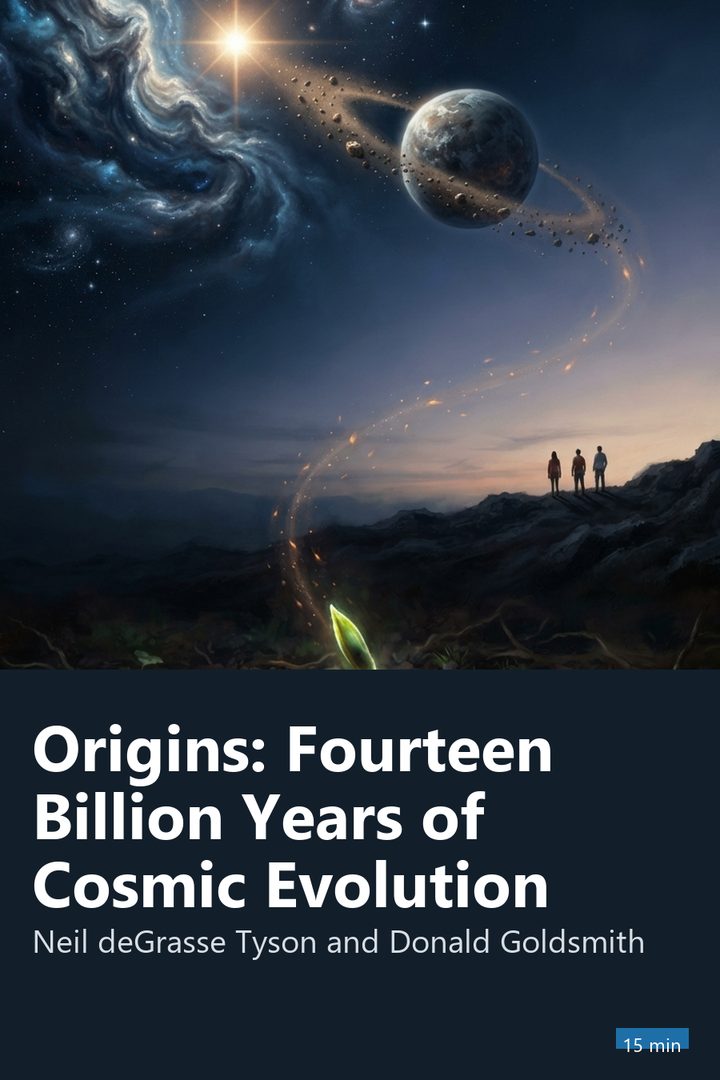
Cover of Origins: Fourteen Billion Years of Cosmic Evolution

Science · 17 min

Origins: Fourteen Billion Years of Cosmic Evolution

Neil deGrasse Tyson and Donald Goldsmith · 2004

Who it's for

For anyone who has always been curious about where the universe, the stars, the planets, and life came from, but never had the patience for a book full of formulas. Origins lays out that whole story in a clear sequence, from the Big Bang to the question of life elsewhere.

Read it in the app

⚡ Free to download • 🎁 One full book free every day

🎧 Audio coming soon in the app

Narration for the English summaries is on its way. Meanwhile you can read the full summary in the app.

3 ideas to take with you

1

The amount of matter left over in the universe after matter and antimatter collided was small enough to fit in a ratio of one in a billion, and even so, it is what makes up everything that exists today.

2

For the authors, galaxies grew from tiny irregularities in the matter of the young universe, pulled together by gravity over billions of years.

3

For the authors, the Drake equation mainly serves to organize the size of our ignorance about life beyond Earth, not to calculate a reliable answer.

“
The universe spent 380,000 years opaque before light could break free for the first time and travel unimpeded through space.
An idea from Origins: Fourteen Billion Years of Cosmic Evolution, in the words of 15 Minutes

Preview

Start reading now

The starting point: what the authors call the Big Bang

Neil deGrasse Tyson and Donald Goldsmith wrote this book as a companion to the series Origins, which aired on the American public TV program NOVA in 2004. The thread running through the whole book is the idea of cosmic evolution: the passage from a simple, uniform universe right after the Big Bang to the universe full of complex structures that we see today, with galaxies, stars, planets, and, in one small corner, people.

The starting point is a universe that was born already expanding, extremely hot and dense, about 13.8 billion years ago. The book's title rounds that number to fourteen billion, which is easier to keep in your head than the exact decimal.

It's worth understanding right away that the Big Bang was not an explosion inside an empty space that already existed, like a bomb going off in a room. It was space itself that began to stretch, carrying along everything that existed within it, including time.

Matter and antimatter: why anything was left over

In the extreme heat of the first instants, pure energy turned into pairs of particles: one of matter and one of antimatter, twins and opposites. When one of those pairs met again, the two annihilated each other and turned back into energy, a constant cycle of creation and destruction.

If the amounts of matter and antimatter had been exactly equal, the book explains, the end result would be nothing but light left in space, with no matter left over to form a star, a planet, or anything solid. For anything to really exist, it depends on a tiny imbalance: for every billion pairs that canceled out, one particle of matter was left with no partner to destroy it.

This small leftover, now called the matter-antimatter asymmetry, is an observed and well-established fact. The exact reason it happened in that specific proportion, though, the authors treat as an open question, not a fully solved mystery.

The light that breaks free: the heat signature of the baby universe

For the first 380,000 years, the universe was opaque, a dense soup of charged particles that scattered any light before it could travel far, a bit like a flashlight beam that can't get through milk boiling in a pot.

When that soup cooled enough, electrons joined atomic nuclei and formed the first neutral atoms, a process scientists call recombination. At that moment the light was finally free to travel, and that same light is still arriving today, stretched by the expansion of space until it became microwave radiation: the cosmic microwave background, the oldest picture we have of the universe.

This radiation was mapped in detail decades after the Big Bang theory was proposed, and it confirmed specific predictions made before the measurement. That is why the authors have so much confidence in this part of the story, unlike the more speculative stretches that appear later in the book.

12 more sections and the quiz

Continue in the app

Read the whole summary, finish with the Origins: Fourteen Billion Years of Cosmic Evolution quiz and follow the guided Journeys. No ads in the app.

About Neil deGrasse Tyson and Donald Goldsmith

Neil deGrasse Tyson is an American astrophysicist, director of the Hayden Planetarium in New York, and host of the TV series Cosmos: A Spacetime Odyssey. Donald Goldsmith is an astronomer and science writer, author of several popular science books on cosmology and the solar system. The two wrote Origins as a direct companion to the documentary series Origins, which aired on NOVA in 2004. It is one of the few Tyson works written with a partner, unlike most of the solo books he is best known for.

Explore

Category:
Science
Part of the Journeys:
The Universe Made Simple