15 Minutes
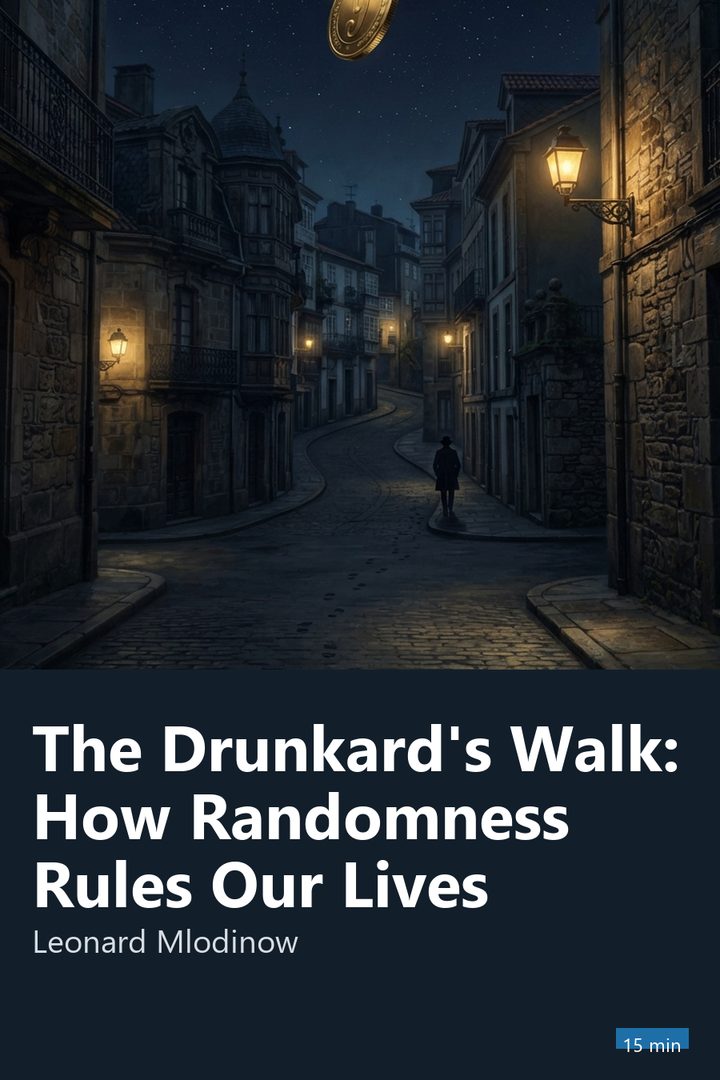
Cover of The Drunkard's Walk: How Randomness Rules Our Lives

Science · 16 min

The Drunkard's Walk: How Randomness Rules Our Lives

Leonard Mlodinow · 2008

Who it's for

For you if you like understanding why things work out or go wrong, and you want to learn to separate luck from merit in your own decisions, at work and with money. An accessible science book for people who have never formally studied statistics.

Read it in the app

⚡ Free to download • 🎁 One full book free every day

🎧 Audio coming soon in the app

Narration for the English summaries is on its way. Meanwhile you can read the full summary in the app.

3 ideas to take with you

1

Two or three times in a row do not make a reliable pattern; they make a sample too small to prove anything on its own.

2

An outlier result tends to be followed by a result closer to the average, without that meaning the person who produced it actually got worse.

3

For the author, a streak of hits that looks like a hot hand in a game usually fits within what chance alone would already produce.

“
For Mlodinow, our life path seems like a story that makes sense in large part because we tell it backward, after the random steps have already happened.
An idea from The Drunkard's Walk: How Randomness Rules Our Lives, in the words of 15 Minutes

Preview

Start reading now

The drunkard's walk: the image that gives the book its name

Physicists use the term random walk to describe someone stumbling out of a bar in the middle of the night, dizzy, taking one step to each side with no fixed pattern. After a hundred steps like that, nobody can predict where that person will end up, because each step is independent of the one before and keeps no memory of the path already walked.

Mlodinow uses this image to talk about careers, business, investing and even whole lives: from far away, the path taken seems to have a clear logic, a plan that worked out step by step. Up close, every decision was pushed along by a bunch of factors nobody controlled, just like the physicist's dizzy drunkard.

That is the central thesis of the book: we insist on finding a single cause for every result, when a good part of what happens is the sum of little random nudges that only seem to have a direction when seen from far away, after they have all already happened.

Why our minds refuse to accept chance

The human brain evolved by hunting for patterns: spotting a shape in the bushes could be a matter of life or death, so it was better to err by seeing a predator that wasn't there than to miss a real one. That same instinct is still switched on when you look at a sequence of lottery numbers or the mood in a work meeting.

The problem is that this instinct can't tell a real pattern from pure noise. It also doesn't separate correlation from cause: two things happening together doesn't prove one caused the other, but the mind insists on stitching together a neat little explanation for any coincidence, a bias psychologists have studied for decades.

Mlodinow calls this needing a story. The book proposes a simple exercise: before accepting the easiest explanation for a result, ask whether it could also have come from pure chance, with no plot hidden behind it.

Cardano, the gambler who became the first mathematician of chance

Gerolamo Cardano was a physician, mathematician and inveterate gambler in sixteenth-century Italy, living off bets on dice and cards when the university didn't pay his bills. He was the first to try to calculate, and not just feel in his gut, the chance of each play.

In the book he wrote about games of chance, Cardano laid the foundations of combinatorics applied to chance: systematically counting how many different results a die or a deck of cards could produce, instead of relying only on luck or on the superstition forever repeated at the table.

The important detail here is the practical origin: probability wasn't born in a classroom, it was born from an indebted guy wanting to understand, once and for all, why he kept losing money gambling.

13 more sections and the quiz

Continue in the app

Read the whole summary, finish with the The Drunkard's Walk: How Randomness Rules Our Lives quiz and follow the guided Journeys. No ads in the app.

About Leonard Mlodinow

Leonard Mlodinow is an American physicist with a Ph.D. in physics from the University of California, Berkeley. He was a professor at the California Institute of Technology, Caltech, and co-authored popular science books with physicist Stephen Hawking. He also worked as a television writer, including episodes of the series Star Trek: The Next Generation.

Explore

Category:
Science
Part of the Journeys:
Think Better