15 Minutes
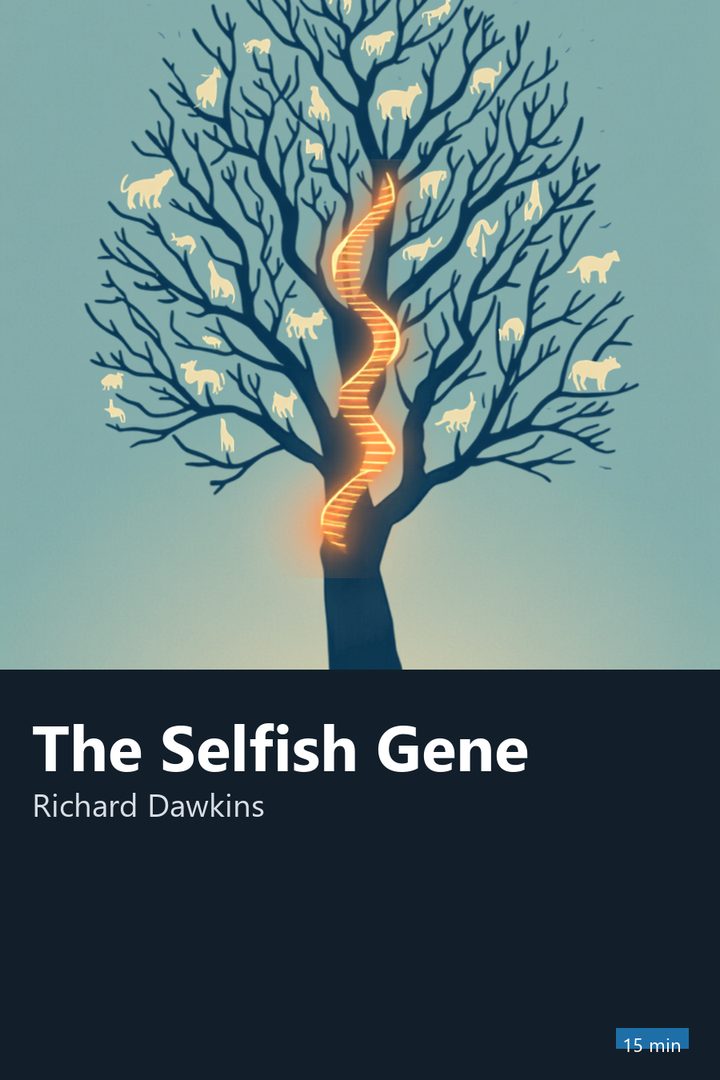
Cover of The Selfish Gene

Science · 15 min

The Selfish Gene

Richard Dawkins · 1976

Who it's for

For anyone who has heard about the "selfish gene" secondhand and wants to understand what Dawkins actually proposed, without falling into the book's most common misunderstanding. It also works for people who enjoy biology applied to everyday life, with examples from family, work and social media.

Read it in the app

⚡ Free to download • 🎁 One full book free every day

🎧 Audio coming soon in the app

Narration for the English summaries is on its way. Meanwhile you can read the full summary in the app.

3 ideas to take with you

1

A generous behavior can be, deep down, the best long-term play for copying genes similar to your own.

2

An entire population can settle into a balance between aggression and caution without anyone having decided on that balance on purpose.

3

Understanding where a biological impulse comes from doesn't oblige anyone to follow it; it gives you precisely the foundation to choose another path.

“
A good part of the reason a body exists is simple: it works as a vehicle to carry genes forward to the next generation.
An idea from The Selfish Gene, in the words of 15 Minutes

Preview

Start reading now

A title that misleads you before you open the book

People who only hear about the "selfish gene" secondhand usually imagine a twisted self-help book, arguing that people are or should be selfish by nature. That's not it.

Dawkins is a biologist, and the book explains a mechanism of evolutionary biology: how natural selection works when you look at it on the scale of the gene, not on the scale of the individual or the species. "Selfish" there is a borrowed technical term, not life advice.

This misunderstanding is so common that Dawkins himself went back to explain the title in later editions and interviews, feeling it necessary to make clear that he never argued humans should act selfishly. We come back to this point more calmly near the end of this summary.


The question the book tries to answer: selection of what?

Before Dawkins, the common sense view of evolution tended to think in terms of the species or the individual: people said a behavior existed because it helped the species survive, or because it was good for the animal individually.

Dawkins proposes another scale of analysis: what really wins or loses over generations is neither the species nor the individual, but the gene itself, the molecule of information copied from parent to child, generation after generation.

Think of a gene as a cake recipe that copies itself, trying to show up in more cakes tomorrow. The recipe doesn't want anything; it simply gets copied more or less often depending on how the cake it produces fares in the world.

You as a vehicle, not as the owner

The most radical idea in the book is this inversion of perspective: an animal's body, including the human body, works as a temporary vehicle built by genes to carry copies of themselves to the next generation.

A useful everyday analogy: think of a store franchise. The brand survives and spreads through each franchised location, even when one specific store closes its doors after decades in business.

This doesn't mean you're just an unimportant vehicle. It means the lens of genetics explains one kind of success, leaving copies of genes in the next generation, which is different from the success you measure in your own life, such as happiness, fulfillment or purpose.

13 more sections and the quiz

Continue in the app

Read the whole summary, finish with the The Selfish Gene quiz and follow the guided Journeys. No ads in the app.

About Richard Dawkins

Richard Dawkins was born in 1941 in Nairobi, then part of colonial British territory in Kenya, and grew up between Africa and England. He graduated in zoology from the University of Oxford, where he later taught for decades and held the chair for the Public Understanding of Science. The Selfish Gene, published in 1976, was his first book and the one that made him one of the most widely read science popularizers in the world. After it, Dawkins wrote other titles on evolution and science, and also became a well-known public voice for defending atheism and criticizing religious thinking.

Explore

Category:
Science
Part of the Journeys:
Science Curiosity