15 Minutes
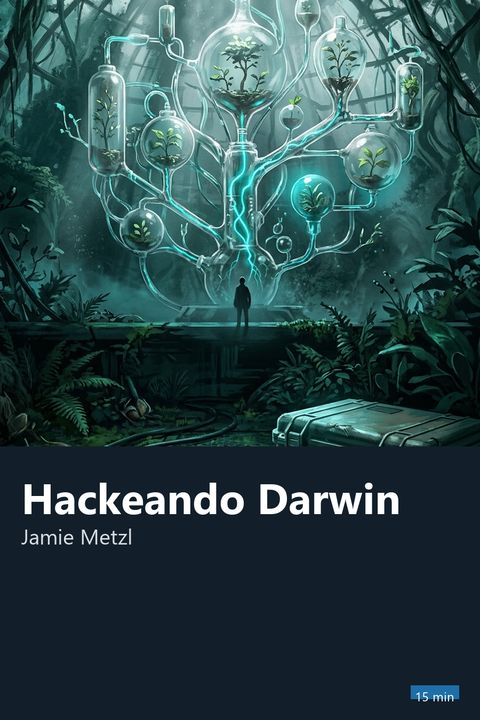
Cover of Hacking Darwin

Science · 15 min

Hacking Darwin

Jamie Metzl · 2019

Who it's for

For anyone who hears about gene-edited babies, DNA tests, and lab-selected embryos, and wants to understand what is real, what is hype, and what is at stake. It is also great for readers who enjoy science paired with ethical debate and politics.

Read it in the app

⚡ Free to download • 🎁 One full book free every day

🎧 Listen to this summary in the app

Every summary has audio narration. Open the app to read it or listen to it.

3 ideas to take with you

1

Once reading a person's genome became cheap, genetics stopped being a topic for elite labs and became a matter of public health, business, and politics.

2

Predicting a trait that depends on thousands of genes and the environment means working with probabilities, and anyone who treats probability as destiny is buying a certainty that science does not sell.

3

If genetic enhancements remain limited to those who can afford them, income inequality will gain a biological version passed down from parent to child.

“
A tool that any small lab can use calls for rules that apply to everyone before the first scandal hits.
An idea from Hacking Darwin, in the words of 15 Minutes

Preview

Start reading now

A revolution already underway

Jamie Metzl starts from a simple and unsettling idea: for billions of years, life changed through natural selection, and now our species has learned how to tinker with its own instruction manual. For him, this is not science fiction a hundred years away, it is a transition already taking place in laboratories, fertility clinics, and hospitals.

The title plays with this idea: hacking Darwin means taking a shortcut. Instead of waiting for random mutations and thousands of generations to decide who survives, we are starting to read, compare, and in some cases rewrite the genome of plants, animals, and people, backed by increasingly affordable biotechnology.

The book carries a tone of both warning and invitation. The author believes the technology will move forward no matter what, so the question that matters is who will decide how to use it, under what rules, and for whose benefit.

From reading the genome to writing the genome

The starting point is the Human Genome Project, completed in the early years of this century after more than a decade of work and billions of dollars. It produced the first complete readout of our code, a kind of map filled with letters whose meaning was not yet clear.

Today, sequencing an individual genome costs a fraction of that and takes very little time. Metzl emphasizes this falling price curve, similar to that of computers, because that is what turns a scientific curiosity into a mass service sold in clinics and even in online kits.

With so much accumulated information, artificial intelligence and massive databases enter the picture. Algorithms search for patterns across millions of genomes and health histories, and that is where the discoveries driving the rest of the book come from: reading has become cheap, and interpreting is getting better every year.

CRISPR: the molecular scissors

The book pays special attention to CRISPR, a gene editing technique that uses a mechanism borrowed from bacteria, which employ it to defend themselves against viruses. Researchers such as Jennifer Doudna and Emmanuelle Charpentier showed that it could be programmed to cut DNA at a chosen spot.

What impresses Metzl is not just the precision, but the cost and ease of use. Before, tinkering with genes required huge teams and years of work. With CRISPR, small labs, even at modest universities, can run experiments that once seemed out of reach.

He reminds us that the tool still makes mistakes. It can cut in the wrong place, cause off-target effects, or produce a mix of edited and unedited cells in the same organism. Because of this, the author treats CRISPR as a real breakthrough, but still far from a risk-free edit button.

11 more sections and the quiz

Continue in the app

Read the whole summary, finish with the Hacking Darwin quiz and follow the guided Journeys. No ads in the app.

About Jamie Metzl

Jamie Metzl is an American writer and futurist who works in geopolitics and biotechnology. He served in the U.S. government on the National Security Council and in the State Department during the Bill Clinton administration. He was a member of the World Health Organization expert advisory committee on human genome editing governance and is a senior fellow at the Atlantic Council. He has also written science fiction novels, and Hacking Darwin was published in 2019.

Explore

Category:
Science