15 Minutes
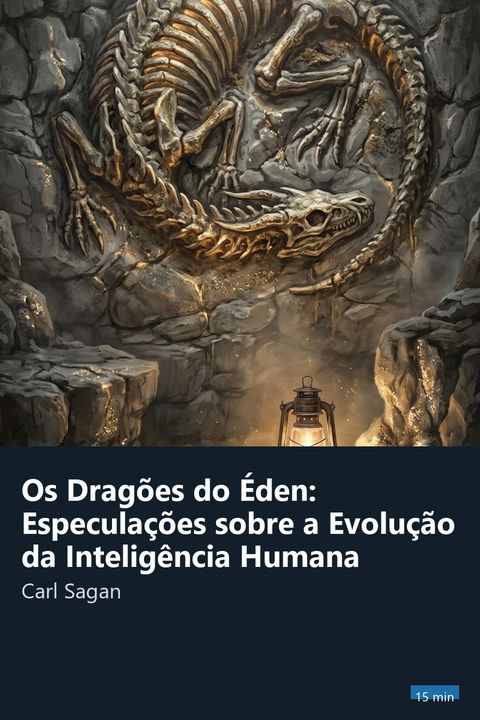
Cover of The Dragons of Eden: Speculations on the Evolution of Human Intelligence

Science · 15 min

The Dragons of Eden: Speculations on the Evolution of Human Intelligence

Carl Sagan · 1977

Who it's for

For anyone who has ever wondered where human intelligence comes from and why we dream, get scared, and fight as though we still lived on the savanna. The book blends brains, evolution, and myth in a speculative exploration best read as an essay, not a neuroscience textbook.

Read it in the app

⚡ Free to download • 🎁 One full book free every day

3 ideas to take with you

1

Most of what we know and do isn't stored in our DNA: it's in the connections our brains have formed and the things culture has preserved outside our bodies.

2

Naming what you feel, even an ancient, uncomfortable emotion, is the first step toward deciding what to do with it.

3

Asking whether an animal thinks means first considering how it would show us, and the answer varies with the researcher's methods.

“
Fighting over a parking space and fans defending their stadium turf resemble the rituals of animals marking their territory.
An idea from The Dragons of Eden: Speculations on the Evolution of Human Intelligence, in the words of 15 Minutes

Preview

Start reading now

A Bold Question: Where the Mind Comes From

Sagan wrote this book to answer a question that seems philosophical but is also biological: how did an animal made of atoms learn to think about atoms? His approach is to examine the human brain as the product of a long evolutionary history, with layers that accumulated functions over hundreds of millions of years, rather than as an isolated piece of machinery.

The title is deliberately provocative. Its dragons are monsters the author connects to distant memories of our mammalian lineage; Eden is the image of a lost paradise that he interprets as a metaphor for an important transition in our history. The subtitle gives fair warning: speculations. Sagan himself says that many of these ideas are hypotheses to test, not conclusions.

That changes how you approach the book. Rather than looking for settled facts on every page, you're better off reading it as a conversation with a scientist thinking out loud, separating the evidence from the hunches.


The Cosmic Calendar: The Year Everything Happened

One of the book's most famous devices is the cosmic calendar. Sagan compresses roughly fifteen billion years of cosmic history into a single year, with the Big Bang on January first and the present at midnight on December thirty-first. The result is humbling: the solar system doesn't emerge until September, life appears late that month, and land plants and animals arrive in December.

Dinosaurs dominate for just a few days at the end of the year. Humans as a species appear only in the final hours of December thirty-first, and all of written history fits into the last few seconds. Whenever you try to wrap your mind around millions of years, the calendar restores a sense of proportion.

It's like imagining you've just arrived at a party that's been going on all night. This device helps you feel how recently intelligence arrived and how much the brain remains a work in progress.

Genes and Brains: Two Ways to Store Information

The author argues that living things store information in two main ways. The first is DNA, which passes instructions from one generation to the next. The second is the brain's circuitry, which learns during an individual's lifetime and is lost when that individual dies, unless its knowledge is passed on through teaching. Sagan makes rough calculations to show that the human brain contains far more potential information than the genetic code.

The brain's advantage is speed: a gene changes over generations, while an individual can learn in minutes what to do about a new threat. Humans went further, creating a third layer: information outside the body, in writing, libraries, and now computers. This is what's called extragenetic memory.

Think about Grandma's cake recipe: it isn't in anyone's DNA, but it survives across generations because someone wrote it down or taught it. Culture is a way for intelligence to accumulate without waiting for natural selection.

10 more sections and the quiz

Continue in the app

Read the whole summary, finish with the The Dragons of Eden: Speculations on the Evolution of Human Intelligence quiz and follow the guided Journeys. No ads in the app.

About Carl Sagan

Carl Sagan was an American astronomer and science communicator, born in Brooklyn in 1934. He was a professor at Cornell University and participated in NASA space missions. The Dragons of Eden won the Pulitzer Prize for General Nonfiction in 1978, and his 1980 series Cosmos made him famous around the world. He died in 1996.

Explore

Category:
Science