15 Minutes
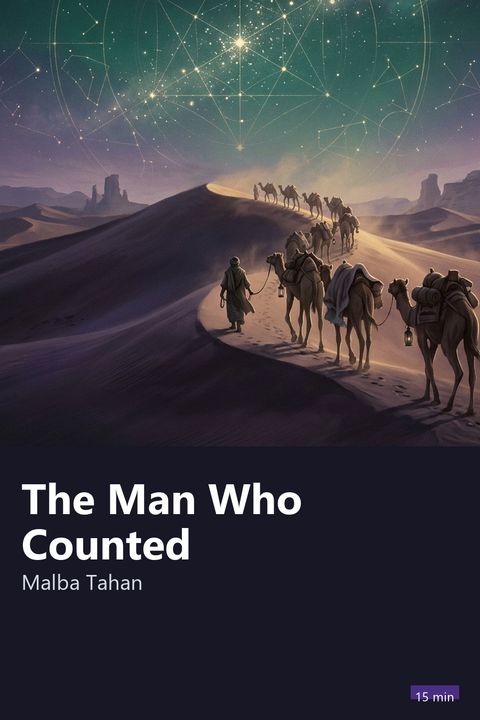
Cover of The Man Who Counted

Fiction · 15 min

The Man Who Counted

Malba Tahan · 1938

Who it's for

For anyone who thinks math is only for geniuses and wants to see reasoning become an adventure. It's also for teachers and parents looking for stories that make teaching fractions and proportions feel less intimidating.

Read it in the app

⚡ Free to download • 🎁 One full book free every day

🎧 Listen to this summary in the app

Every summary has audio narration. Open the app to read it or listen to it.

3 ideas to take with you

1

In this book, math becomes more accessible when it grows out of a concrete situation involving sharing, debt, or trade, rather than an isolated formula.

2

The author championed teaching math through games and curiosity, and used a novel to bring that idea to thousands of readers.

3

Giving a literary voice a foreign name was an author's strategy: Malba Tahan existed as a brand before the name became famous.

“
When the numbers don't add up, changing the size of the problem can reveal the structure that was hidden.
An idea from The Man Who Counted, in the words of 15 Minutes

Preview

Start reading now

An Encounter in the Desert

The Man Who Counted is an adventure novel written by a Brazilian but set in an imagined Arab world full of caravans, palaces, and starry nights. The story's narrator is a traveler named Hanck-Tade-Maiá, who is crossing the desert toward Baghdad when he comes across a thin, plainly dressed man who spends his time counting everything around him.

This man is Beremiz Samir, a young Persian from a humble background. He counts trees, footsteps, birds, and anything that moves, and the curious narrator decides to accompany him. Their friendship begins with simple admiration. From there, the book becomes a series of episodes in which the pair meet people in trouble, and Beremiz solves their problems with calculation and common sense.

Who Is Beremiz Samir?

Beremiz isn't a white-bearded sage sitting in a study. He's a poor young man who makes a living from what he knows and approaches numbers the way others approach music or poetry. His reputation as a calculator doesn't come from loving money. It comes from seeing relationships between quantities that nobody else notices.

The book makes a point of showing that his talent can be developed and used with kindness. Beremiz explains every step, welcomes questions, and never humiliates anyone who doesn't understand. That attitude is the heart of the book: the character is a kind of ideal teacher, and the story gives readers an invitation to think along with him, rather than pressure to get everything right the first time.

The Thirty-Five Camels

The most famous episode involves an inheritance. Three brothers are arguing along the road because their father left thirty-five camels and stipulated that the oldest should receive half, the middle brother one-third, and the youngest one-ninth. Nobody can divide them without cutting an animal in half, and the atmosphere is getting tense.

Beremiz steps in as an arbitrator and does something that seems crazy: he adds the camel the narrator himself was riding, bringing the herd to thirty-six. Now the division comes out evenly: eighteen for the first brother, twelve for the second, and four for the third. That adds up to thirty-four. Two animals remain, one that he returns to its owner and another that he keeps as payment for his services. Each brother leaves feeling he received more than expected.

12 more sections and the quiz

Continue in the app

Read the whole summary, finish with the The Man Who Counted quiz and follow the guided Journeys. No ads in the app.

About Malba Tahan

Malba Tahan is the pseudonym of Júlio César de Mello e Souza, a Brazilian teacher and writer born in Rio de Janeiro in 1895. He taught math at schools in Rio and championed teaching through games and curiosity. He published dozens of books, and The Man Who Counted, from 1938, is his best known. He died in Recife in 1974, and his birthday, May 6, is Brazil's National Mathematics Day.

Explore

Category:
Fiction