15 Minutes
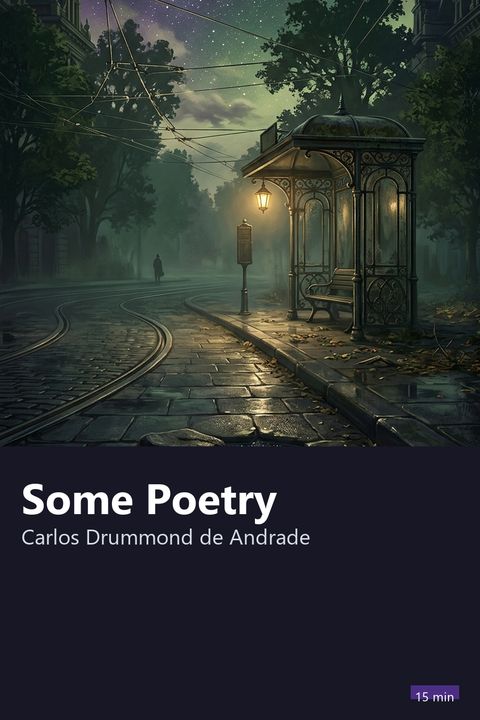
Cover of Some Poetry

Fiction · 15 min

Some Poetry

Carlos Drummond de Andrade · 1930

Who it's for

Original title (Portuguese): Alguma Poesia. This book is for you if poetry feels distant, full of rules, and hard to get into, and you want to start with a collection that talks about everyday life with humor and irony. It is also great for anyone studying Brazilian literature who wants to understand how poetry began to change in the twentieth century.

Read it in the app

⚡ Free to download • 🎁 One full book free every day

🎧 Listen to this summary in the app

Every summary has audio narration. Open the app to read it or listen to it.

3 ideas to take with you

1

You can laugh at a small situation and, at the same time, take seriously what it reveals about us.

2

A common object, when closely observed, can carry more meaning than a grand theme that is poorly explained.

3

For the author, the strangeness of the verse is part of the invitation to read, and accepting that invitation takes willingness.

“
No one is just a single person, and poetry can shelter all of them at the same time.
An idea from Some Poetry, in the words of 15 Minutes

Preview

Start reading now

A debut book with a voice of its own

Some Poetry came out in 1930 and marked the debut of Carlos Drummond de Andrade in book-length published poetry. He was a young man from Minas Gerais who wrote without asking tradition for permission, and this first volume already shows a voice that does not fit into the pretty, rhyming poetry that dominated the reading rooms of the time. For anyone just starting to read poetry, it is a great entry point: the texts are short, the images come from day-to-day life, and the tone feels like a conversation.

The collection brings together poems on varied themes, from the inner world to small-town scenes. Nothing there seems designed to please a panel of critics; everything seems to want to say something directly, even when the path to meaning is crooked.

Seven-Sided Poem: the divided self

One of the best-known texts in the book is the Seven-Sided Poem, which opens the way to an old question: who am I, after all? The speaker presents himself as someone born outside the mold, a bit crooked, who keeps piling up contradictions along the verses. It is not an organized confession; it is a portrait that comes undone and remakes itself in every stanza.

The charm lies in this mix of self-irony and melancholy. The poem plays with the idea that we have several versions of ourselves, one for family, another for work, another for the person we love, and none of them alone can handle the whole picture.

For readers, the feeling is usually familiar. Anyone who has ever felt different in their own town or group of friends recognizes the discomfort of not fitting into a single portrait. The poem turns this discomfort into the raw material of poetry, without asking the person to solve everything at once.

In the Middle of the Road: the stone that bothers

Perhaps the most quoted poem in the book is In the Middle of the Road, which became almost an icon of Brazilian poetry. The phrase that gives it its title and repeats throughout the text seems simple, but the impact comes from repetition: something apparently trivial comes back again and again, until it gains the weight of an event.

Many people read this text as a joke about monotony, others as a reflection on obstacles that we insist on finding in the same place. In both cases, the poem works with the reader's expectation: you expect something grand and receive a small detail that refuses to budge.

In the context of the time, the text also sparked debate by breaking with the idea that poetry needs a noble subject. It is worth reading calmly and noticing how an ordinary object can be enough to create real tension.

11 more sections and the quiz

Continue in the app

Read the whole summary, finish with the Some Poetry quiz and follow the guided Journeys. No ads in the app.

About Carlos Drummond de Andrade

Carlos Drummond de Andrade (1902-1987) was born in Itabira, Minas Gerais, and is one of the most important names in twentieth-century Brazilian poetry. Besides being a poet, he wrote columns and short stories, and worked as a federal civil servant in Rio de Janeiro. Some Poetry, from 1930, was his first published book, and his following books, such as Sentiment of the World and The People's Rose, deepened his phase of social and reflective poetry.

Explore

Category:
Fiction