15 Minutes
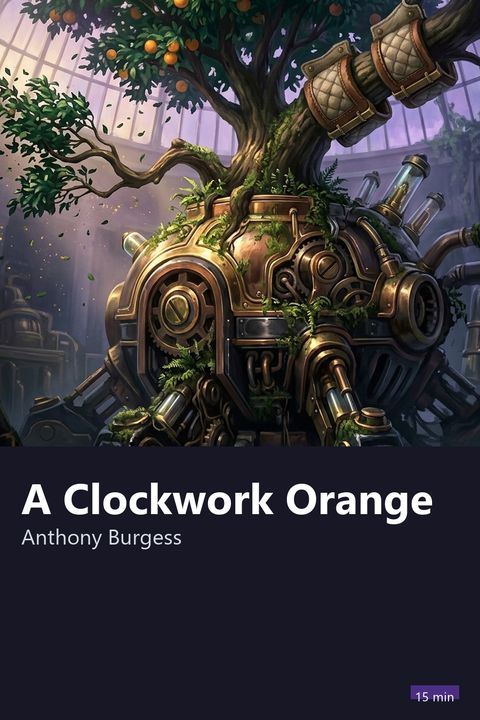
Cover of A Clockwork Orange

Fiction · 15 min

A Clockwork Orange

Anthony Burgess · 1962

Who it's for

For readers interested in deep moral dilemmas about free will, state authoritarianism, and the limits of behavioral rehabilitation in modern society.

Read it in the app

⚡ Free to download • 🎁 One full book free every day

🎧 Listen to this summary in the app

Every summary has audio narration. Open the app to read it or listen to it.

3 ideas to take with you

1

Virtue forced by state conditioning is nothing more than a biological farce that strips away an individual's very humanity.

2

Removing the capacity to choose evil does not make a person good; it merely turns them into a harmless cog in a machine.

3

Genuine ethical maturity is born from inner reflection and lived experience, never from authoritarian external interventions.

“
Virtue cannot be manufactured in a laboratory, because it only has moral value when a human being possesses the real freedom to do wrong.
An idea from A Clockwork Orange, in the words of 15 Minutes

Preview

Start reading now

The suburban night and the cult of ultraviolence

In a dark, oppressive future dominated by social apathy and bureaucratic control, youth gangs take over the shadowy streets after nightfall. Young Alex, a fifteen-year-old teenager with a sharp intellect and an insatiable appetite for destruction, leads a small band of friends who hang out at the Korova Milkbar to drink milk laced with chemical stimulants and plan their late-night attacks.

With hypnotic prose punctuated by Nadsat, an ingenious slang invented by the author that blends Slavic roots with colloquial English, the book plunges us into the mind of a fascinating and terrifying protagonist. Alex commits acts of extreme barbarity with astonishing lightness, breaking into homes, beating helpless elderly people, and clashing with rival gangs without a shadow of remorse.

The most unsettling element of Alex's personality is his overwhelming love for classical music. While unleashing his fury upon innocent victims, his mind vibrates to the sound of Ludwig van Beethoven's symphonies, crudely demonstrating that an appreciation for high culture and aesthetic refinement does not automatically turn a human being into someone kind or compassionate.


Betrayal among accomplices and the leader's fall

Alex's tyrannical leadership within the group begins to breed resentment and rebellion among his three accomplices: Pete, Georgie, and Dim. Tired of obeying their boss's arrogant orders and seduced by the promise of more lucrative heists, the partners start challenging their leader's authority, demanding a more democratic say in deciding their robberies.

The final break happens during the invasion of a mansion belonging to an elderly woman who lives surrounded by cats. Alex brutally attacks the woman, but he is caught off guard by the rapid arrival of the police; as he tries to flee, Dim strikes him across the face with a milk bottle, leaving the teenager stunned and blinded by pain on the sidewalk to be captured by the officers.

At fifteen, the ruthless leader discovers that loyalty in the criminal underworld is a fleeting illusion. Betrayed by those he ruled with an iron fist, Alex is beaten at the police station and learns with bureaucratic coldness that the cat lady did not survive her injuries, turning his sentence into a murder conviction.

The harshness of Staja 84 and the desire to escape

Imprisoned in State Jail 84, known as Staja 84, Alex is confronted with the decay and institutional violence of the prison system. The prison is an overcrowded, corrupt, and filthy human warehouse, where sadistic guards wield authority through fear and brutal veterans fight for space with helpless youths.

To survive this daily hell, the protagonist uses his usual cunning: he fakes religious devotion, wins the trust of the prison chaplain by playing the organ in the chapel, and helps read scripture passages during services. However, his piety is pure theater designed to gain privileges and speed up his release.

When a violent riot in the crowded cell results in the death of a new inmate, the blame falls collectively on Alex and his cellmates. Desperate at the prospect of spending long years rotting behind bars, the teenager volunteers to test a revolutionary medical treatment that promises to cure criminals in just two weeks.

10 more sections and the quiz

Continue in the app

Read the whole summary, finish with the A Clockwork Orange quiz and follow the guided Journeys. No ads in the app.

About Anthony Burgess

Anthony Burgess was a British novelist, musical composer, linguist, and literary critic. Born in Manchester, he served in the British Army during World War II and worked as an education officer in Malaya and Brunei before devoting himself entirely to literature. He published more than thirty novels and dozens of works of nonfiction, in addition to composing symphonies and orchestral concertos. A Clockwork Orange, his most celebrated work, cemented his reputation as one of the great thinkers on dystopia in the twentieth century.

Explore

Category:
Fiction