15 Minutes
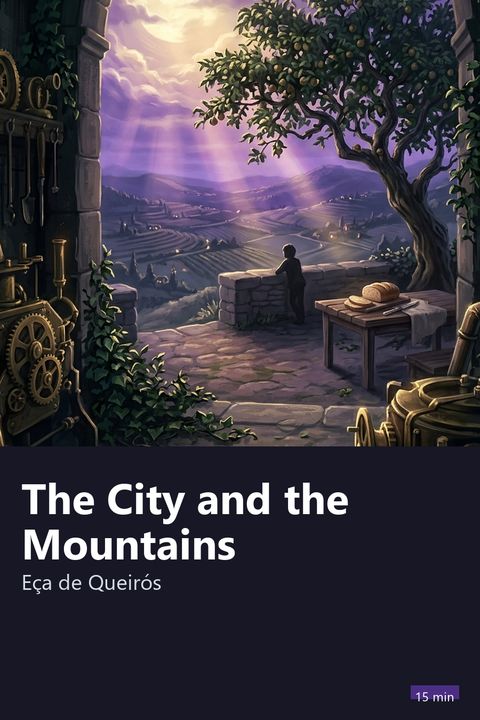
Cover of The City and the Mountains

Fiction · 15 min

The City and the Mountains

Eça de Queirós · 1901

Who it's for

For anyone feeling exhausted by the frantic pace of big cities, suffocated by an excess of screens and technological gadgets, and looking to reflect on the true essence of human happiness. It is an exquisite read for lovers of classic literature from the Portuguese-speaking world.

Read it in the app

⚡ Free to download • 🎁 One full book free every day

🎧 Listen to this summary in the app

Every summary has audio narration. Open the app to read it or listen to it.

3 ideas to take with you

1

An excess of technological material comforts creates a maintenance burden that steals free time and breeds boredom.

2

Physical reconnection with the land, sunlight, and natural food dispels the neuroses of urban confinement.

3

Authentic happiness requires using technology as a servant of human dignity, never as a master that enslaves the mind.

“
Fulfillment does not lie in the multiplicity of gadgets we accumulate, but in the sobriety with which we live.
An idea from The City and the Mountains, in the words of 15 Minutes

Preview

Start reading now

The palace of two hundred gadgets in Paris

At the end of the nineteenth century, on the refined Avenue des Champs-Élysées in Paris, lived Jacinto de Tormes, heir to one of the richest and most aristocratic families in Portugal. A man of sharp intelligence and prodigious culture, Jacinto had embraced with almost religious fervor the supreme dogma of modernity and hyper-civilization: a human being is truly happy only in direct proportion to how civilized he is.

To put his thesis into practice, the nobleman turned his mansion at number 202 into a true laboratory of mechanical vanguard. His rooms were crisscrossed by pneumatic tubes for sending messages, electric telegraphs, elevators to bring up books from the monumental library, cylinder phonographs, typewriters, and radiant heating stoves with dozens of gleaming brass cranks.

However, instead of the fulfillment promised by industrial catalogs, what reigned in Jacinto's life was a suffocating atmosphere of complication and boredom. Every hour a water pipe burst, a telegraph wire short-circuited, or a pile of thousands of volumes collapsed onto his desk, forcing the owner to live in constant alarm just to manage the devices invented to serve him.

The gray melancholy of excess and artificiality

The novel's narrator, José Fernandes, Jacinto's childhood friend, watches with affectionate irony the gradual spiritual decline of the Portuguese nobleman in the heart of the City of Light. Despite attending the most exclusive high-society dinners, surrounding himself with powerful politicians, and having the most sophisticated dishes of French gastronomy at his disposal, Jacinto sinks deeper day by day into a corrosive melancholy.

The food at the grand Parisian banquets seemed sterile, seasoned with heavy sauces that masked the lack of real freshness in the ingredients. Conversations in the aristocratic salons were empty of genuine feeling, dominated by fleeting gossip, ministerial intrigues, and a sterile vanity that warmed no one's heart.

This observation by Eça de Queirós resonates with astonishing relevance in the routine of the modern citizen. Swap Jacinto's telegraph cables for nonstop smartphone notifications and infinite feeds of short videos: the human result is strictly the same, an extreme sensory saturation accompanied by an existential void that no consumer object can fill.

The providential catastrophe in the Portuguese mountains

The turning point in the plot comes through a seemingly disastrous twist of fate. A violent storm in northern Portugal causes part of the ancestral chapel of Jacinto's family in Tormes to collapse, ruining the solemn tombs where the bones of his warrior ancestors rested.

Moved by the filial duty to transfer the family's remains to a new crypt, Jacinto makes a decision that shocks his circle of Parisian friends: to travel to the remote Douro mountains to oversee the work on the rural estate he had never visited in his entire adult life.

Preparations for the expedition take on comical proportions. Terrified by the idea of spending weeks in a territory without metropolitan comforts, Jacinto dispatches entire train cars loaded with tons of luxurious furniture, crates of enameled bathtubs, orthopedic devices, imported wines, and packaged gourmet provisions.

9 more sections and the quiz

Continue in the app

Read the whole summary, finish with the The City and the Mountains quiz and follow the guided Journeys. No ads in the app.

About Eça de Queirós

Eça de Queirós was one of the greatest novelists in the Portuguese language and the leading figure of literary realism in Portugal. A career diplomat, he lived in cities such as Havana, Newcastle, and Paris, a cosmopolitan experience that sharpened his ironic and elegant eye for the customs of nineteenth-century society. The author of immortal works such as The Maias, Cousin Bazilio, and The Crime of Father Amaro, he published The City and the Mountains posthumously in 1901 as his philosophical testament of love for his homeland.

Explore

Category:
Fiction