15 Minutes
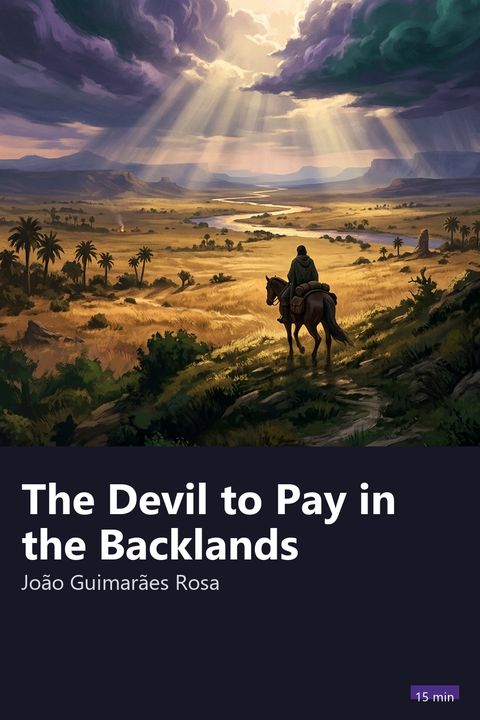
Cover of The Devil to Pay in the Backlands

Fiction · 15 min

The Devil to Pay in the Backlands

João Guimarães Rosa · 1956

Who it's for

For anyone ready to take on a classic of Brazilian literature, willing to read slowly, and drawn to stories about doubt, love, and destiny. It's also for anyone who has tried before and given up on the first page.

Read it in the app

⚡ Free to download • 🎁 One full book free every day

🎧 Listen to this summary in the app

Every summary has audio narration. Open the app to read it or listen to it.

3 ideas to take with you

1

The book's devil can be read as something inside us, that hunger for power that disguises itself as courage.

2

When language breaks with convention, you learn to listen before you understand, developing a kind of attention that rushing can never give you.

3

The final revelation about Diadorim reminds us that what we hide to protect ourselves can leave those who love us paying the price in loneliness.

“
People who tell their life story to a stranger often discover that the real question wasn't the one they asked at the beginning.
An idea from The Devil to Pay in the Backlands, in the words of 15 Minutes

Preview

Start reading now

An Old Man Talks to a Visitor

The novel has no chapters or pauses to catch your breath: it is one long, uninterrupted account. Riobaldo, now an aging rancher in the northern interior of Minas Gerais, welcomes an educated man from the city and begins telling him his entire life story. This visitor almost never answers. We know only that he listens, because the narrator addresses him as "sir" and keeps asking him to understand.

What Riobaldo recounts is his time among the hired gunmen, armed men who served local leaders and fought in bands across the backlands. But he doesn't tell the story in a straight line. He doubles back, interrupts himself, makes corrections, leaves a subject unfinished, and returns to it much later, as anyone might when reliving something painful.

We soon realize that a question has driven this conversation, one that has consumed him for decades. Riobaldo wants to know whether the devil exists, whether he himself made a pact, and what those years turned him into. Telling everything is the way he has found to face it.


The Boy on the River and Their First Meeting

The story begins in childhood. Riobaldo is the son of a poor woman, raised under the protection of a godfather who owns a ranch. One day, while still a boy, he crosses the São Francisco River in a canoe beside another boy with a serious, beautiful gaze, who challenges him to overcome his fear of the water. It is a brief moment, but it stays with him forever.

That boy reappears years later, now grown, among the men in an armed band. His name is Reinaldo, and he soon becomes known as Diadorim. Riobaldo recognizes the boy from the river crossing, and the friendship that begins there becomes the emotional backbone of the entire book.

Their relationship is built on admiration, silence, and an attraction Riobaldo doesn't know how to name. He feels guilt, confusion, a desire to stay close, and fear of what that means. The book's backlands are a place of weapons and bravery, and there is no easy place for this feeling there.

Joining the Band

Riobaldo becomes a hired gunman almost by accident, drifting from one situation to another until he finds himself among men who live by the law of the strongest. He learns to shoot so well that he earns the nickname Tatarana, the name of a caterpillar that burns when touched. He is respected but also viewed with suspicion because he can read and write, setting him apart from the others.

The world of these bands runs on personal loyalties. The gunmen obey famous leaders such as Joca Ramiro, a man of almost mythical standing who commands respect and is considered just. When he appears, the band straightens up. He is portrayed as a charismatic leader whom men would follow out of conviction, not just fear.

In these men's company, Riobaldo sees firsthand what the backlands demand: endless marches, ambushes, hunger, fights over honor, and the burden of never knowing who is a friend. The book depicts this daily life in detail, but without easy glamour.

10 more sections and the quiz

Continue in the app

Read the whole summary, finish with the The Devil to Pay in the Backlands quiz and follow the guided Journeys. No ads in the app.

About João Guimarães Rosa

João Guimarães Rosa was born in Cordisburgo, Minas Gerais, in 1908. He earned a medical degree before pursuing a diplomatic career. He published Sagarana in 1946 and The Devil to Pay in the Backlands in 1956, works that transformed Brazilian literature. He died in 1967, shortly after taking his seat in the Brazilian Academy of Letters.

Explore

Category:
Fiction