15 Minutes
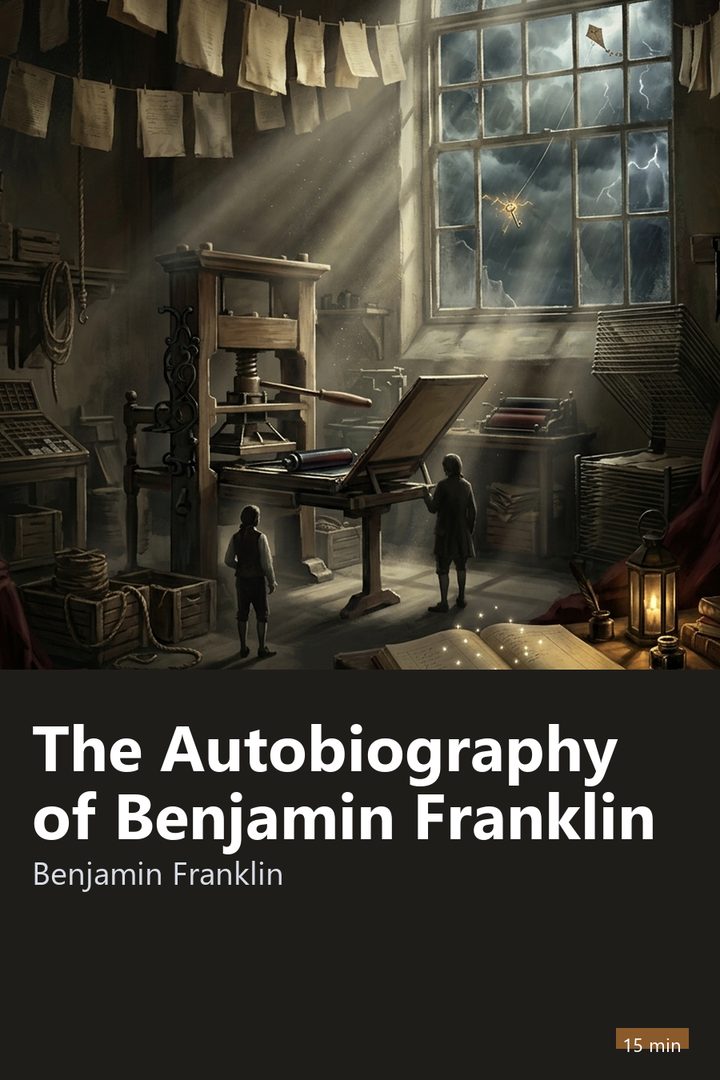
Cover of The Autobiography of Benjamin Franklin

Biographies and Memoirs · 20 min

The Autobiography of Benjamin Franklin

Benjamin Franklin · 1791

Who it's for

For anyone interested in life stories, lifelong learning, and civic engagement. It also appeals to readers who want to reflect on habits without treating personal success as a universal formula.

Read it in the app

⚡ Free to download • 🎁 One full book free every day

🎧 Audio coming soon in the app

Narration for the English summaries is on its way. Meanwhile you can read the full summary in the app.

3 ideas to take with you

1

When we rebuild an idea in our own words, we uncover gaps that passive reading can hide.

2

A reliable reputation combines real results with clear communication about what others can expect.

3

Sharing resources can turn an individual limitation into a collective possibility.

“
A useful plan leaves room for the life that does not fit on the schedule.
An idea from The Autobiography of Benjamin Franklin, in the words of 15 Minutes

Preview

Start reading now

1. A Life Organized to Teach

Benjamin Franklin begins his autobiography by addressing his son, like someone opening a conversation about family roots. Soon, however, personal memory takes on another role: showing how a young man without great wealth built knowledge, prestige, and influence. The book presents a life interpreted by its own protagonist, not a neutral portrait.

The writing began in 1771, and was interrupted and resumed at different times. Franklin died in 1790, leaving the account unfinished, with the narrative focused up through 1757. The first publication appeared in French in 1791. As a result, his later roles in American independence and diplomacy do not receive the full treatment here that many readers expect.

This frame helps us notice how the memories are selected. Franklin highlights hardships he managed to overcome and decisions that seem to explain his success. There is real learning in this, but also image-building. Just as when someone tells their career story in a job interview, the episodes chosen favor a specific interpretation of the person speaking.

2. The Workshop as a First School

Born in Boston into a large family, Franklin had little formal schooling. His father made soap and candles, and the household budget limited his options. His curiosity, however, found a path through whatever books were available. The education presented in this account depends less on a prestigious institution and more on the persistent use of opportunities.

While still a teenager, he became an apprentice in his brother James's print shop. The workshop taught him a trade and brought the boy into contact with texts, news, and debates. This apprenticeship mixed hard labor, discipline, and intellectual discovery. Yet the very environment that offered access to culture also subjected him to his brother's authority and demands.

For today's reader, a familiar parallel is that first job that feels like pure repetition, yet allows you to observe processes and learn useful tools. That does not turn exploitation into a desirable opportunity. The more careful lesson is to look for transferable skills: understanding customer service, writing, organization, or production can widen your options, even when your current job offers little recognition.

3. Learning to Write Without Waiting for Talent

Franklin describes the exercises he used to improve his writing by studying texts he admired. He took brief notes, let some time pass, and tried to reconstruct the arguments in his own words. Then he compared the versions. The goal was not to memorize pretty sentences, but to uncover flaws in vocabulary, sequence, and clarity in his own expression.

This self-education had a method. In certain exercises, he scrambled the order of ideas so he could reorganize them later; in others, he turned prose into verse and then back into prose. In this way, he created specific challenges to build his skills. His account suggests that an ability grows when practice allows us to spot mistakes, rather than simply repeating familiar moves.

Today, you can adapt this when writing a work email or explaining a neighborhood issue to your homeowners association. Read a good explanation, close the text, and rebuild the line of reasoning. Then check what came out confusing. On a bus commute, a few minutes of attentive reading can yield more than scrolling through dozens of posts without developing a single thought.

11 more sections and the quiz

Continue in the app

Read the whole summary, finish with the The Autobiography of Benjamin Franklin quiz and follow the guided Journeys. No ads in the app.

About Benjamin Franklin

Benjamin Franklin was born in Boston in 1706 and died in Philadelphia in 1790. He was a printer, writer, inventor, researcher of electricity, and diplomat. He took part in drafting the United States Declaration of Independence and represented American interests in France. He began his autobiography in 1771, but died before finishing it.

Explore

Part of the Journeys:
Entrepreneur Biographies