15 Minutes
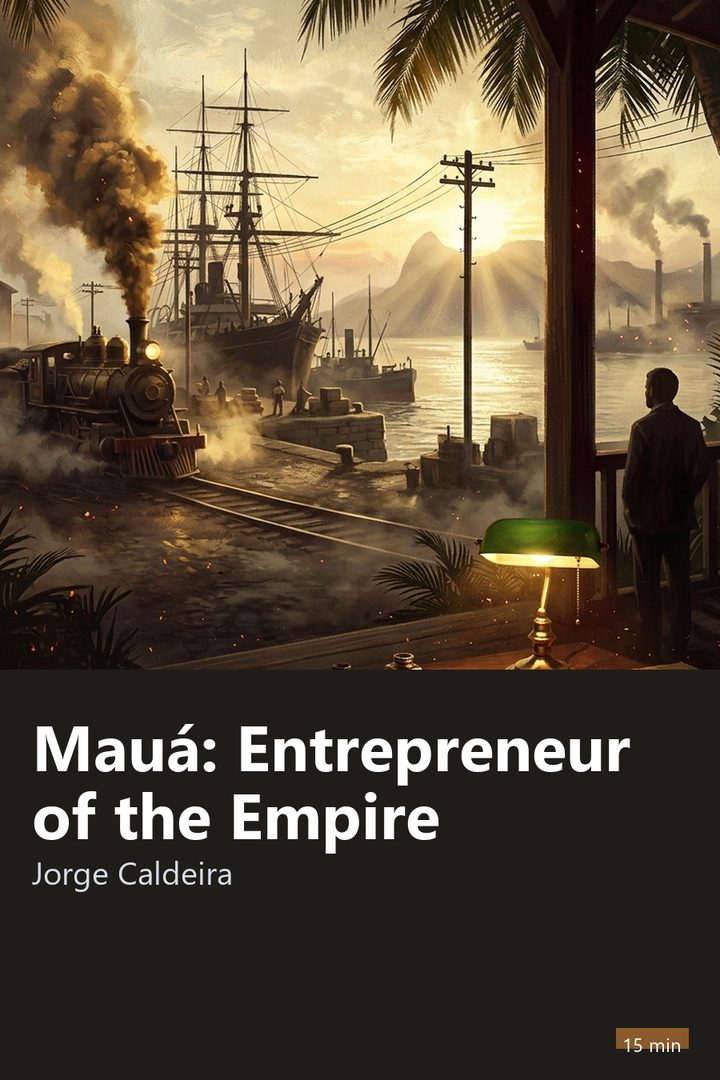
Cover of Mauá: Entrepreneur of the Empire

Biographies and Memoirs · 20 min

Mauá: Entrepreneur of the Empire

Jorge Caldeira · 1995

Who it's for

Original title (Portuguese): Mauá: Empresário do Império. For anyone who wants to explore imperial Brazil through an entrepreneur’s life and understand the connections among innovation, slavery, money, and power.

Read it in the app

⚡ Free to download • 🎁 One full book free every day

🎧 Audio coming soon in the app

Narration for the English summaries is on its way. Meanwhile you can read the full summary in the app.

3 ideas to take with you

1

Learning a different way to work can reveal problems that familiarity had hidden.

2

The value of infrastructure also shows up in the time it gives back to people’s lives.

3

Owning many businesses can increase your exposure when they all depend on the same funding.

“
A technical innovation can advance faster than the distribution of its benefits.
An idea from Mauá: Entrepreneur of the Empire, in the words of 15 Minutes

Preview

Start reading now

1. An Entrepreneur as a Window into Brazil

The biography of Irineu Evangelista de Sousa presents an imperial Brazil that cannot be captured solely through portraits of plantation owners, ministers, and emperors. Jorge Caldeira follows an entrepreneur interested in commerce, industry, and the circulation of money. His life reveals economic possibilities that existed in uneasy tension with Brazil’s slaveholding society.

Known first as the Baron and later as the Viscount of Mauá, Irineu participated in ventures connecting production, transportation, communication, and credit. The book presents this variety as part of a vision for development. Rather than simply accumulating property, its central figure sought to make different businesses work together, expanding markets and reducing obstacles to circulation.

The central question is not just how someone becomes wealthy. It is also how a society responds to someone trying to change its economic routines. Think of a Brazilian merchant who needs roads, energy, and financing: personal competence matters, but it depends on structures that no amount of individual effort can provide for a growing business alone.

2. The Sales Counter as a First Classroom

Born in 1813 in what is now Rio Grande do Sul, Irineu experienced family losses and arrived in Rio de Janeiro while still a boy. He entered commerce early, far removed from the prestige he would later achieve. Daily work taught him to observe goods, payments, customers, and the differences between appearances and actual business results.

The sales counter was a classroom in economic information. Knowing how much to buy, when to sell, and whom to trust required constant attention. Accounting emerged as a tool for understanding the business, not merely a bureaucratic obligation. Between orders and payment collections, the young man built knowledge that required neither a diploma nor an influential family name.

This training helps explain his approach. Mauá learned to look for connections between concrete details and larger opportunities. A salesperson who notices frequent delivery delays may discover that the main problem is not advertising. It lies in transportation, inventory, or the deadlines agreed upon with regular suppliers.

3. Learning from a Different Set of Experiences

His growing relationship with Scottish merchant Richard Carruthers broadened Irineu’s horizons. Exposure to British commercial practices, the English language, and international networks opened paths rarely available to a Brazilian employee. His education included ways to organize businesses and interpret changes taking place far beyond the local market.

Carruthers represents a bridge to a different body of economic knowledge. Their relationship shows the importance of trust, but also of the ability to absorb new ideas. Mauá did not receive a ready-made formula for success. He developed tools for comparing situations, evaluating proposals, and participating in broader commercial networks, with greater opportunities and greater risks.

The everyday parallel is someone who learns from an experienced colleague without turning admiration into automatic obedience. A mentor broadens your questions and introduces alternatives. Whether you work in a repair shop, an office, or a store, discovering another way to organize tasks can reveal waste that routine had made almost invisible.

11 more sections and the quiz

Continue in the app

Read the whole summary, finish with the Mauá: Entrepreneur of the Empire quiz and follow the guided Journeys. No ads in the app.

About Jorge Caldeira

Jorge Caldeira was born in São Paulo in 1955. He is a writer and historian with a degree in social sciences and a doctorate in political science from the University of São Paulo. His books include Mauá: Entrepreneur of the Empire and A History of Wealth in Brazil. He was elected to the Brazilian Academy of Letters in 2022.

Explore

Part of the Journeys:
Brazilian Biographies