15 Minutes
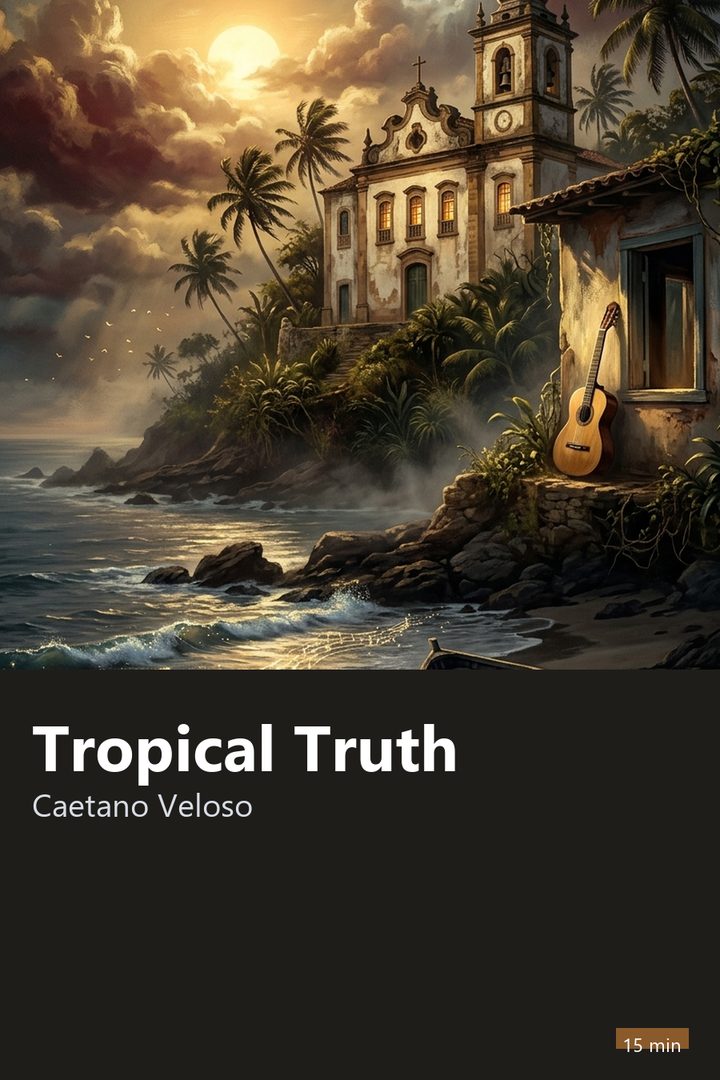
Cover of Tropical Truth

Biographies and Memoirs · 19 min

Tropical Truth

Caetano Veloso · 1997

Who it's for

For anyone who enjoys Brazilian music and wants to understand the connections between creativity, identity, and politics. This book rewards readers who welcome a personal narrative with digressions and provocative opinions.

Read it in the app

⚡ Free to download • 🎁 One full book free every day

🎧 Audio coming soon in the app

Narration for the English summaries is on its way. Meanwhile you can read the full summary in the app.

3 ideas to take with you

1

Where we begin can give us tools for understanding the world without determining every path we take.

2

A cultural identity can grow stronger by transforming outside influences rather than treating every encounter as a threat.

3

Even an insightful account of your own life deserves to be considered alongside other people's memories.

“
Some profound changes begin when we learn to listen to a detail.
An idea from Tropical Truth, in the words of 15 Minutes

Preview

Start reading now

1. A Life Told as a Discussion About Brazil

Published in 1997, Tropical Truth blends personal memory, aesthetic reflection, and an interpretation of Brazil. Caetano Veloso does more than arrange important events in sequence. He tries to understand how his formative experiences led to Tropicalism, a movement that helped transform Brazilian music during the 1960s, under the military dictatorship.

The autobiography unfolds like an extended conversation, full of digressions, preferences, and judgments. A childhood memory can open the door to a discussion of film, sexuality, or inequality. This structure reveals the narrator's thinking, but it also demands attention: following his associations matters as much as finding out what happened next.

The title connects a Brazilian experience with a question about truth. The country emerges as a place of invention and violence, beauty and backwardness, openness and authoritarianism. Rather than presenting a ready-made national identity, Caetano follows disputes over who can represent Brazil and which cultural mixtures deserve recognition.


2. Santo Amaro: The World Begins Close to Home

Caetano's formative years unfold in Santo Amaro da Purificação, in Bahia's Recôncavo region. The town is more than a beloved backdrop. Its celebrations, social differences, conversations, and religious practices offer reference points for understanding the country. Family life contributes to this education in feeling and perception, before intellectual theories and public disputes enter the picture.

Childhood offers a chance to observe how culture circulates before anyone gives it a respectable name. A song heard at home, a remark on the street, and a trip to the movies can shape lasting sensibilities. Our cultural repertoire also grows out of these everyday encounters, not just selected books or institutions recognized as important.

If you cross town on the bus listening to music your family loves, the idea will feel familiar: our development brings together experiences that seem small as they happen. Caetano turns this ordinary material into an inquiry. Your hometown offers resources for seeing the world without having to become a sentimental prison or a fixed essence.

3. João Gilberto and the Discovery of Another Way to Listen

João Gilberto plays a decisive role in Caetano's musical education. His way of singing and playing shows that profound transformation can happen without grand gestures. Bossa nova reshapes the relationships among voice, rhythm, silence, and accompaniment, allowing modernity to emerge from Brazilian materials rather than simply arriving as an import.

The impact goes beyond a taste for particular songs. Caetano recognizes a shift in perspective: tradition and innovation do not have to stand on opposing sides. Samba can find a different form of expression without losing its power. Sophistication can also exist in restraint, in a rhythmic detail or a seemingly understated vocal delivery.

In everyday life, this helps us question the idea that improvement means adding volume, speed, or decoration. A work meeting can become clearer when someone cuts out the excess. The comparison is ours, but it illuminates the musical learning described here: transforming a language may require listening more closely to the possibilities it already holds.

11 more sections and the quiz

Continue in the app

Read the whole summary, finish with the Tropical Truth quiz and follow the guided Journeys. No ads in the app.

About Caetano Veloso

Caetano Veloso was born on August 7, 1942, in Santo Amaro da Purificação, Bahia. A singer and songwriter, he was a leading figure in Tropicalism alongside artists such as Gilberto Gil, Gal Costa, and Tom Zé. He was imprisoned by the military dictatorship in 1968 and lived in exile in London from 1969 to 1972. He published Tropical Truth in 1997.

Explore

Part of the Journeys:
Lives in Music