15 Minutes
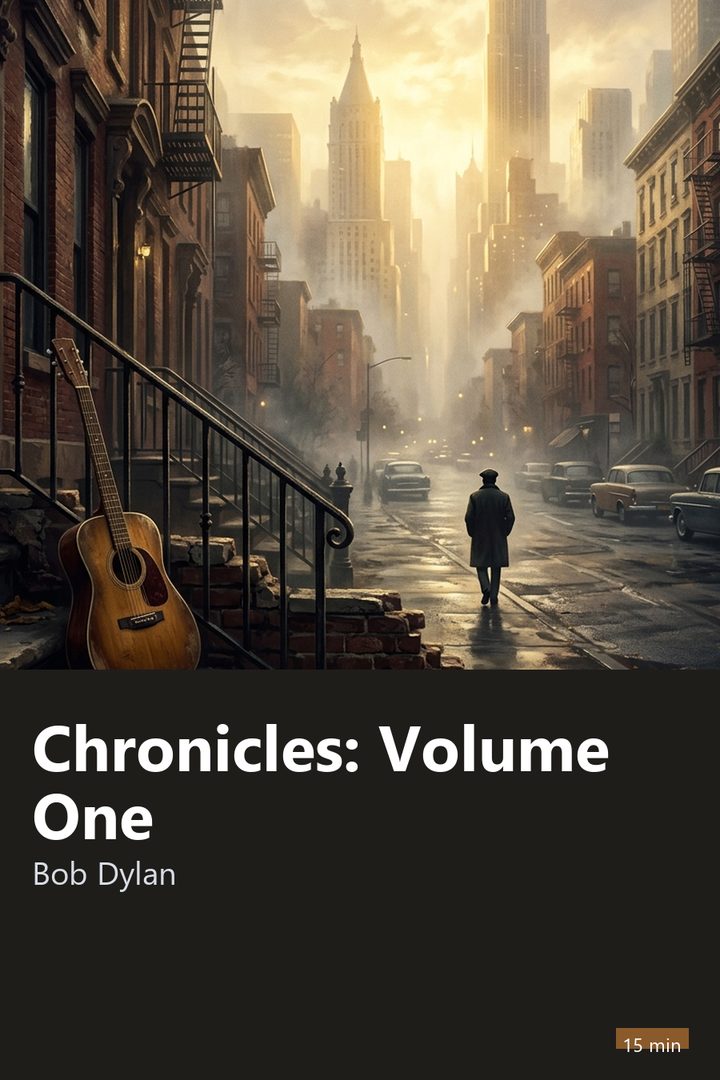
Cover of Chronicles: Volume One

Biographies and Memoirs · 19 min

Chronicles: Volume One

Bob Dylan · 2004

Who it's for

For anyone who loves music, memoirs, and the creative process, even if you don't know Dylan's entire discography. It is not the best entry point for readers looking for a complete biography organized neatly by date.

Read it in the app

⚡ Free to download • 🎁 One full book free every day

🎧 Audio coming soon in the app

Narration for the English summaries is on its way. Meanwhile you can read the full summary in the app.

3 ideas to take with you

1

Knowing a tradition can expand creative freedom because it offers more paths than trying to start from scratch.

2

Recognition becomes heavy when the image other people value starts deciding which responsibilities we are supposed to take on.

3

A creative partnership grows stronger when disagreement helps sharpen the work instead of turning into a battle over authority.

“
An influence matures when it stops being a mold and starts becoming a conversation.
An idea from Chronicles: Volume One, in the words of 15 Minutes

Preview

Start reading now

1. A Life Told Through Its Side Doors

Bob Dylan does not organize his story as a neat line of events. Instead of following childhood, success, and maturity in a tidy sequence, he chooses periods that shed light on his development and his turning points. This fragmentary structure presents memory like a house entered through a few doors while other rooms remain closed to the reader.

The book focuses on his arrival in New York, the making of New Morning, the recording of Oh Mercy, and memories from before he was famous. Chronology matters less than association. A chance meeting can open the door to something he read years earlier, which then leads to a specific musical or artistic choice.

That shifts what we expect from an autobiography. Anyone looking for a definitive explanation for every song will find detours, moods, and silences instead. The most rewarding approach is to watch how Dylan builds his way of seeing. Like a long conversation at a corner bar, what looks like a digression can reveal more than a direct answer.
2. Arriving Small So You Can Learn

When Dylan arrives in New York in 1961, he still has to figure out where to play, who to talk to, and how to get by. Greenwich Village offers coffeehouses, musicians, and arguments that work like an informal school. His education depends less on a planned career than on his willingness to move around and watch people closely.

Precarity shows up right alongside possibility. Borrowed couches, modest gigs, and uncertain connections are all part of the landscape. It would be dishonest to turn that insecurity into a recipe for success. What the account shows is someone making use of available resources, finding people to talk with, and gathering experience in a specific cultural scene full of material hardship.

For anyone starting out at a new job, the useful parallel lies in observation. Before trying to dominate the meeting, it pays to notice who understands the workflows and where the real problems are. Dylan picks up repertoire and habits because he pays attention. His ambition lives side by side with an apprentice's posture, even when he wants to go far.

3. Tradition as Living Material

The young Dylan dives into folk music, old ballads, and the many ways of telling a story through song. Tradition does not show up as a museum piece. It offers characters, conflicts, and structures that can be rearranged. Knowing the past widens his possibilities for expression rather than simply boxing in his voice.

In that world, orality matters just as much as printed lyrics. A pause, an inflection, or a way of holding a certain word changes the story being told. Dylan watches performers and absorbs their techniques. The repertoire handed down to him has already passed through many lives, showing that a song can carry traces of very different collective experiences.

A familiar comparison might be the old country, gospel, or blues songs heard around the house or passed down through family gatherings. Learning those forms does not mean copying them mechanically. You can recognize their power and still look for another direction. The book suggests that originality gains depth when it stays in conversation with materials that came before it.

11 more sections and the quiz

Continue in the app

Read the whole summary, finish with the Chronicles: Volume One quiz and follow the guided Journeys. No ads in the app.

About Bob Dylan

Bob Dylan was born Robert Allen Zimmerman in Duluth, Minnesota, in 1941. He became a central figure in popular music by bringing folk, blues, and rock traditions together with songwriting of remarkable poetic power. His albums include Highway 61 Revisited, Blood on the Tracks, and Oh Mercy. In 2016, he was awarded the Nobel Prize in Literature.

Explore

Part of the Journeys:
Lives in Music