15 Minutes
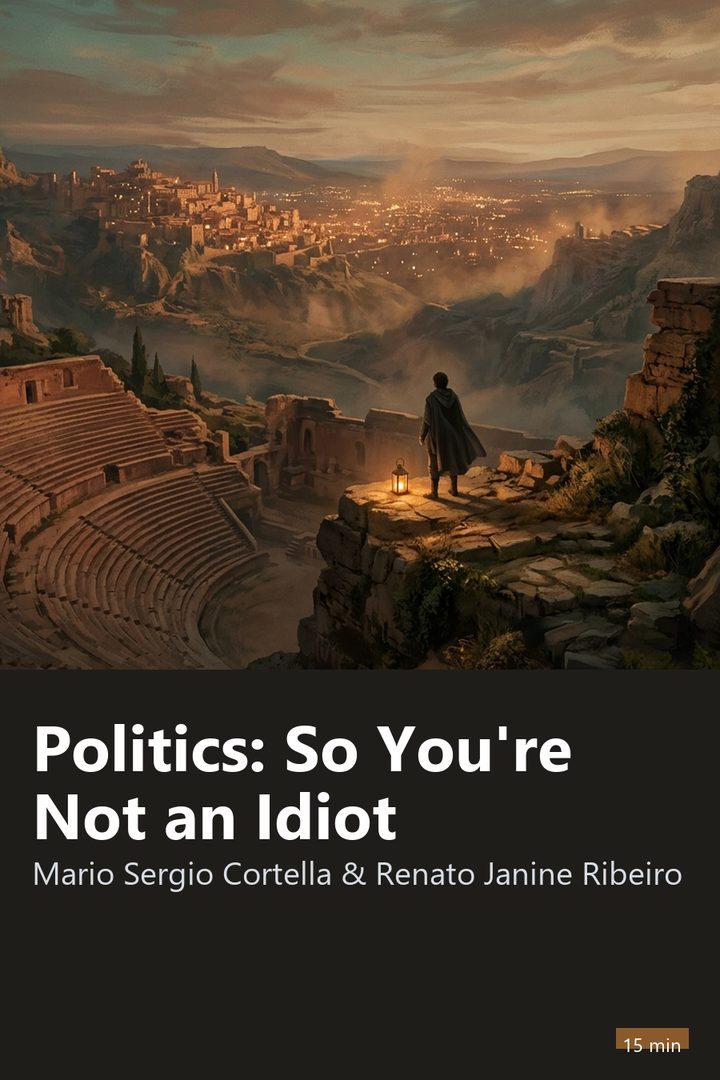
Cover of Politics: So You're Not an Idiot

Economy and Society · 15 min

Politics: So You're Not an Idiot

Mario Sergio Cortella & Renato Janine Ribeiro · 2010

Who it's for

Original title (Portuguese): Política: Para Não Ser Idiota. For you who say politics isn't your thing, or who got tired of complaining about the country and want to understand why taking part matters. It also works for teachers and students looking for a short text to start the conversation.

Read it in the app

⚡ Free to download • 🎁 One full book free every day

🎧 Audio coming soon in the app

Narration for the English summaries is on its way. Meanwhile you can read the full summary in the app.

3 ideas to take with you

1

Staying out of the decisions of your condo board, your school or your neighborhood is not neutrality: it is handing your vote to whoever showed up.

2

Demanding ethics from politicians sounds stronger when it comes together with a review of the little everyday shortcuts we all take.

3

For the authors, democracy is worthwhile for the conflict it manages to handle without violence, not for the absence of disagreement.

“
Complaining about politics at Sunday lunch and not going to the neighborhood meeting is one way of being an idiot, in the Greek sense.
An idea from Politics: So You're Not an Idiot, in the words of 15 Minutes

Preview

Start reading now

A provocative title and an invitation to talk

The title of this book sounds like an insult, but it works as a provocation with a historical basis. The two authors, the philosopher Mario Sergio Cortella and the political philosophy professor Renato Janine Ribeiro, put together a short, accessible conversation about politics for people who think the subject is boring, dirty or from another world.

The dialogue format is part of the proposal. Instead of a treatise, the reader follows two professors exchanging ideas about what politics is, why it matters in everyday life and what it means to take part. That makes the reading light, with the tone of a bar chat between people who have studied the subject.

In this summary we will go through the central ideas of the work in our own words, without copying passages, and then make an honest assessment of what it delivers and what it leaves out.

Where the word idiot comes from

The key to the title lies in ancient Greece. Back then, the word that gave rise to idiot referred to someone who took care only of private life, without any interest in the affairs of the city. It was not an insult about intelligence. It was the description of a person who refused to take part in the decisions that affected everyone.

The authors use this origin to show that the problem is not a lack of ability, but a lack of involvement. A person can be educated, successful and sharp, and still live as if what happens on the street, at school and in the public hospital were none of their business.

The idea is uncomfortable because it turns the mirror toward the reader. Whoever says they don't like politics and would rather mind their own life is, without noticing, in a position the Greeks would view with suspicion.

Think of a building manager who decides everything alone because nobody wants to attend the meetings. The residents complain afterward, but they gave up the space when it existed. The analogy helps us see that the word idiot, in the ancient sense, describes a choice, and choices can change.

Politics is not just parties and elections

One of the central moves of the book is to broaden what is understood by politics. For many people, the word brings to mind candidates, campaign ads and scandals. The authors' conversation insists that politics is much broader: it is the way a community decides what to do with what belongs to everyone.

That includes the condo meeting that chooses whether to replace the gate, the school council that decides how to spend the budget, the neighborhood association that presses city hall about an unpaved street and the conversation at home about who does what. Wherever there is a decision about what belongs to everyone, there is politics.

This view has a practical consequence. If politics is only what happens in the nation's capital, the citizen feels powerless. If it is also what happens in the neighborhood, they realize they already take part, for better or worse, every single day.

It also helps us see that politics involves power. Whoever decides the bus schedule, the school lunch menu or the amount of a tax is exercising power over the lives of many people. Understanding this takes politics out of the abstract plane and places it where people stand in line, catch the bus and pay the bills.

10 more sections and the quiz

Continue in the app

Read the whole summary, finish with the Politics: So You're Not an Idiot quiz and follow the guided Journeys. No ads in the app.

About Mario Sergio Cortella & Renato Janine Ribeiro

Mario Sergio Cortella is a Brazilian philosopher, writer and professor, with a long career at the Pontifical Catholic University of São Paulo and many books on education, ethics and work. Renato Janine Ribeiro is a professor of ethics and political philosophy at the University of São Paulo and the author of books on politics and democracy. Both are educators, and they talk to each other in a conversational format in this popular book. It was published in Brazil in 2010.

Explore