15 Minutes
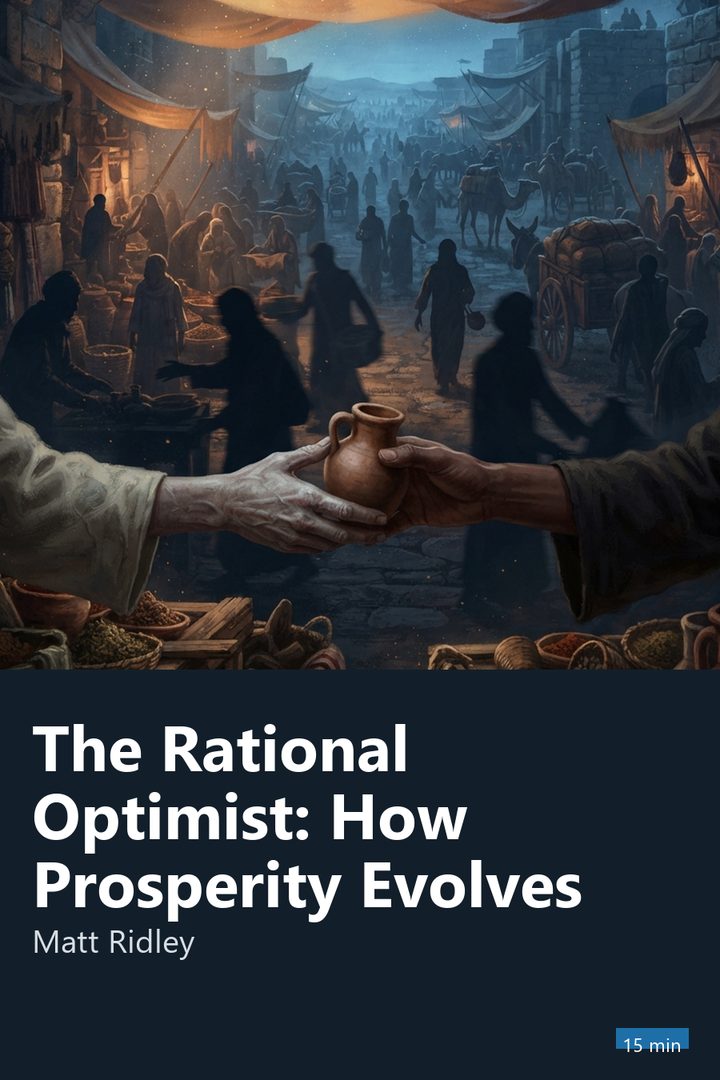
Cover of The Rational Optimist: How Prosperity Evolves

Economy and Society · 17 min

The Rational Optimist: How Prosperity Evolves

Matt Ridley · 2010

Who it's for

Original title (Portuguese): O Otimista Racional: Por Que o Mundo Melhora. For people who enjoy economic history and want to understand, with examples reaching back to prehistory, why the typical human being lives better today than in any other era, even with the crises that show up in the news. It also works for anyone who wants to get to know the argument of someone who disagrees with those who think everything is getting worse, without having to agree with all of it.

Read it in the app

⚡ Free to download • 🎁 One full book free every day

🎧 Audio coming soon in the app

Narration for the English summaries is on its way. Meanwhile you can read the full summary in the app.

3 ideas to take with you

1

A family that cuts off all exchange with the rest of the world and tries to produce everything on its own does not become freer. It becomes poorer and more fragile, because no individual talent can handle doing every step of every task in life well.

2

According to the author, a good share of the predictions of widespread catastrophe over the last few centuries, such as worldwide famine and the collapse of natural resources, have a high rate of error, because they tend to underestimate the human ability to adapt and invent in the face of scarcity.

3

According to Ridley, simple everyday objects bring together the knowledge of thousands of people who never met, and no one alone would know how to make them from scratch.

“
For Ridley, one idea alone yields little; the leap happens when ideas from different people meet and become a third thing that none of them would have invented alone.
An idea from The Rational Optimist: How Prosperity Evolves, in the words of 15 Minutes

Preview

Start reading now

A construction helper today lives better than a king of old

Take a worker who earns minimum wage in a mid-sized American city and compare him with a king from the eighteenth century. The king had a castle and servants, but he had no electric light, no medicine for a simple infection and no way to call a distant relative. Today's worker has all of that by flipping a switch, opening the refrigerator or dialing a number on a cell phone.

For Ridley, this comparison is the central argument of the book. He argues that humanity is objectively better off today than at any other moment in history, even with the problems that remain, because more people have access to food, health care and comfort than in any earlier century.

The author does not credit this improvement to luck or to any particular government. He credits a simple mechanism that has repeated itself since before agriculture: one person trades what he does well for what another person does well, and both come out ahead. That mechanism is what the whole book traces, from prehistory to today.
No one can do everything alone

Imagine living without trading anything with anyone: growing your own food, spinning your own clothes, building your own house, making your own knife. That is not freedom, it is misery disguised as independence. The author points out that the more a family tries to live in total self-sufficiency, the poorer and more fragile it becomes, because one person alone has neither the time nor the talent to do every step of every task well.

The way out that let our species prosper was the opposite: each person specializes in one small part of production and trades the surplus with someone who specialized in another part. One bakes bread, another fixes shoes, another looks after children, and what the three have together adds up to more than what each would have alone.

This holds for the corner bar just as much as for the economy of an entire country: the bar owner does not grow the sugarcane for the rum or raise the chickens for the wings. He buys from people who do that better and cheaper, and focuses on taking good care of whoever sits at his tables. That is the principle of the division of labor: each person focuses on a small part of production, trades for the rest, and everybody comes out ahead together.

Trading is older than farming

Many people think commercial trade is a recent invention of big cities. The book shows the opposite: archaeological finds from tens of thousands of years ago, long before agriculture, show seashells from the coast found far inland and obsidian stone far from any volcano. That only happens if one group traded with another, handing over what it had in surplus in exchange for what it lacked.

For Ridley, this is proof that trading was already part of human life before any city, currency or writing. A band of hunter-gatherers trading stone tools with the neighboring band is doing, on a small scale, the same thing two factories in different countries do today: each side hands over what it produces best.

The author uses this to knock down the idea that commercial trade corrupted a humanity that was originally cooperative and generous. For him it is the opposite: trade has always been part of human cooperation, it just kept growing in scale, from the band to the village, from the village to the city, from the city to the whole connected planet.

11 more sections and the quiz

Continue in the app

Read the whole summary, finish with the The Rational Optimist: How Prosperity Evolves quiz and follow the guided Journeys. No ads in the app.

About Matt Ridley

Matt Ridley is a British science writer with a doctorate in zoology from the University of Oxford and a former journalist at The Economist. He is a member of the United Kingdom's House of Lords and has written other popular science books on genetics and evolution over his career. He was the non-executive chairman of the British bank Northern Rock when the institution suffered a bank run and collapsed in 2007. The Rational Optimist, from 2010, is the book in which he brings together prehistory, economics and biology to argue that prosperity comes from exchange between people.

Explore

Part of the Journeys:
Understand the Economy