15 Minutes
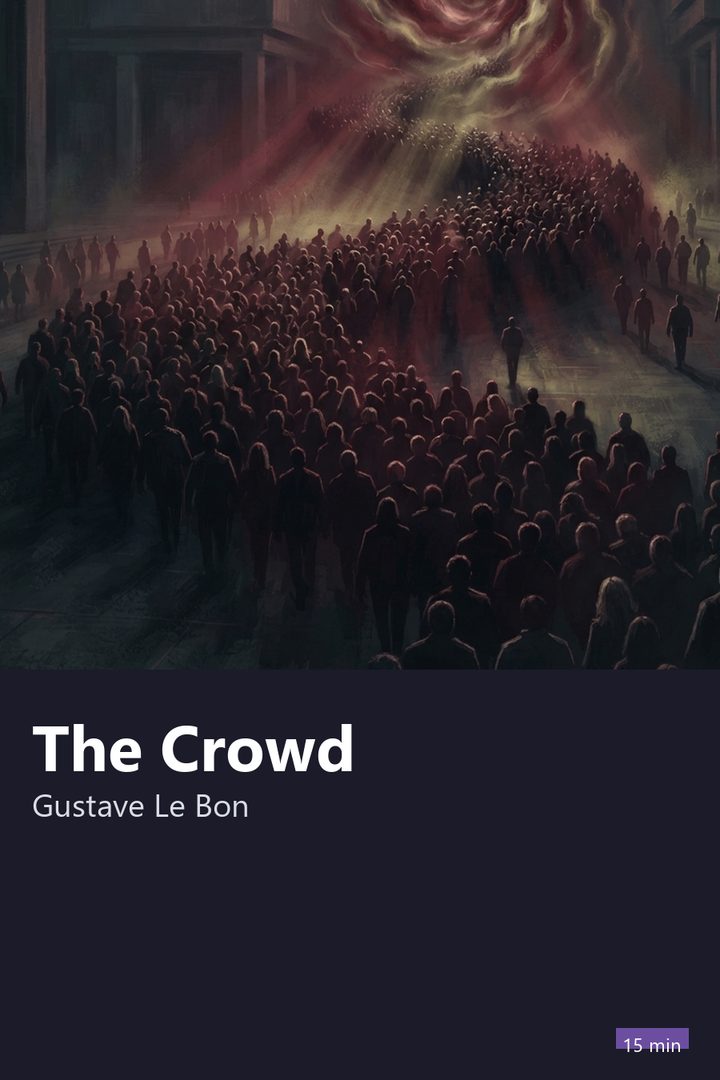
Cover of The Crowd

Economy and Society · 14 min

The Crowd

Gustave Le Bon · 1895

Who it's for

For you if you've ever gotten swept up in a stadium crowd, been spooked by a rumor in the family group chat, or wondered how the opinion of lots of people together turns into a force. The book is an 1895 classic that launched the study of collective behavior, and today it's read with a critical eye.

Read it in the app

⚡ Free to download • 🎁 One full book free every day

🎧 Audio coming soon in the app

Narration for the English summaries is on its way. Meanwhile you can read the full summary in the app.

3 ideas to take with you

1

For Le Bon, anonymity gives the impression that no one will answer for what the group does, and that loosens brakes a person alone would keep on.

2

A story with a strong image travels faster than a careful explanation full of caveats.

3

According to the book, a crowd leader persuades less through argument and more through firmness, repetition, and prestige.

“
The same group that vandalizes a bus stop can organize to rescue a stranger, because the crowd amplifies what was already in the air.
An idea from The Crowd, in the words of 15 Minutes

Preview

Start reading now

A doctor frightened by the streets of Paris

Gustave Le Bon wrote the book in the late 19th century, in a Europe watching its cities grow, labor unions organize, mass-circulation newspapers multiply, and popular uprisings shake governments. The memory of the Paris Commune of 1871 was still fresh for the French.

For him, the world was entering the age of crowds, in which the opinion of large groups would weigh more than that of rulers. The question driving him is practical: how does a person behave in the middle of a lot of people, and how can anyone deal with that phenomenon?

The book was a worldwide success and became required reading for politicians, advertisers, and scholars. But you have to read it carefully: it's an opinion piece, written with a great deal of class bias and the prejudices of its time.
What a psychological crowd is

The book's first idea is that a crowd is not just any gathering. A hundred people waiting for the bus don't form a crowd in the author's sense. He means a group in which people, under a shared emotion or goal, start acting in ways they wouldn't alone.

In that state, according to Le Bon, each person's conscious personality fades and a kind of collective soul emerges. The individual comes to feel, think, and act differently from how they would in isolation, and the crowd takes on an identity of its own, which is not the simple sum of its parts.

Think of a championship final in a stadium. Calm people who never raise their voices day to day sing, curse, and cry along with thousands of strangers. That's the kind of transformation the author tries to explain.

Anonymity and a sense of power

The author points to three mechanisms that would help explain the change. The first is anonymity: in the middle of a lot of people, individuals feel that no one knows who they are and that responsibility gets diluted. They gain a sense of strength that helps them give in to instincts they would suppress alone.

Think of the rioting after a game, or of aggressive comments from people who would never talk that way in real life. Distance and the feeling of not being identified loosen the brakes, especially when the group seems to be on the same side.

Later social psychology took up this idea under the name deindividuation, with mixed results. There are situations in which anonymity increases aggression, and others in which the group reinforces positive norms. The book presents only the first side.

12 more sections and the quiz

Continue in the app

Read the whole summary, finish with the The Crowd quiz and follow the guided Journeys. No ads in the app.

About Gustave Le Bon

Gustave Le Bon was born in France in 1841 and trained as a physician. He became interested in anthropology, archaeology, and physics, and traveled through several countries in Europe, Asia, and North Africa. He wrote about Arab civilization and about the psychology of peoples, until he scored a hit with his work on crowds. He died in 1931, at age 90.

Explore

Part of the Journeys:
Why We Act This Way