15 Minutes
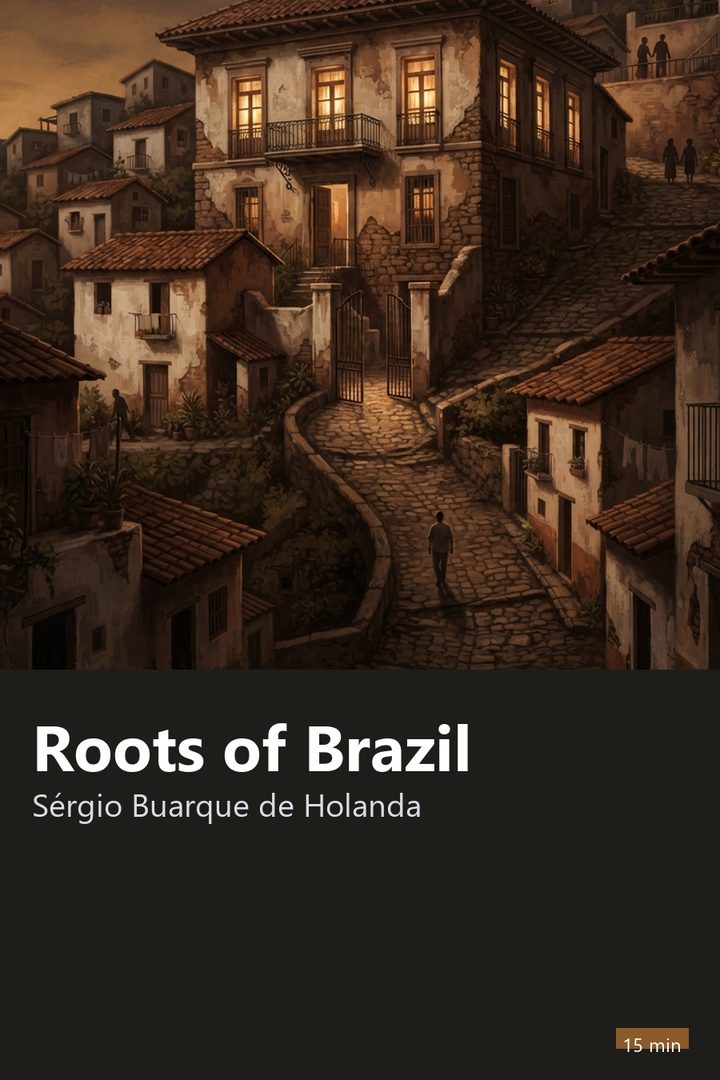
Cover of Roots of Brazil

Economy and Society · 17 min

Roots of Brazil

Sérgio Buarque de Holanda · 1936

Who it's for

Original title (Portuguese): Raízes do Brasil. For anyone who has heard of the Brazilian knack for workarounds (the famous "jeitinho") or the "cordial man" and wants to understand where that idea comes from, without clichés and without turning it into an excuse for anything. It is also for people who enjoy the history of ideas and want to see how a short book from 1936 still shows up in every serious discussion about the social formation of Brazil.

Read it in the app

⚡ Free to download • 🎁 One full book free every day

🎧 Audio coming soon in the app

Narration for the English summaries is on its way. Meanwhile you can read the full summary in the app.

3 ideas to take with you

1

According to Sérgio Buarque, the resistance to impersonal rules and orderly lines that many people today call the Brazilian way was not born here: it arrived in the cultural baggage of Portugal, of an Iberian Peninsula that valued the standout individual more than anonymous association among strangers.

2

According to the book, the Spanish colonizer arrived in the Americas with the city already drawn in his head with a set square, while the Portuguese colonizer let the settlement sprout little by little, adjusting to the hillside and the river like a seed growing wherever it finds room.

3

For the author, comparing with Weber, the Brazil shaped by the plantation big house and by cordiality had a harder time building a truly impersonal bureaucracy, because personal loyalty to the boss weighed more than cold obedience to an office or a written rule.

“
For Sérgio Buarque, the adventurer is not the lazy one in the story: he is the one who aims for big, fast results and treats the long, methodical road of steady work as a waste of time.
An idea from Roots of Brazil, in the words of 15 Minutes

Preview

Start reading now

A Small Book That Tried to Explain an Entire Country

Roots of Brazil came out in 1936, at the height of a generation of writers trying to make sense of a Brazil fresh out of the Revolution of 1930, when the country swapped the power of the states for a more centralized government. The book was published by José Olympio, in the Documentos Brasileiros series, alongside other classics pursuing the same project: explaining the social formation of the country.

Unlike other classics of the same generation, which lean on abundant detail about life on the colonial plantation, Sérgio Buarque writes a short, dense essay, almost a philosophical argument. He revised the text in 1948 and again in 1956, fixing passages and adding notes, proof that he saw his own book as a work in progress, not a closed truth.

The central thesis can be summed up like this: Brazil inherited from Portugal a way of organizing life in society that rests more on the person and on affection than on impersonal rules and offices, and that inheritance keeps shaping how Brazilians deal with authority, with the state, and with one another.


Europe's Frontiers: The Inheritance That Came Before Brazil Existed

The first chapter does not talk about Brazil yet: it talks about Portugal and Spain within Europe itself. Sérgio Buarque describes the Iberian Peninsula as a region that resisted, more than the rest of the continent, a trait gaining strength in places like Holland: the discipline of subjecting individual will to a rule or an organized body.

He calls this the culture of personality: a tendency to value the individual, personal talent, and merit recognized by face and name, instead of valuing the office or the impersonal association among strangers. Where other parts of Europe early on built guilds and orders that were strong as collective bodies, the Iberian Peninsula kept betting on the figure of the standout individual.

This distinction matters because it is the foundation of everything that follows in the book: for the author, Brazil did not invent personalism on its own, nor the resistance to cold rules and to the anonymity of the orderly line. It inherited this even before existing as a colony, in the cultural baggage of those who crossed the Atlantic.

The Adventurer and the Worker: Two Ways of Dealing With the World

To explain the mentality the colonizers brought, Sérgio Buarque proposes two ideal types, meaning models that help us think, even knowing that no real person fits perfectly into either one. On one side is the worker: someone who values steady effort and long-term planning. On the other is the adventurer: someone who aims for big, immediate results and treats the long, methodical road as a waste of time.

The adventurer is not, in the book, a synonym for slacker or irresponsible person. He is someone willing to take a high risk for a high reward, in a hurry to harvest results and with little patience for investing decades in a single trade, the spirit of someone who would rather prospect for gold than plow a field, who would rather find a shortcut than slowly build a road.

For Sérgio Buarque, the Portuguese colonizer brought this adventurer spirit to Brazil in a more pronounced way than other colonizing peoples. Not because he was braver or greedier than other Europeans, but because Portugal's own formation, a small kingdom turned early toward long-distance trade, pushed in that direction.

10 more sections and the quiz

Continue in the app

Read the whole summary, finish with the Roots of Brazil quiz and follow the guided Journeys. No ads in the app.

About Sérgio Buarque de Holanda

Sérgio Buarque de Holanda was born in São Paulo in 1902 and died in 1982. He was a historian, sociologist, and literary critic, and he taught Brazilian history at the University of São Paulo, where he also directed the Institute of Brazilian Studies. He wrote other landmark works on the formation of the country, such as Caminhos e Fronteiras and Visão do Paraíso. He was the father of the composer and singer Chico Buarque.

Explore

Part of the Journeys:
Brazil in Books, Thinking Brazil