15 Minutes
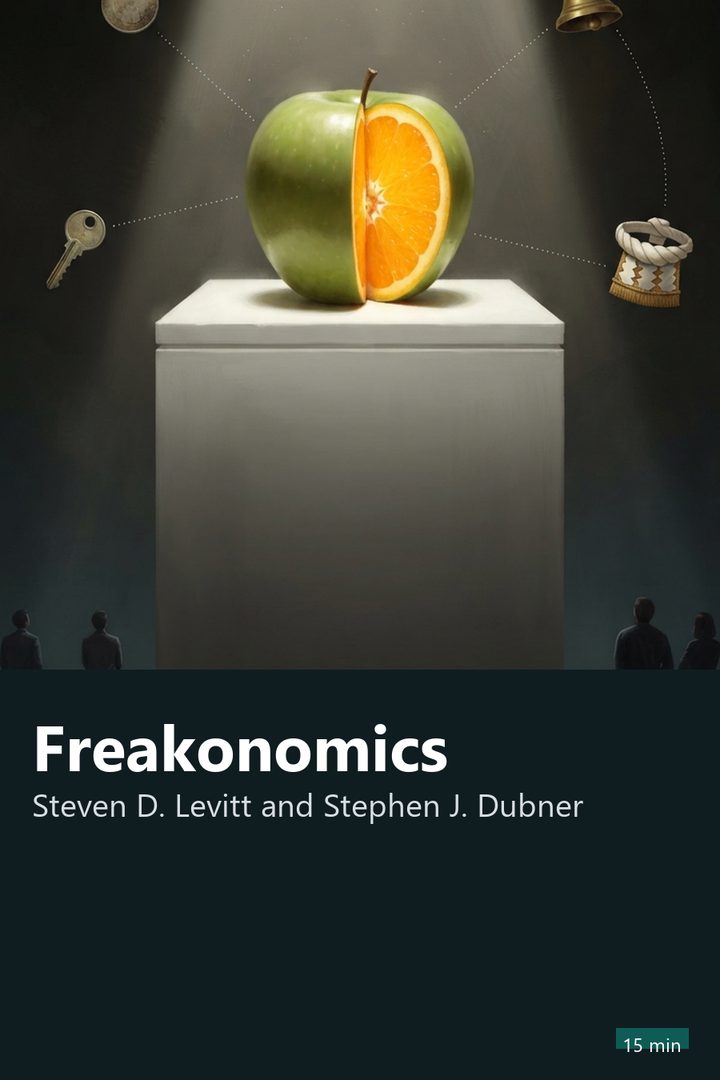
Cover of Freakonomics

Economy and Society · 13 min

Freakonomics

Steven D. Levitt and Stephen J. Dubner · 2005

Who it's for

For anyone who likes seeing the world from an unexpected angle and wants to understand why people do what they do, from the teacher who cheats to the parent who runs late. It's also for people who think economics is boring and want proof otherwise.

Read it in the app

⚡ Free to download • 🎁 One full book free every day

🎧 Audio coming soon in the app

Narration for the English summaries is on its way. Meanwhile you can read the full summary in the app.

3 ideas to take with you

1

Where the payoff is big and nobody is watching closely, shortcuts tend to show up, even among respectable people.

2

According to the book, someone who earns a small commission on your profit tends to sell faster, and not necessarily at the best price.

3

Low pay at the bottom is offset by the hope of reaching the top: we accept little today when we can see a big prize down the road.

“
When you put a price on a moral obligation, it can become just another fee.
An idea from Freakonomics, in the words of 15 Minutes

Preview

Start reading now

An economist who barely talks about money

Freakonomics grows out of a simple idea: economics, at its core, studies how people respond to incentives, and that applies to far more than the stock market or a paycheck. The book uses that lens to look at odd subjects: cheating, crime, parenting and even baby names.

The authors, an economist and a journalist, start from a healthy distrust of conventional wisdom, that set of ideas everybody repeats without checking. Instead of opinion, they look for data, and the method is empirical: look at what actually happened before explaining why.

The book is not a finance treatise but a collection of stories with a common thread. Think of a detective who, instead of fingerprints, uses a spreadsheet to find out who is lying and why. Each chapter works like a case, with a question, a clue and a surprise at the end.

The three kinds of incentive

According to the book, an incentive is anything that makes someone act one way or another. The authors split them into three kinds: economic, which hits your wallet, social, which touches what other people think, and moral, which touches what a person believes is right.

In real life they blend together. Someone double-parking might be thinking about the ticket, the neighbor watching and their own conscience all at once. The book's point is that we usually see only one kind, typically the economic one, and let the rest slip by.

Social norms, for example, weigh a lot: some people don't cut in line because the others in line would give them dirty looks, not because of any rule. Understanding the whole picture helps predict why people act the way they do, and also why certain policies backfire.

Teachers and sumo wrestlers

One of the most famous cases is that of the Chicago teachers. When students' test performance began to determine bonuses and jobs, some teachers started changing their students' answers. The authors spotted this through strange patterns in the data, like a run of correct answers right after several wrong ones.

Sumo wrestlers are part of the same story. To keep their spot in the rankings, a wrestler on the verge of losing may fix the result with his opponent, a collusion that only shows up when you look at the match history: the one who needs the win most wins more often than probability would explain.

The lesson is uncomfortable: where the result is worth a lot and oversight is weak, cheating shows up even among respectable people. Think of a salesperson with a tight quota or a student in a test-prep course chasing a cutoff score: the game invites a shortcut, and some give in.

11 more sections and the quiz

Continue in the app

Read the whole summary, finish with the Freakonomics quiz and follow the guided Journeys. No ads in the app.

About Steven D. Levitt and Stephen J. Dubner

Steven Levitt is an economist and a professor at the University of Chicago, and in 2003 he received the John Bates Clark Medal, an award given to American economists under 40. Stephen Dubner is a journalist and writer who met Levitt while writing a profile of him for The New York Times Magazine. That partnership produced the book, published in 2005, which went on to spawn sequels, a movie and the podcast Freakonomics Radio.

Explore

Part of the Journeys:
Understand the Economy