15 Minutes
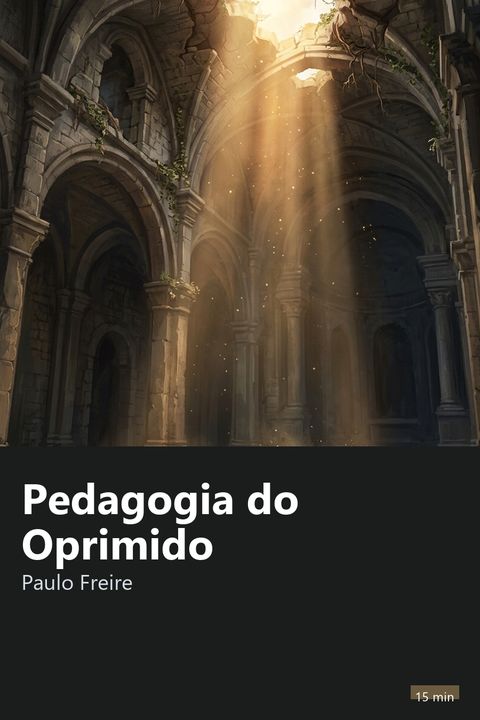
Cover of Pedagogy of the Oppressed

Economy and Society · 15 min

Pedagogy of the Oppressed

Paulo Freire · 1968

Who it's for

For you if you work in education, or have simply felt treated like someone who knows nothing, and want to understand why teaching is also a political act. This Brazilian classic is a demanding read that becomes especially rewarding when discussed in a group.

Read it in the app

⚡ Free to download • 🎁 One full book free every day

3 ideas to take with you

1

For Freire, people who receive help without having a say in decisions learn to wait for favors rather than change their own situation.

2

Learning to read is complete only when people also learn to read the world they live in: the line, the fare, the unpaved street.

3

Knowledge brought in from outside creates lasting change only when it connects with the knowledge of people who live with the problem.

“
Memorizing for a test and forgetting the following week is just a symptom of a school that deposited content instead of asking questions.
An idea from Pedagogy of the Oppressed, in the words of 15 Minutes

Preview

Start reading now

A Book Written in Exile

Pedagogy of the Oppressed grew out of lived experience. After working in adult literacy in northeastern Brazil, Paulo Freire was imprisoned and forced to leave the country following the military coup of 1964. In exile, mainly in Chile, he shaped what he had learned teaching rural workers to read into a book.

That hands-on experience matters. Freire did not write from an empty library, but from years of conversations with people whom schools had left behind: peasants, fishermen, factory workers. Those relationships gave him the conviction that education is never neutral, because it either helps keep the world as it is or helps transform it.

Written in 1968, the book became one of the world's most widely read works on education. Keep that background in mind: this is a fighting text, written by someone who believed that teaching people to read also meant teaching them to see themselves as agents of their own lives.
Oppressors, the Oppressed, and Dehumanization

The first chapter begins with a powerful idea: wherever there is oppression, everyone experiences dehumanization. Oppressors lose some of their humanity by treating other people as things, while the oppressed have their humanity denied. For Freire, the human calling is to become more fully human: to grow, create, and decide. Oppression blocks that path.

He points out a painful trap. People who live under domination for a long time may internalize the oppressor's image of them: lazy, ignorant, incapable. They end up saying, 'I don't know anything. The expert knows,' and accepting the place assigned to them as natural.

That is why liberation cannot be handed down from above. The oppressed must discover their own ability to think and act, and that requires a process of critical consciousness that cannot be decreed or given as a gift.

The Fear of Freedom and False Generosity

Freire observes that the oppressed often fear freedom even as they long for it. Being free means accepting risks and responsibility, while dependence, however bad it may be, offers a familiar routine. Some people prefer having a boss make decisions to having to decide for themselves.

Among those with power, he identifies what he calls false generosity. This is charity that relieves symptoms while preserving the conditions that produce poverty: a box of groceries without any change to the circumstances that cause hunger. The gesture may be sincere, but it helps preserve the giver's position.

For the author, true generosity would mean fighting to make such acts of assistance unnecessary. That requires seeing other people as partners in a struggle, not as recipients of favors.

10 more sections and the quiz

Continue in the app

Read the whole summary, finish with the Pedagogy of the Oppressed quiz and follow the guided Journeys. No ads in the app.

About Paulo Freire

Paulo Freire was born in Recife in 1921 and died in São Paulo in 1997. An educator and philosopher of education, he was known for his adult literacy work, including the 1963 Angicos project in Rio Grande do Norte. Imprisoned after the 1964 coup, he spent years in exile and later served as São Paulo's municipal secretary of education from 1989 to 1991. Pedagogy of the Oppressed, written in 1968, is his best-known work.

Explore