15 Minutes
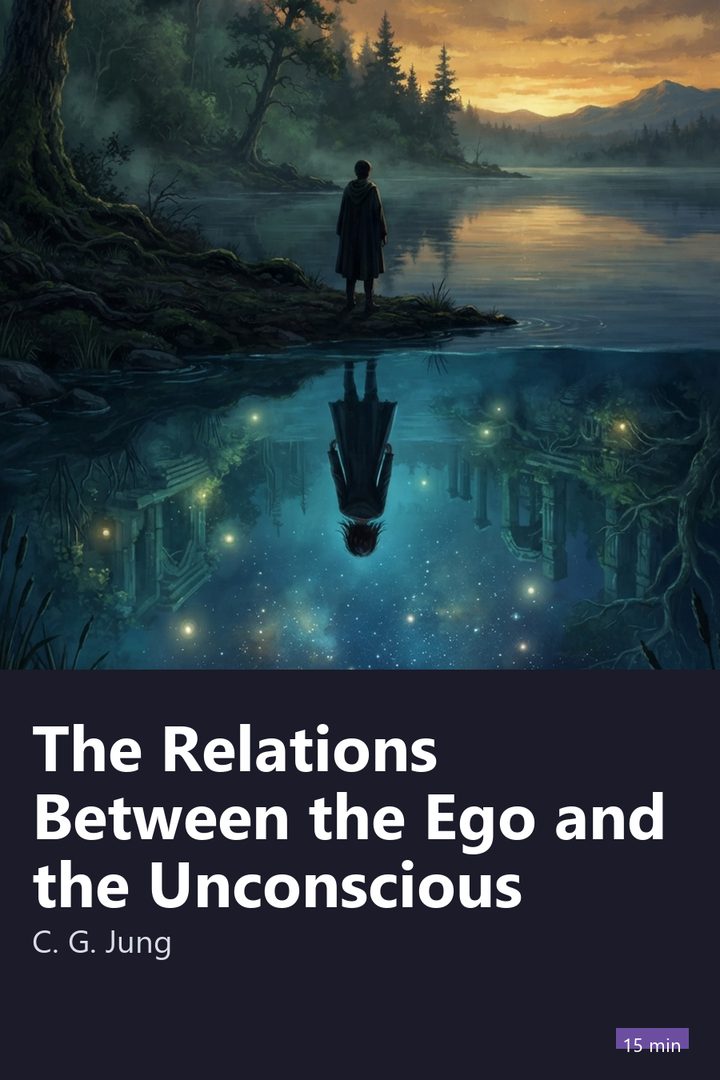
Cover of The Relations Between the Ego and the Unconscious

Psychology · 16 min

The Relations Between the Ego and the Unconscious

C. G. Jung · 1928

Who it's for

For anyone who likes to reflect on social masks, idealized passions, and what is left of you when the role ends. Also for readers who have heard terms like persona, shadow, and individuation and want to know where they came from.

Read it in the app

⚡ Free to download • 🎁 One full book free every day

🎧 Audio coming soon in the app

Narration for the English summaries is on its way. Meanwhile you can read the full summary in the app.

3 ideas to take with you

1

Recognizing the side of yourself that you deny takes away some of the power it holds over you.

2

For Jung, becoming whole does not mean becoming perfect. It means including light and shadow in a more coherent life.

3

In the book, dreams are seen as a mirror of the inner moment, not as a verdict.

“
According to Jung, the persona is not a lie: it is the role that allows us to live together, as long as the person knows how to take it off.
An idea from The Relations Between the Ego and the Unconscious, in the words of 15 Minutes

Preview

Start reading now

The ego does not own the whole house

Jung starts from a simple observation: we believe we are what we think and decide, but the mind goes far beyond what is in plain sight. The ego, which is the center of consciousness and what we call "myself," would be only the lit part of a much larger space, mostly dark.

Think of the boss who swears he never gets irritated but blows up every Monday, or the person who decides to change her life and repeats the same pattern in three jobs. The ego wants one thing, and something outside the field of awareness pulls toward another. For Jung, that "something" has its own logic and deserves attention, not contempt.

The book sets out to describe the relations between the ego and this unknown territory, the unconscious, and to show how a person can live with it without being dominated by it or pretending it does not exist. It is a text from 1928, and part of the vocabulary we use today about "hidden sides" comes from there.


Two basements: the personal and the collective

Jung divides the unconscious into two layers. The personal unconscious holds what has been forgotten, repressed, or never noticed in each person's history: memories, desires, fears, and complexes, which are clusters of ideas and emotions that take on a life of their own and get in the way when you least expect it.

Beneath it would lie the collective unconscious, shared by all humanity. It is not made of personal memories but of inherited predispositions to imagine, feel, and react in certain ways to universal situations like being born, loving, losing, and dying. This is the most original point of the theory, and also the most controversial.

The practical difference is that the personal is explained by biography, while the collective would show up in themes that appear among peoples who never met: myths, tales, religious symbols. When a dream brings an image that seems bigger than the person's life, Jung suspects the source is this deeper layer.

Archetypes: molds, not ready-made images

The contents of the collective unconscious are the archetypes, a word Jung uses for basic patterns of human experience. They are not finished figures in the head but empty molds that each culture and each person fills with their own images. He compares them to the structure of a crystal, which determines the form without being the crystal.

For example, the archetype of the protective mother appears as the Virgin Mary on an altar, as a sea goddess on a beach, as the grandmother who welcomes you in the kitchen. The image changes, and the core, the care that shelters, stays. The same goes for the hero, the sage, the trickster. Each one touches something we recognize without ever having studied it.

When an archetype is activated, it stirs up a lot of emotional energy. That is why certain stories move crowds, and certain public figures inspire exaggerated devotion or hatred. Jung considers this both normal and dangerous: the archetype gives meaning to life, but it can also capture an unsuspecting ego.

11 more sections and the quiz

Continue in the app

Read the whole summary, finish with the The Relations Between the Ego and the Unconscious quiz and follow the guided Journeys. No ads in the app.

About C. G. Jung

Carl Gustav Jung was born in 1875 in Switzerland and worked as a psychiatrist in Zurich. He collaborated with Freud between 1907 and 1913 and then broke away to create analytical psychology. He is the author of concepts such as the collective unconscious, the archetype, introversion, and extraversion. He died in 1961.

Explore

Category:
Psychology
Part of the Journeys:
Jung, Myths, and Symbols