15 Minutes
Cover of The Man Who Mistook His Wife for a Hat

Psychology · 14 min

The Man Who Mistook His Wife for a Hat

Oliver Sacks · 1985

Who it's for

For you if you love true stories and want to understand how the brain can fail in surprising ways without the person ceasing to be who they are. It also works for anyone in caregiving, health, or education who wants to see the patient beyond the diagnosis.

Read it in the app

⚡ Free to download • 🎁 One full book free every day

🎧 Audio coming soon in the app

Narration for the English summaries is on its way. Meanwhile you can read the full summary in the app.

3 ideas to take with you

1

Extraordinary talent has a human cost too: treating someone only by what they can do is losing sight of the person.

2

A good treatment is not just the one that erases the symptom, but the one the person agrees to bring into their own life.

3

Case stories are moving, but an account written by a writer's hand proves nothing about all patients.

“
Seeing well is not the same as recognizing: the eye delivers the image, and it is the brain that puts a name to the face.
An idea from The Man Who Mistook His Wife for a Hat, in the words of 15 Minutes

Preview

Start reading now

A neurologist who listened to stories

Imagine a doctor who, instead of looking only at the test results, sits down next to the patient and listens to their whole life. Oliver Sacks did that for decades and turned what he saw into small medical tales. The book gathers more than twenty of these cases, all about brains that fail in strange ways.

The underlying idea is simple and uncomfortable. The neurology of the time measured what was missing in a person, and Sacks also wanted to describe who was still there. To him, the patient is someone with a history, tastes, and dignity, not a list of symptoms on a chart in a crowded hospital.

The book is divided into four parts: losses, excesses, transports, and the world of the simple. Losses are functions that disappear. Excesses are functions that fire too much. Transports are involuntary trips to memories and visions. And the world of the simple is about people with intellectual disabilities.


The music teacher who couldn't see faces

The case that gives the book its name is Dr. P., a respected singer and music teacher. He saw well, spoke well, and taught with talent. But his students began to notice that he only recognized someone when the person spoke, because a face, by itself, told him nothing.

During the exam, Sacks showed him objects and photos. Dr. P. described shapes and colors with an engineer's precision, but never reached the meaning. A rose became a red shape curled up with a green stem, and only the smell solved the riddle. A glove became a folded fabric with five pockets.

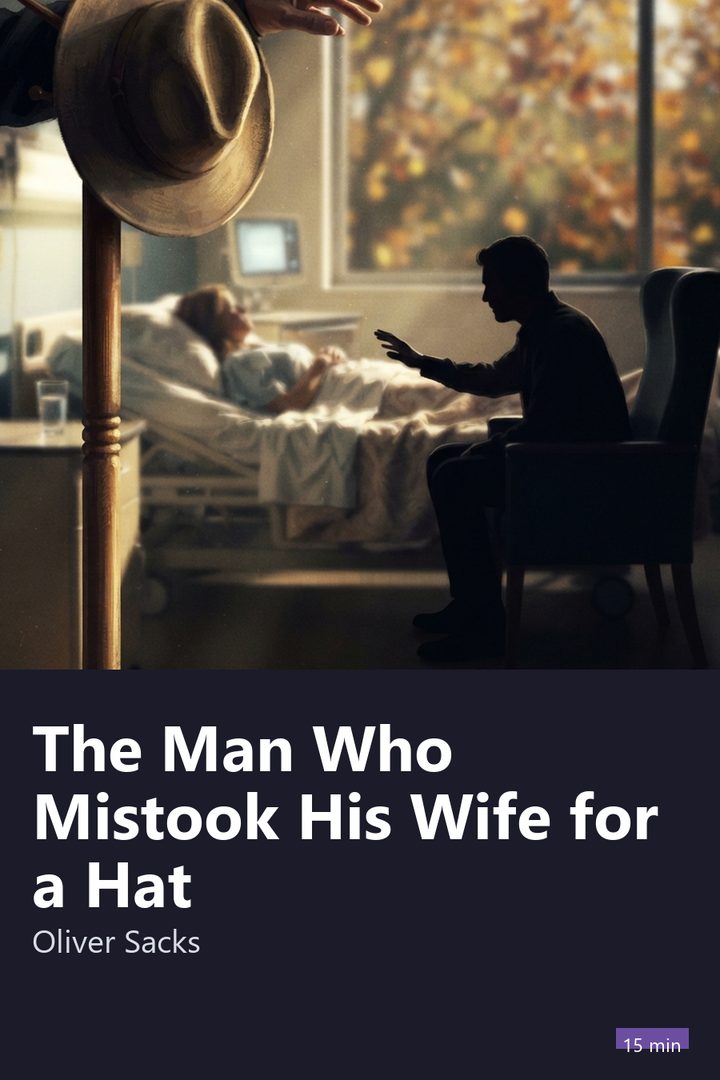
At the end of the visit, while looking for his hat, he reached out and tried to lift his own wife's head, as if it were the object. The scene sounds like a joke, but it is tragic: he did not realize anything was wrong. The problem was in the part of the brain that puts the pieces together into a familiar picture.

The eye delivers the image, the brain delivers the meaning

What Dr. P. had is called visual agnosia, the inability to recognize what you see even when your vision is intact. The optics of the eye worked. What was missing was the next step, in which the brain compares the image with everything it already knows and says: that's my son, that's a bus.

Think of a coworker you recognize from far away at the bus stop just by the way they walk. You don't calculate anything, the recognition comes ready-made. For Dr. P., that shortcut had broken, and he had to assemble each face from loose details, like a mustache, a forehead, a gold tooth.

Sacks explains that this is not a lack of intelligence or attention. It is a specific failure, and that is why it is so frightening: the person remains brilliant in everything around it. It's worth remembering that his exact diagnosis is uncertain, and the book suggests a degenerative problem or a tumor in the visual region.

11 more sections and the quiz

Continue in the app

Read the whole summary, finish with the The Man Who Mistook His Wife for a Hat quiz and follow the guided Journeys. No ads in the app.

About Oliver Sacks

Oliver Sacks was born in London in 1933 and earned his medical degree in England. He moved to the United States and worked as a neurologist in New York, where he also taught at universities. He became famous for turning clinical cases into books, such as Awakenings, which became a movie in 1990. He died in 2015.

Explore

Category:
Psychology
Part of the Journeys:
Journey Through the Brain