15 Minutes
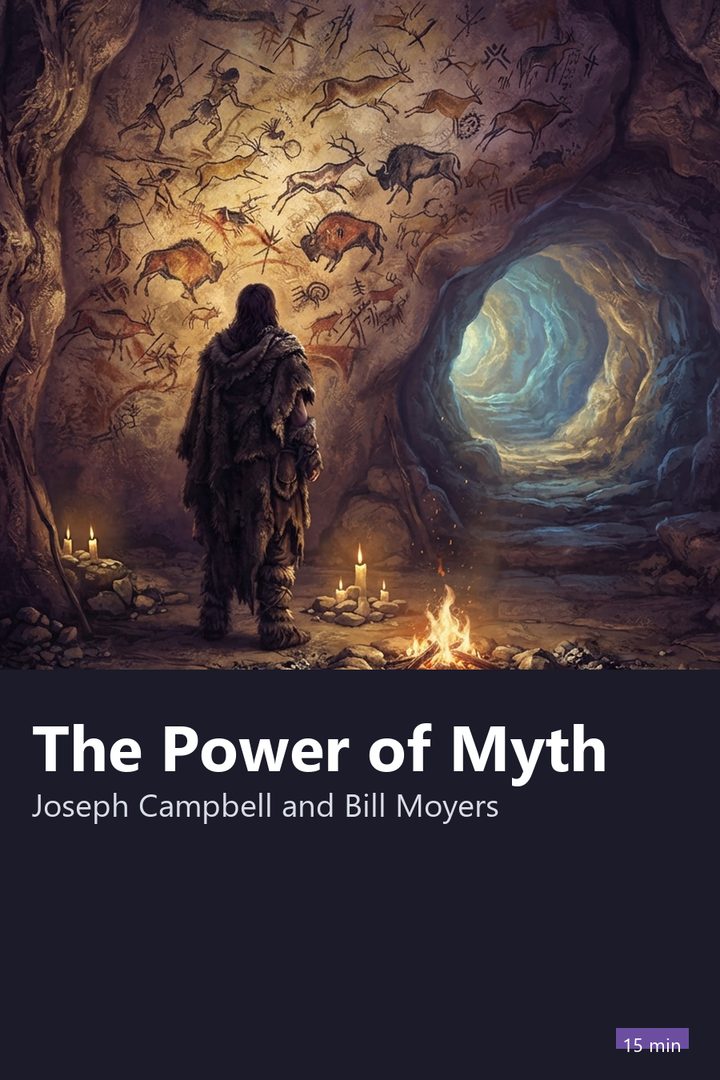
Cover of The Power of Myth

Psychology · 15 min

The Power of Myth

Joseph Campbell and Bill Moyers · 1988

Who it's for

Original title (Portuguese): O Poder do Mito. This one is for you if you love movies, TV dramas, and family stories and want to understand why they stir us so much. The book is a conversation about myths and how they still help us make sense of life.

Read it in the app

⚡ Free to download • 🎁 One full book free every day

🎧 Audio coming soon in the app

Narration for the English summaries is on its way. Meanwhile you can read the full summary in the app.

3 ideas to take with you

1

Following what makes you feel alive doesn't mean dropping everything: it means testing, in small steps, what makes you want to get out of bed.

2

For the book, marriage is less an agreement between two people and more a commitment to the relationship, which becomes a third thing to be looked after.

3

A story that only informs doesn't change anyone; the one that gives meaning and direction is the one that crosses generations.

“
For Campbell, myth is not a lie, but the story that carries a truth that facts alone can't reach.
An idea from The Power of Myth, in the words of 15 Minutes

Preview

Start reading now

A conversation that became a book

The Power of Myth grew out of a series of interviews between the American mythologist Joseph Campbell and the journalist Bill Moyers, recorded in 1985 and 1986, much of it at filmmaker George Lucas's ranch. Campbell was over eighty and had spent a lifetime studying the world's religions and stories. He died in 1987, before seeing the series air on American public television in 1988.

The book organizes those conversations into chapters such as the modern world and myth, the inner journey, the first storytellers, the hero's adventure, and the masks of eternity. Moyers asks the questions of someone who wants to understand, and Campbell answers with stories from India, Greece, Native Americans, the Bible, and the movies.

Because it's a conversation, the tone is light and full of examples, but the ideas are big. The common thread is simple: myths are stories that societies tell to give life meaning, and we still need them today.

Myth is not a lie

In everyday speech, calling something a myth means it's false. Campbell turns that around: for him, a myth is a story that carries a truth that facts alone can't carry. It hardly matters whether the siren of the rivers, say, ever existed. What matters is what she says about fascination and danger, and about the fear of what attracts us.

Sacred stories, he argues, should be read as metaphors, not as news reports. When someone argues over whether the sea really parted, they miss the key: the account is about a crossing, about leaving slavery and getting through a fear. The mistake, he says, is taking the metaphor as fact and ceasing to hear the message.

This stirs people up. Those with a traditional faith may feel uneasy, and it's important to respect that reading. The practical point is a different one: every culture has stories that shape what is considered good, beautiful, and possible, and knowing those stories is knowing yourself. America has many of them, of Native, African, European, and frontier origin.

The four functions of myth

Campbell sums up what myths do in four functions. The first is the mystical one: awakening awe at the mystery of existing, that feeling that the world is bigger than what we understand.

The second is the cosmological one, which offers an image of the universe, of where we came from and where we are. Today that image comes mainly from science, and Campbell sees this without drama, as long as science doesn't wipe out the awe. The third is the sociological one: sustaining a social order, with rules about what is right, who is in charge, and who marries whom.

The fourth, the closest to each person's life, is the pedagogical one: teaching how to live a human life under any circumstance, from childhood to old age, from illness to celebration. It's the function that interests Campbell most in the modern world, because it's the one that tends to go missing when the old stories lose their strength.

10 more sections and the quiz

Continue in the app

Read the whole summary, finish with the The Power of Myth quiz and follow the guided Journeys. No ads in the app.

About Joseph Campbell and Bill Moyers

Joseph Campbell was born in 1904 in the United States and died in 1987. He taught literature at Sarah Lawrence College for almost four decades and studied mythology and comparative religion. His 1949 book The Hero with a Thousand Faces became a classic on the pattern of the hero's journey. Bill Moyers, born in 1934, is an American journalist who conducted the interviews for the public television series.

Explore

Category:
Psychology
Part of the Journeys:
Jung, Myths, and Symbols