15 Minutes
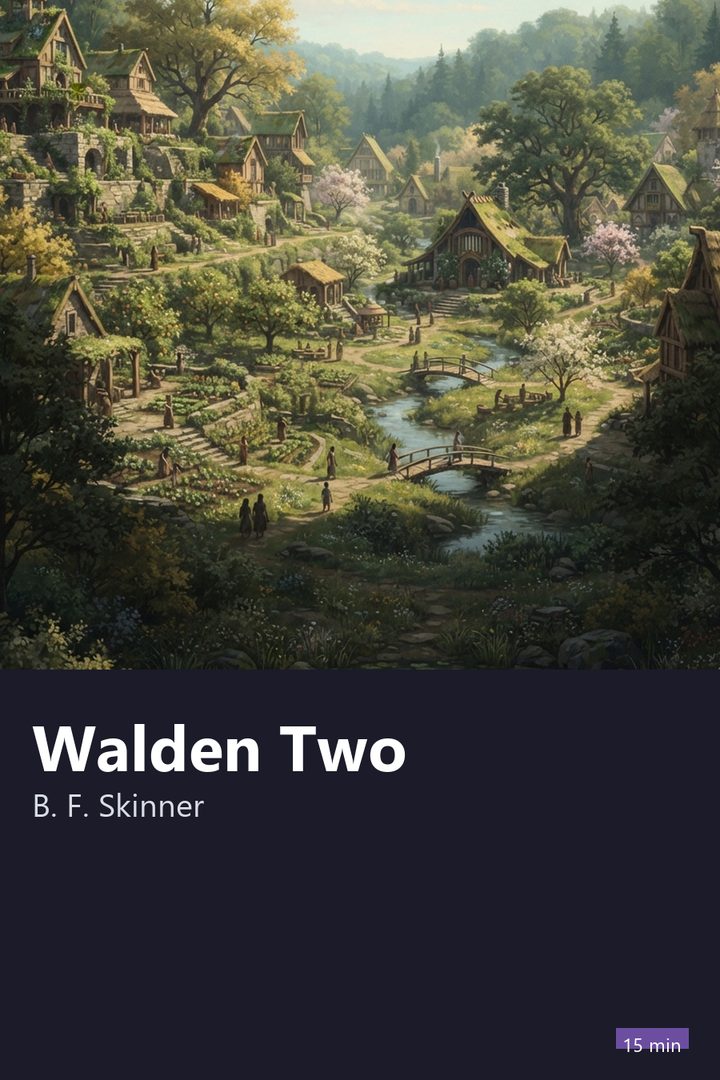
Cover of Walden Two

Psychology · 15 min

Walden Two

B. F. Skinner · 1948

Who it's for

For anyone who enjoys novels of ideas and wants to consider whether we can design a better society without taking away people's freedom. It's also for readers interested in habits, education, and behavior.

Read it in the app

⚡ Free to download • 🎁 One full book free every day

🎧 Audio coming soon in the app

Narration for the English summaries is on its way. Meanwhile you can read the full summary in the app.

3 ideas to take with you

1

Well-applied reinforcement usually teaches more than threats do, because it shows people what to do, not just what to avoid.

2

Anyone who designs a community's rules holds enormous power, and the question of who watches the planners remains open.

3

The ending suggests that Burris's discomfort said more about the life he was leading than about the community.

“
Awarding more credits for unpleasant tasks is a simple way to turn what nobody wants to do into a choice.
An idea from Walden Two, in the words of 15 Minutes

Preview

Start reading now

A Utopia Written After the War

Walden Two was published in 1948, three years after World War II ended, as the world surveyed the ruins and wondered how to build a better society. B. F. Skinner, a Harvard psychologist, responded with a novel: instead of a treatise, an imaginary community where readers could see his ideas in action.

The title pays tribute to Henry David Thoreau's Walden, which championed a simple life in the woods. Skinner keeps the desire to live simply but rejects isolation. He proposes a small, planned society with real people, work, schools, parties, and clear rules.

The book is fiction, but it works as a manifesto. The characters talk a lot, and their conversations lay out arguments. That's why it helps to read on two levels at once: the story of what happens to the visitors and the ideas it aims to defend.


The Visit: Who Comes to Walden Two

The story is told by Burris, a psychology professor approached after the war by two veterans, Rodge and Steve. They tell him about an old college acquaintance, T. E. Frazier, who has reportedly founded an experimental community. Curious and somewhat skeptical, Burris agrees to investigate.

The traveling group represents a range of viewpoints. There are the two young men and their girlfriends, Barbara and Mary, hoping to find a better place to live. And there's Professor Castle, a skeptical philosopher who defends individual freedom and finds any attempt to plan other people's lives suspicious.

When they arrive, Frazier welcomes them and leads them through fields, dining halls, workshops, and residential buildings. What they see seems almost too good to be true: calm people working short hours, studying, singing, and playing. The book uses each visitor's perspective to reveal admiration, doubt, and resistance.

Frazier, the Charismatic Founder

Frazier is the book's standout character. He talks nonstop, argues with biting irony, and is certain he's gotten things right. He explains that he spent years planning the community, tested ideas on a small scale, corrected mistakes, and now sees around a thousand people living in harmony.

Skinner portrays him as brilliant, but also vain and somewhat authoritarian. Questions bother Frazier, he treats criticism as misunderstanding, and at times he seems to enjoy seeing himself as a kind of god presiding over his own creation. The author leaves that ambiguity in plain sight.

That makes the reading experience richer. You can see Frazier as Skinner's spokesman, but also as a character readers can challenge. The lingering question is whether a society so dependent on a charismatic founder can be genuinely stable and fair.

11 more sections and the quiz

Continue in the app

Read the whole summary, finish with the Walden Two quiz and follow the guided Journeys. No ads in the app.

About B. F. Skinner

Burrhus Frederic Skinner was born in 1904 in Pennsylvania and became one of the best-known psychologists of the twentieth century. He was a professor at Harvard University and developed radical behaviorism and the theory of operant conditioning. He also wrote Science and Human Behavior, published in 1953. He died in 1990.

Explore

Category:
Psychology
Part of the Journeys:
Personality Theories