15 Minutes
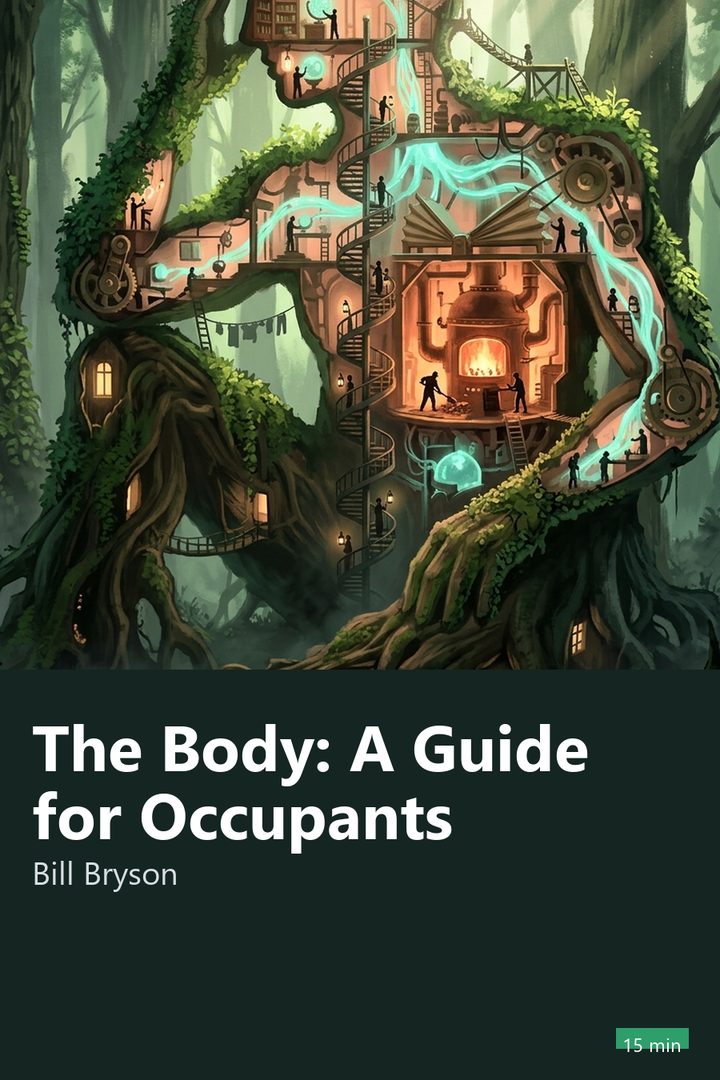
Cover of The Body: A Guide for Occupants

Health · 17 min

The Body: A Guide for Occupants

Bill Bryson · 2019

Who it's for

For anyone who wants to understand how their body operates behind the scenes, exploring how organs, cells, and systems work without excessive academic jargon. A recommended read for anyone curious about the biology of everyday life and the history of medical discoveries.

Read it in the app

⚡ Free to download • 🎁 One full book free every day

🎧 Audio coming soon in the app

Narration for the English summaries is on its way. Meanwhile you can read the full summary in the app.

3 ideas to take with you

1

The raw materials that make up the body have negligible monetary value in nature. The real biological marvel lies in the coordination of trillions of cells working together.

2

Human survival depends on living in balance with trillions of microbial partners that perform vital tasks the body could not handle alone.

3

The skeleton is a living structure that constantly remodels itself in response to physical exertion, serving as a dynamic mineral storehouse rather than a lifeless framework.

“
The brain inhabits a dark, silent chamber, interpreting electrical signals to construct our everyday experience of the world.
An idea from The Body: A Guide for Occupants, in the words of 15 Minutes

Preview

Start reading now

The Cheapest Chemical Recipe in the Universe

If you went to a chemical supply store and bought all the raw ingredients of the human body, the bill would come to no more than a few dozen dollars. About sixty-five percent of our mass is oxygen, followed by carbon, hydrogen, nitrogen, and pinches of calcium and phosphorus. In practical terms, we are essentially a generous helping of warm water with ordinary minerals.

The great mystery is how this lifeless matter comes alive. Organized into thirty-seven trillion coordinated cells, these atoms create a person capable of catching the bus in the rain, paying a bill, and maintaining a miraculous internal balance known as homeostasis without having to tell the heart what to do.

You have inhabited this machine since birth and depend on it every moment, yet you probably know much less about your own physical frame than about the settings on the phone you carry in your pocket throughout your busy day.
The Living Armor You Replace Every Month

The first major barrier between you and outside dangers is your skin, the largest organ in the human body. Covering about two square meters and weighing four kilograms in an average adult, it regulates temperature through sweat, produces vitamin D in sunlight, and serves as a wall against harmful microbes.

Beneath that surface lies melanin, the biological pigment that determines different skin and hair colors and acts as a natural sunscreen against ultraviolet radiation. Ancestral populations in sunny regions needed plenty of pigment to protect nutrients in their blood, while in colder climates this barrier diminished so they could synthesize the vitamin with limited sunlight.

Your epidermis sheds thirty thousand dead cells an hour, making fragments of your own body a substantial part of household dust. Over thirty days, the entire outer layer is quietly replaced with a new suit of armor.

An Apartment Complex with Trillions of Microbes

We tend to think of ourselves as solitary individuals, but biology reveals that you are an overcrowded apartment complex. Tens of trillions of bacteria, fungi, and viruses inhabit every centimeter of your skin and the dark bends of your intestines. This living community makes up the microbiome, which can weigh more than a kilogram and contains more genes than the human genome.

Far from being a threat you need to wipe out with expensive drugstore soaps, these microbes digest complex fiber, produce essential vitamins, and train your body's defenses to recognize real dangers without attacking harmless foods.

A major modern danger is taking antibiotics on your own to try to cure every weekend cold. Because the flu is caused by viruses, it does not respond to these medications, which end up devastating beneficial gut flora and selecting dangerous strains of superbugs resistant to conventional medical treatments.

11 more sections and the quiz

Continue in the app

Read the whole summary, finish with the The Body: A Guide for Occupants quiz and follow the guided Journeys. No ads in the app.

About Bill Bryson

Bill Bryson is an acclaimed American journalist and author known for his ability to turn scientific and historical subjects into engaging, accessible stories. Among his most celebrated works is 'A Short History of Nearly Everything,' which won prestigious international awards for science writing. Bryson lived in the United Kingdom for many decades, where he served as chancellor of Durham University and received honors from the Order of the British Empire. In 2019, he published 'The Body: A Guide for Occupants,' the result of extensive interviews with dozens of specialists and physicians around the world.

Explore

Category:
Health
Part of the Journeys:
Lasting Health