15 Minutes
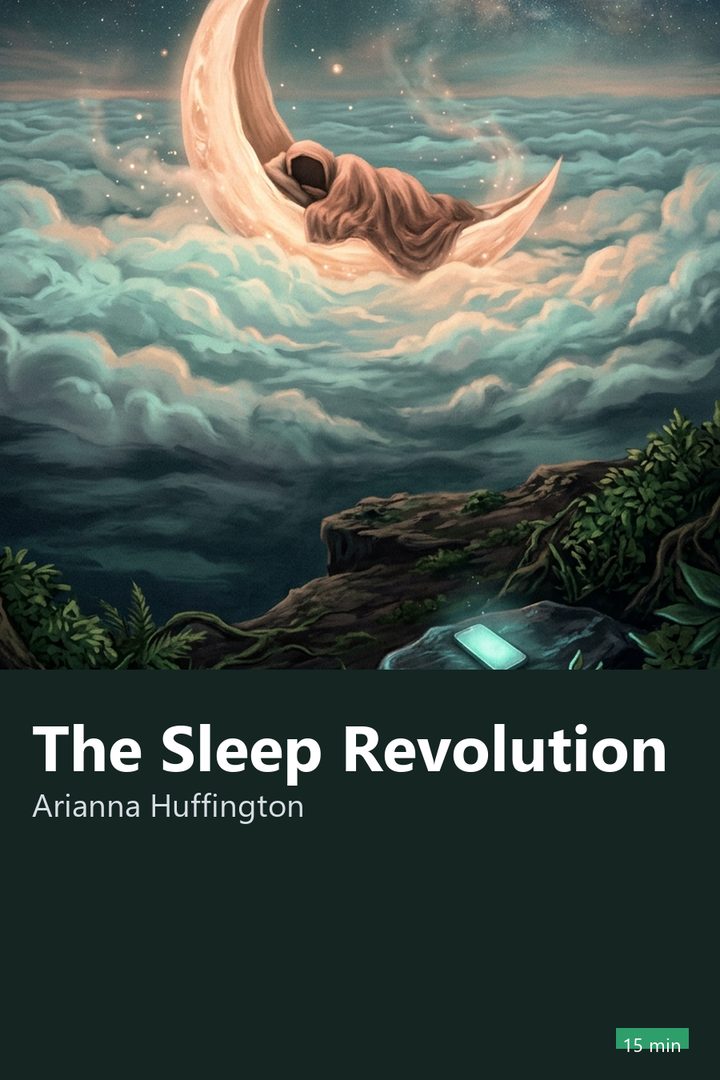
Cover of The Sleep Revolution

Health · 15 min

The Sleep Revolution

Arianna Huffington · 2016

Who it's for

For anyone who gets too little sleep, wakes up tired, and thinks rest is a luxury, yet wants to understand what sleep actually does to the body and mind. The book serves as a wake-up call and offers solid practical ideas, as long as you read its grander promises with a healthy dose of skepticism.

Read it in the app

⚡ Free to download • 🎁 One full book free every day

🎧 Audio coming soon in the app

Narration for the English summaries is on its way. Meanwhile you can read the full summary in the app.

3 ideas to take with you

1

Your brain does not shut off at night: it organizes memories and processes the day across different stages.

2

The effect of a late-afternoon coffee can last for many hours and disrupt your sleep without you even realizing it.

3

According to the book, your bed should be used only for sleeping, not for working or scrolling on your phone.

“
Anyone who cuts back on sleep to get more done may simply be trading hours of rest for hours of mistakes.
An idea from The Sleep Revolution, in the words of 15 Minutes

Preview

Start reading now

A fall that changed her course

In 2007, Arianna Huffington, cofounder of The Huffington Post, collapsed from exhaustion in her own office. She fell, hit her face on the corner of her desk, and broke her cheekbone. No one pointed to a single cause: it was the buildup of short nights, a packed schedule, and the belief that sleeping was a waste of time. She admits that at first she did not see it as a warning sign, but simply as a failure to manage her own calendar.

That episode became the starting point for this book. Huffington uses her own story to ask what we truly gain when we cut back on sleep in order to get more done. Her answer is uncomfortable: the gain is small, and the bill arrives in the form of fatigue, mistakes, irritability, and illness.

From there, the book turns into an investigation. She speaks with researchers and shares stories of people from several countries who were also living on the edge. Her central argument is that sleep is a pillar of health, right alongside nutrition and exercise, rather than the leftover item at the bottom of the list.
Sleep is not a luxury, it is a foundation

Huffington argues that sleep works as a kind of maintenance crew for the body and the mind. During the night, the body repairs tissues, regulates hormones, and resets your mood for the next day. When that maintenance falls short, the damage shows up gradually, and you almost never notice it right away.

Here the book rests on solid research. There is broad scientific consensus that chronic sleep deprivation is linked to greater trouble concentrating, higher irritability, and poorer weight control. These effects are well documented, even when a person feels wide awake. It is worth noting that the quality of rest matters just as much as the quantity, because fragmented sleep can leave you exhausted even after spending plenty of hours in bed.

Where the book overreaches is when it promises that sleeping more solves practically everything. That is an exaggeration. Sleep is an important piece of the puzzle, not the only one. Anyone dealing with persistent pain, anxiety, or fatigue needs to see a doctor instead of trying to fix it simply by going to bed earlier.

What happens while you sleep

Sleep is not a uniform blackout. It moves through cycles that repeat throughout the night, with lighter stages, stages of deep sleep, and stages in which the most vivid dreams occur. Each cycle lasts about ninety minutes, and each stage serves a different purpose. Because of that, waking up in the middle of the night does not always mean something is seriously wrong; what matters is how your body feels over the course of the week.

REM sleep, the stage in which brain activity looks a lot like waking life, helps organize the day's memories and emotions. Deep sleep is tied to physical recovery. Interrupting either of these blocks, even if you log eight hours in total, changes the quality of your rest.

These cycles follow the body's internal clock, known as the circadian rhythm, which responds to light and darkness. When you go to bed and wake up at wildly irregular times, that clock gets thrown off, and your body struggles to know when it is time to rest. To put this into everyday terms: sleeping too little on weekends and trying to catch up later usually backfires, because your internal clock feels the mess.

11 more sections and the quiz

Continue in the app

Read the whole summary, finish with the The Sleep Revolution quiz and follow the guided Journeys. No ads in the app.

About Arianna Huffington

Arianna Huffington is a Greek-born journalist, author, and entrepreneur based in the United States. She cofounded The Huffington Post in 2005, a media site that was later sold to AOL. She went on to found Thrive Global, a platform dedicated to well-being and healthy productivity. In addition to The Sleep Revolution, she has published books on balanced living and leadership, including Thrive.

Explore

Category:
Health