15 Minutes
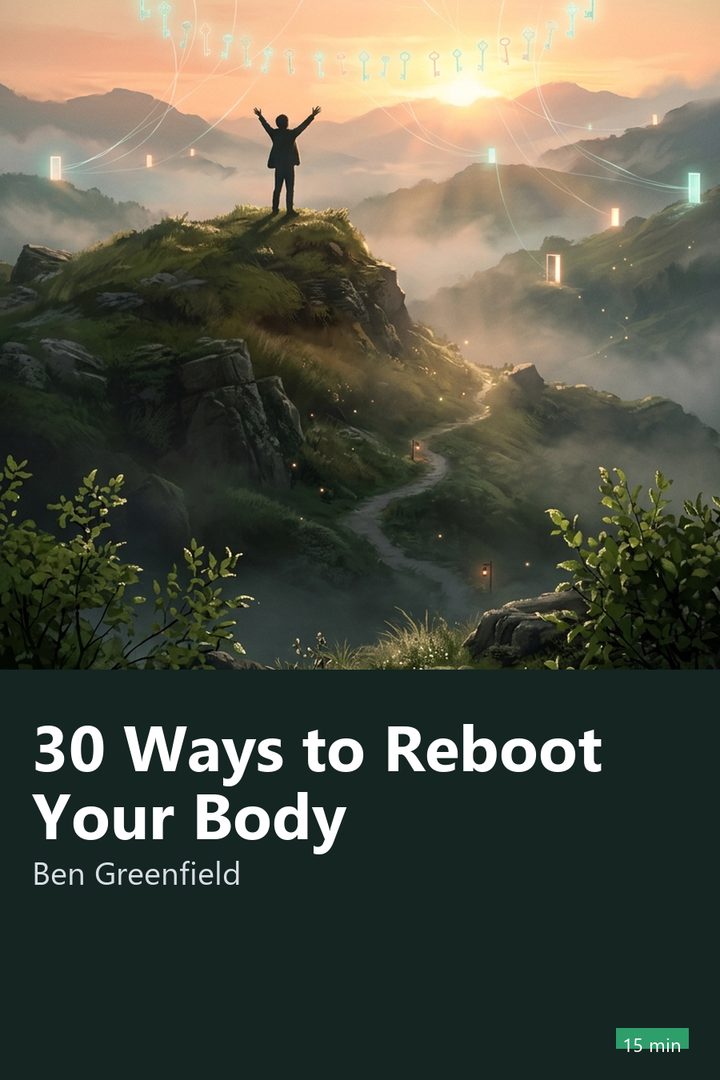
Cover of 30 Ways to Reboot Your Body

Health · 15 min

30 Ways to Reboot Your Body

Ben Greenfield · 2016

Who it's for

For anyone who wants to understand the core principles of biohacking and physical optimization without falling for expensive fads. It is a body-maintenance guide that draws a frank line between facts proven by science and the author's personal bets.

Read it in the app

⚡ Free to download • 🎁 One full book free every day

🎧 Audio coming soon in the app

Narration for the English summaries is on its way. Meanwhile you can read the full summary in the app.

3 ideas to take with you

1

Treating your body like a biological machine with its own manual swaps the anxious question of what broke for a calm search for the habit you have been neglecting.

2

Slow, paced breathing works like a hand brake for the nervous system: a free tool you can use in any line at the bank or in any traffic jam.

3

Small doses of movement scattered with discipline throughout the day create more biological adaptation than a single grueling gym session that tiredness keeps postponing.

“
Biological stress in small, controlled doses is training that strengthens; continuous emotional stress with no rest is a debt that makes you sick.
An idea from 30 Ways to Reboot Your Body, in the words of 15 Minutes

Preview

Start reading now

Your body as a machine that needs maintenance

Ben Greenfield's central premise is direct and almost mechanical: most people treat their own bodies far worse than they treat the family car. While any prudent driver changes the oil on schedule, checks the tire pressure, and does preventive service to avoid breaking down on the road, when it comes to health the most common habit is to ignore clear signs of wear until a serious crisis forces a rushed trip to the hospital.

The idea of a biological reboot proposed in the book is not about creating lab-made superhumans. It is about giving the body back the ideal conditions to run without the chronic drag of daytime fatigue, brain fog, and heavy digestion that so many adults passively accept as normal consequences of aging.

When you adopt the view that the body is an integrated ecosystem that responds with mathematical precision to sleep, food, temperature, and movement, you step out of the role of passive victim of tiredness and take operational control of your own biology.


Resetting the digestive tract and your diet

The first big lever in the manual focuses on the health of the gastrointestinal tract. For the author, trying to boost your daily energy or burn fat while keeping a gut inflamed by ultra-processed foods and dietary toxins is like trying to speed up a car with the parking brake on.

The initial practical recommendation is to clear out inflammatory triggers for two to four weeks, temporarily cutting refined sugars, white flour, industrial vegetable oils, and artificial sweeteners. The goal of this stage is to reduce the permeability of the intestinal lining and let the microbiome recover its natural, protective balance.

In place of supermarket packages, the rebuilding diet favors dense whole foods, collagen-rich broths, clean meats, fish, and well-cooked vegetables, restoring healthy chemical communication between the digestive system and the brain.

Cellular power plants and positive stress

At the microscopic level, the true source of the body's vitality lies in the mitochondria, tiny organelles found inside almost all of our cells and responsible for the continuous production of adenosine triphosphate, the chemical energy currency of the human body.

To stimulate the renewal of these power plants and clear out defective cell components, Greenfield turns to the classic physiological principle of hormesis. The concept teaches that applying acute, brief, carefully dosed environmental stressors can activate genetic cell-defense pathways that increase the whole body's resistance to future insults.

In everyday practice, this translates into contrasting temperature stimuli: finishing a hot shower with two minutes of fully cold water or going to short dry sauna sessions. These moderate thermal shocks stimulate mitochondrial biogenesis and help reduce systemic inflammation.

11 more sections and the quiz

Continue in the app

Read the whole summary, finish with the 30 Ways to Reboot Your Body quiz and follow the guided Journeys. No ads in the app.

About Ben Greenfield

Ben Greenfield is an American author, health consultant, and sports trainer, known internationally in the world of biohacking and endurance sports as an Ironman and Spartan Race athlete. He has been named one of the most influential professionals in the world of fitness and is the author of well-known titles such as Beyond Training and Boundless. He published 30 Ways to Reboot Your Body in early 2016 as a direct, concise manual focused on restoring energy and supporting cellular longevity.

Explore

Category:
Health