15 Minutes
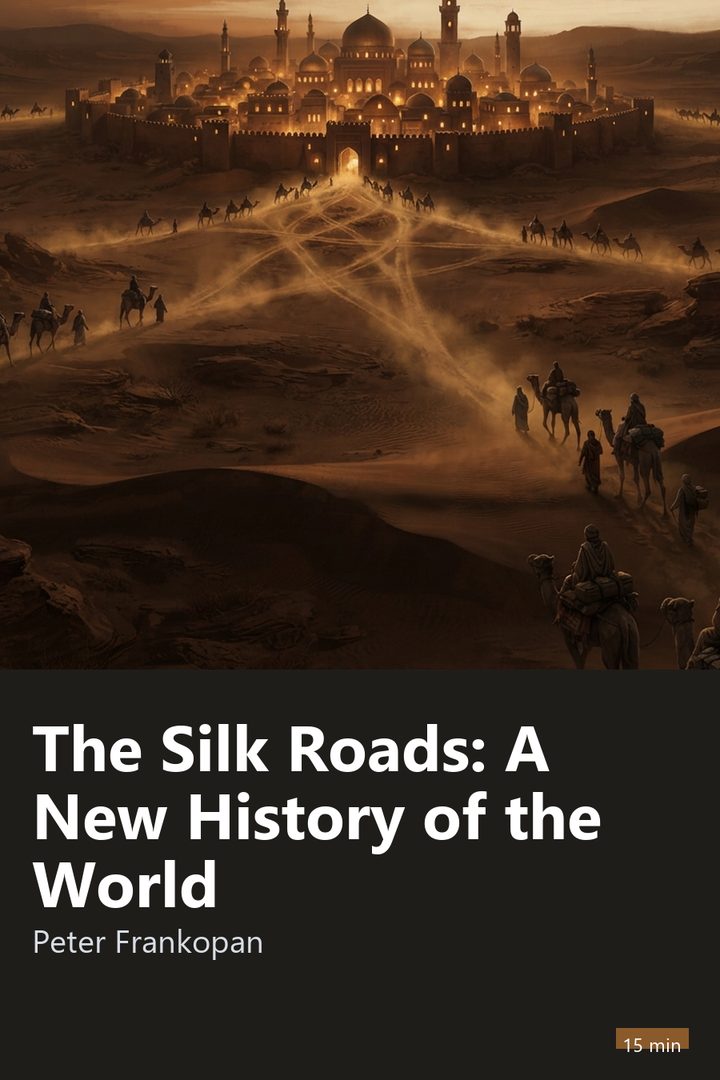
Cover of The Silk Roads: A New History of the World

History · 17 min

The Silk Roads: A New History of the World

Peter Frankopan · 2015

Who it's for

For you if you wonder why the international news keeps coming back to the Middle East and Central Asia, and you want to understand the history of the world without putting Europe at the center of everything.

Read it in the app

⚡ Free to download • 🎁 One full book free every day

🎧 Audio coming soon in the app

Narration for the English summaries is on its way. Meanwhile you can read the full summary in the app.

3 ideas to take with you

1

An empire that looks like nothing but destruction can also open a road: the Mongols killed a lot of people and still left trade safer than it was before the conquest.

2

According to the book, Europe didn't get rich by accident when it took over the sea. It got rich by cutting out the middleman who had been charging tolls on the land routes for centuries.

3

For Frankopan, a recent war in Central Asia is not an isolated event. It is one more chapter in an old struggle for control of this corridor of the world.

“
According to Frankopan, for centuries the world's wealth didn't live in Europe, but in the corridor between the Mediterranean and China.
An idea from The Silk Roads: A New History of the World, in the words of 15 Minutes

Preview

Start reading now

A history of the world told from the middle of the map

Most of the history books we learned from in school follow a similar path: they start in Greece, move through Rome, vanish for about a thousand years, and reappear in Renaissance Europe, as if the rest of the planet had stood still waiting. Frankopan proposes the opposite: for much of human history, the real center of wealth, trade and invention didn't live in London, Paris or Rome. It lived in the land corridor between the Mediterranean and China, running through Persia, Central Asia and the Middle East.

That is why the book is called 'The Silk Roads': this strip of territory, seen today as a distant periphery on the evening news, was for centuries the place where almost everything that mattered passed through: money, ideas, armies, religion and knowledge.

The argument is not that Europe never mattered. It's that Europe became the lead player late, for a specific reason that the book explains further on.
It wasn't only silk that moved along the routes

The name 'Silk Roads' is misleading if you think only of fabric. Along the same trails and through the same ports came horses, spices, precious stones, slaves, paper, irrigation techniques and number systems. A caravan leaving a trading post in Central Asia might carry silk in one direction and return loaded with a completely different kind of goods.

These trading posts worked like the toll plazas of the ancient economy: cities that grew rich not by producing a lot, but by sitting in the right spot along the way and taking their cut from every caravan that came through.

The book uses this detail to make a bigger point: for most of history, wealth had less to do with what a territory produced on its own and more to do with how much of other people's goods flowing through it that territory controlled.

Where the great religions crossed paths on the same road

A traveling merchant doesn't carry only goods, but also customs and beliefs. Buddhism left India and spread across Central Asia following trade routes, Christianity reached communities in Persia long before it became the dominant religion in Europe, and centuries later Islam spread along the same network of roads and ports that had been carrying products for generations.

Cities like Samarkand and Bukhara became places where pilgrims of different faiths crossed paths with merchants, and for a good while they coexisted without one belief having to erase another in order to survive there.

The book describes this coexistence without taking sides with any faith. Its interest is in showing how trade and religion moved together, each merchant carrying his belief along with his goods, without treating this as better or worse than any other path of religious expansion.

13 more sections and the quiz

Continue in the app

Read the whole summary, finish with the The Silk Roads: A New History of the World quiz and follow the guided Journeys. No ads in the app.

About Peter Frankopan

Peter Frankopan is a British historian, Professor of Global History at the University of Oxford and a Senior Research Fellow at Worcester College. He directs the Oxford Centre for Byzantine Research and is a specialist in the history of Byzantium and Central Asia. 'The Silk Roads,' originally published in 2015, became an international best-seller translated into dozens of languages. Frankopan also wrote 'The New Silk Roads,' released years later as a follow-up to the first book.

Explore

Category:
History
Part of the Journeys:
World History