15 Minutes
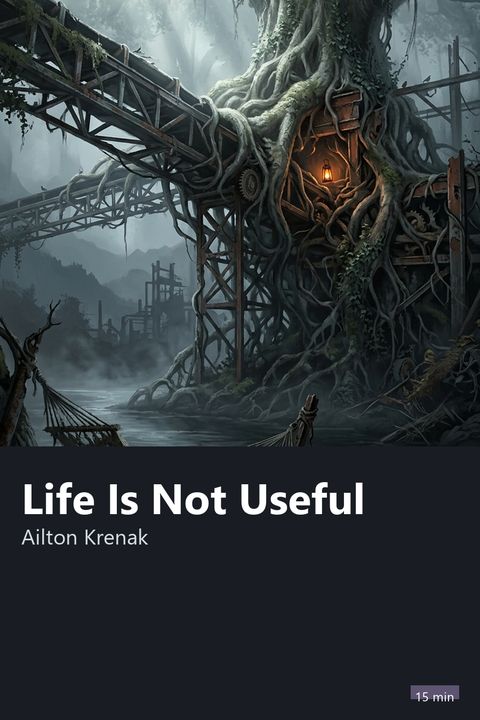
Cover of Life Is Not Useful

Philosophy · 15 min

Life Is Not Useful

Ailton Krenak · 2020

Who it's for

For you if you're tired of measuring every hour by what it produces and want to hear an Indigenous voice question all that rushing. This short book grew out of conversations, and you'll get more from it by reading slowly and discussing it with someone.

Read it in the app

⚡ Free to download • 🎁 One full book free every day

🎧 Listen to this summary in the app

Every summary has audio narration. Open the app to read it or listen to it.

3 ideas to take with you

1

For Krenak, an economy that puts itself before people reverses the relationship between who serves whom.

2

According to the book, the desire to keep consuming often comes from people who have only recently gained access to consumer goods, and deserves to be heard before being judged.

3

Imagining another future becomes harder when we've lost the habit of dreaming together and sharing what we've dreamed.

“
Resting without guilt is a way to remember that life doesn't need to justify itself through results.
An idea from Life Is Not Useful, in the words of 15 Minutes

Preview

Start reading now

A Book Built from Conversations

Life Is Not Useful wasn't written as a treatise. It brings together remarks by Ailton Krenak from interviews and lectures, organized into five chapters by writer Rita Carelli. The text preserves the rhythm of someone thinking out loud, with detours, stories, and digressions, and that's part of the point.

Krenak comes from a tradition in which knowledge passes through the spoken word, from person to person. That's why the book doesn't present a sequence of arguments like a handbook. It invites you to listen, let the images do their work, and draw your own conclusions.

The author himself warns that he doesn't want to offer self-help advice. His intention is more of a wake-up call: to make us recognize a way of living he considers dangerous. Keep that in mind as you read, rather than expecting a list of steps.


What It Means for Life Not to Be Useful

The title is a provocation. We live in a culture that measures everything by utility: time has to pay off, people have to produce, and life has to serve some purpose. Krenak pushes back against this idea, saying life can't be reduced to a tool, because it's an experience to be lived, not a means to something else.

For him, life is enjoyment, and the image he uses is a cosmic dance. Dancing isn't useful for anything beyond the pleasure of dancing itself, and that's precisely where its value lies. Trying to fit existence into a choreography of results, in his view, makes it poorer.

In everyday life, this idea speaks to anyone who spends Sunday thinking about Monday, feels guilty about resting, or measures their life by what they've managed to deliver. The book asks: what if the simple fact of being alive were reason enough?

You Can't Eat Money

The first chapter starts with a simple statement that also gives it its title: you can't eat money. The idea is to remind us that what truly sustains life is land, water, food, and connection with others. Money is a human convention, useful but dependent on those foundations.

The author criticizes an economy that places itself above people. When we say the economy can't stop, that reasoning turns things upside down by treating people as components of the system. The economy should serve life, not the other way around.

This theme becomes concrete when we look at decisions about development. When a mining company or a major construction project is justified by jobs and tax revenue, the book invites us to ask what is lost in rivers, mountains, and communities, and whether that accounting is being done honestly.

10 more sections and the quiz

Continue in the app

Read the whole summary, finish with the Life Is Not Useful quiz and follow the guided Journeys. No ads in the app.

About Ailton Krenak

Ailton Krenak was born in 1953 in the Doce River Valley region of Minas Gerais, Brazil, and belongs to the Krenak people. He is a writer, journalist, environmentalist, and leader in the Indigenous movement. In 1987, he addressed the National Constituent Assembly in Brasília, painting his face with genipap dye in defense of Indigenous rights. His books include Ideas to Postpone the End of the World, published in 2019, and Ancestral Future, published in 2022.

Explore

Category:
Philosophy