15 Minutes
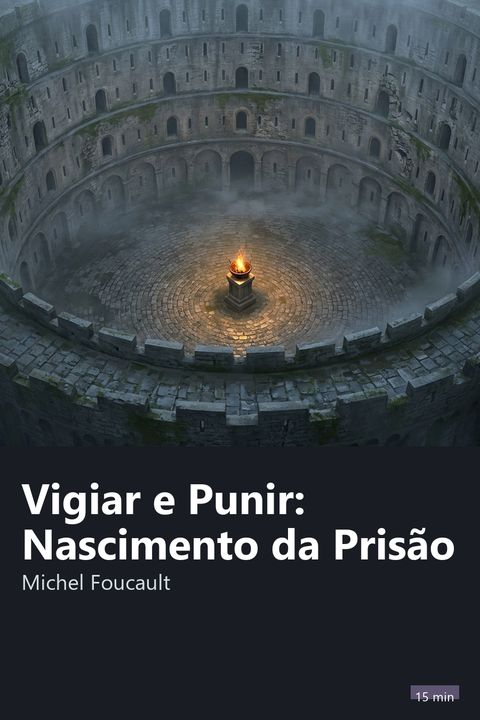
Cover of Discipline and Punish: The Birth of the Prison

Philosophy · 15 min

Discipline and Punish: The Birth of the Prison

Michel Foucault · 1975

Who it's for

For anyone who has ever felt that school, work, and even your smartphone shape your behavior without ever having to raise their voice, and wants to understand where that logic comes from. It is a dense classic that truly comes alive when read through the lens of everyday life.

Read it in the app

⚡ Free to download • 🎁 One full book free every day

3 ideas to take with you

1

Punishing less in public and more on a daily basis can reach far more people than an occasional grand spectacle.

2

A prison system that fails to rehabilitate anyone can be seen, through the book's lens, as a useful tool of social control rather than a simple failure.

3

When you constantly measure and compare someone, you end up defining who they are, not just what they did.

“
Once you start policing yourself, the guard can pack up and leave.
An idea from Discipline and Punish: The Birth of the Prison, in the words of 15 Minutes

Preview

Start reading now

A Quartered Body and a Daily Timetable

The book opens with two scenes that seem to belong to entirely different worlds. In the first, set in Paris in 1757, a man convicted of attempting to kill the king is tortured in a public square for hours until his body is torn apart before a crowd. In the second, less than a century later, we see the daily timetable of a juvenile detention facility: time to wake up, time to pray, time to work, time to stay silent.

Foucault uses this contrast as a hook. The question he poses is not 'how did humanity become kinder,' but rather: what shifted in the way power reaches people? Punishment moved away from the body suffering in public and entered a tightly timed routine, hidden far from the eyes of the city.

The rest of the book tries to unpack this turning point. And the answer is unsettling, because it suggests that the modern prison was not born out of pure compassion, but from a brand-new technique for governing people.

Public Torture as Theater of Power

In the old model, punishing was a political ritual. When someone broke the law, it was understood as a direct injury to the sovereign himself, and public torture was his response: a calculated spectacle designed to show who was in charge. The suffering was not gratuitous excess; it was a language, governed by rules about how much pain to inflict, in what order, and for how long.

The crowd was an essential part of the play. People watched, learned to fear, and confirmed through their presence that sovereign power was real. Think of a public execution as a kind of violent political rally, where the state asserts itself by displaying exactly what it can do to a human body.

That system, however, had a hidden flaw: it relied on the crowd siding with the executioner. Whenever the spectators turned against him, the whole theatrical performance became a dangerous risk for the ones staging it.

Why the Spectacle Stopped Working

According to accounts from that era, public executions increasingly sparked riots. The condemned prisoner was sometimes treated like a folk hero, the executioner was cast as the villain, and a celebration of state power could quickly spiral into rebellion. At the same time, Enlightenment thinkers began advocating for milder penalties that were proportional to the crime.

The standard version of history credits this shift to pure humanitarianism. Foucault does not deny the rise of new sensibilities, but he sees something else underneath: a drive to punish with greater consistency and less public scandal. Punishment needed to be certain, predictable, and distributed across the whole social fabric, rather than rare and savage.

In other words, the goal became punishing better, not necessarily punishing less. A penalty that is less cruel but far more constant reaches significantly more people than an occasional grand spectacle.

11 more sections and the quiz

Continue in the app

Read the whole summary, finish with the Discipline and Punish: The Birth of the Prison quiz and follow the guided Journeys. No ads in the app.

About Michel Foucault

Michel Foucault was born in Poitiers, France, in 1926, and died in Paris in 1984. He was a philosopher and historian of ideas who held the chair in the History of Systems of Thought at the Collège de France starting in 1970. Among his best-known works are Madness and Civilization and The Order of Things. Discipline and Punish was published in 1975.

Explore

Category:
Philosophy