15 Minutes
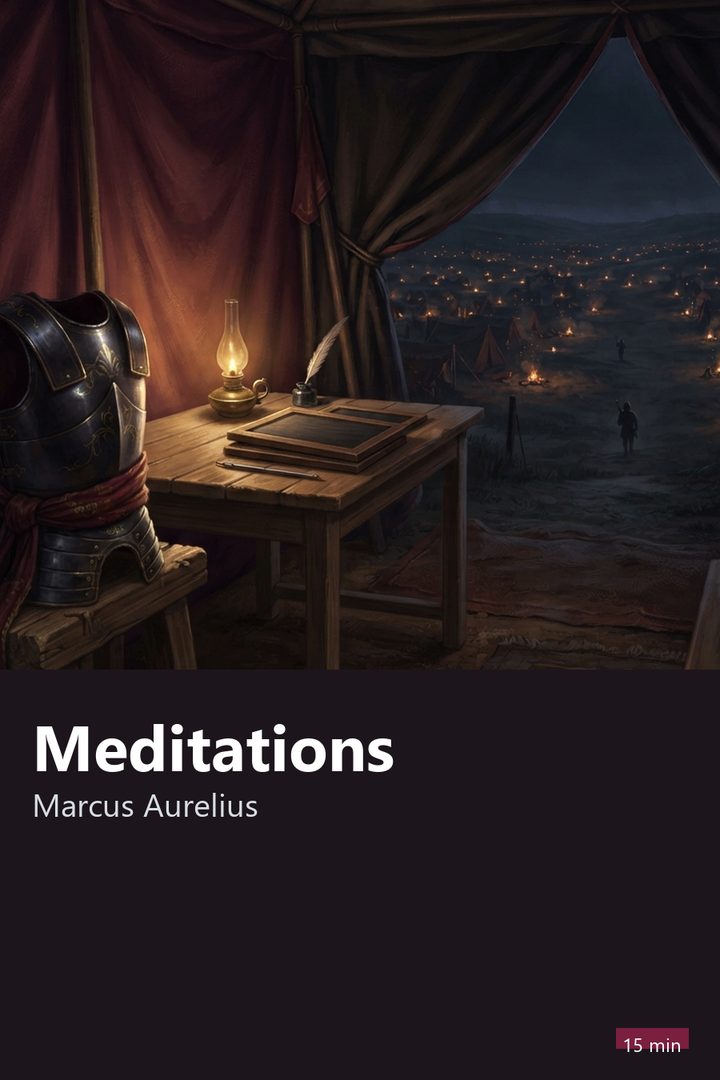
Cover of Meditations

Philosophy · 14 min

Meditations

Marcus Aurelius · 180

Who it's for

For anyone carrying heavy responsibility, at home, at work, or on a team, who feels the weight of deciding alone even when exhausted. Meditations is the notebook of a man who tried, almost every day, to be fairer and less reactive with the power he held in his hands.

Read it in the app

⚡ Free to download • 🎁 One full book free every day

🎧 Audio coming soon in the app

Narration for the English summaries is on its way. Meanwhile you can read the full summary in the app.

3 ideas to take with you

1

According to Marcus Aurelius himself, it was his teacher Rusticus who lent him the lessons of Epictetus: a book lent at the right moment can redirect an entire life.

2

Marcus Aurelius's comparison with the bee and the ant is not meant to put humans down: it is a reminder that creatures with no ability to choose fulfill their function without hesitating, while we, who can choose, tend to be the ones who procrastinate the most.

3

Marcus Aurelius wrote reminders to keep his office from changing who he was inside, proof that even someone with nearly absolute power needs constant discipline so as not to become a worse person.

“
Marcus Aurelius opens the book by thanking, one by one, those who taught him something: a reminder that no one is formed alone.
An idea from Meditations, in the words of 15 Minutes

Preview

Start reading now

A journal that was never meant to become a book

Marcus Aurelius did not sit down to write a self-help book. He was emperor of Rome from 161 to 180 and spent much of the last years of his reign camped on the empire's borders, near the Danube River, commanding troops against the Marcomanni and other Germanic peoples. On nights in the military camp, he wrote a notebook in Greek, just for himself.

The original Greek title means something like "to himself": he was not addressing a reader, he was correcting himself. The notebook has twelve parts, with no neat chapters and no argument stitched together from start to finish. It is made of loose sentences, repeated in different ways, the kind we write to remind ourselves of something we already know but keep forgetting in practice.

The text survived only by chance, copied by hand by monks throughout the Middle Ages, and it only got the name Meditations and became a printed book many centuries after the author's death. Reading it is like opening someone's diary, with all the rawness and repetition that implies, not a polished manual written to sell.

The first book is a gratitude list

Before any philosophical reflection, Book 1 of Meditations is an almost bureaucratic list of thank-yous. Marcus Aurelius names person after person, grandfather, father, mother, teachers, and notes exactly what he learned from each: from his grandfather Verus, courteous treatment of people; from the memory of his father, modesty and manliness without showing off; from his mother, simple devotion and distance from luxury.

It is a moral inventory, almost an accounting before he starts holding himself to account in the rest of the notebook. He mentions that he had private tutors at home because of his family's position, which spared him from attending a poor-quality public school, a privilege he acknowledges as such, without pretending he got there on his own.

It is worth noticing the gesture: before writing about virtue, he credits those who shaped his character. No idea in this book appears out of nowhere; each one comes from someone he names with care.

The teacher who introduced Epictetus

Among the acknowledgments in Book 1 is a name that changes the rest of the story: Rusticus, his philosophy teacher. It was Rusticus who lent Marcus Aurelius the notes of Epictetus, a former slave who became one of the main teachers of Stoicism. From then on, the young heir to the throne began studying this school of thought seriously.

Marcus Aurelius also credits Rusticus with another, harder lesson: not to write showy texts just to impress an audience, and not to be the kind of person who makes peace too quickly just to avoid discomfort in an argument. These are lessons of character, not of rhetoric.

It is interesting that the most powerful emperor of the ancient world learned his philosophy of life from the thinking of a man born a slave. Stoicism, for Marcus Aurelius, did not come wrapped in status.

10 more sections and the quiz

Continue in the app

Read the whole summary, finish with the Meditations quiz and follow the guided Journeys. No ads in the app.

About Marcus Aurelius

Marcus Aurelius (121 to 180) was emperor of Rome from 161 to 180, sharing the throne with Lucius Verus until 169. Adopted by Antoninus Pius as part of a succession plan organized by Emperor Hadrian, he ruled through years of continuous war on the Danube frontier and during a pandemic that struck much of the empire. He wrote Meditations in Greek, with no intention of publishing it, mainly during military campaigns, and he is considered one of the central names of Roman Stoicism, alongside Seneca and Epictetus. He was succeeded by his son Commodus.

Explore

Category:
Philosophy
Part of the Journeys:
Stoicism in Practice