15 Minutes
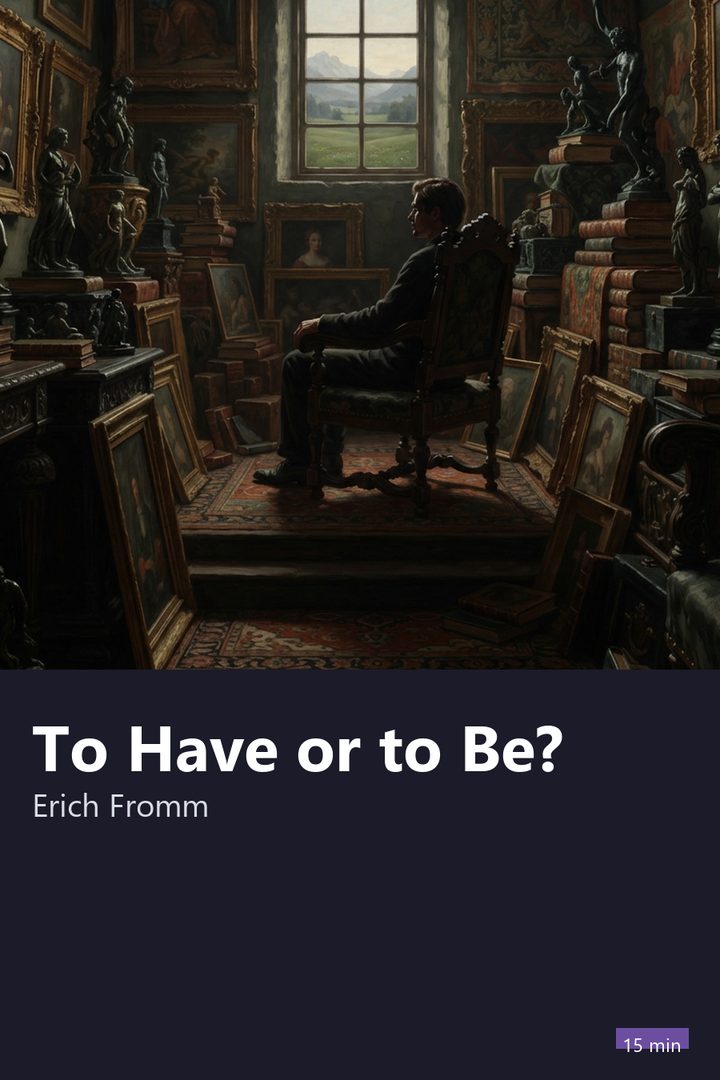
Cover of To Have or to Be?

Philosophy · 15 min

To Have or to Be?

Erich Fromm · 1976

Who it's for

For anyone who feels like they are constantly chasing things and accomplishments yet still feels empty inside. It is also great for anyone wanting to examine the relationship between consumerism, identity, and well-being.

Read it in the app

⚡ Free to download • 🎁 One full book free every day

🎧 Audio coming soon in the app

Narration for the English summaries is on its way. Meanwhile you can read the full summary in the app.

3 ideas to take with you

1

True learning changes how you view the world, and writing down everything does not guarantee that.

2

The promise that consuming more brings more happiness deserves to be tested against your own personal experience.

3

Asking yourself how you would feel if you lost something you are proud of reveals where your self-worth truly lies.

“
Saying 'I have a worry' turns it into an object, while 'I am worried' restores the movement of real life.
An idea from To Have or to Be?, in the words of 15 Minutes

Preview

Start reading now

Two Modes of Existence

Erich Fromm starts with a simple, uncomfortable question: do you relate to the world through what you have or through what you are? For him, these are two distinct modes of existence. In the having mode, life revolves around possessing things, people, knowledge, and even one's own image. In the being mode, what matters is living actively and being truly present.

The book does not treat this as a matter of wealth. You can be wealthy and live in the being mode, and you can be poor and spend your entire day obsessed with possession. The difference lies in attitude: using the world as an inventory to store up or as an experience to be lived.

Fromm wrote in 1976, at the height of mass consumerism, convinced that industrial society was pushing everyone toward having. His core thesis is that this leaves us anxious, empty, and dependent on what we accumulate, and that another path exists.
What Language Reveals

One of the author's key clues lies in how we speak. We say 'I have a problem,' 'I have insomnia,' 'I have a relationship,' as if everything were an object kept in a drawer. Instead of speaking about an experience, we talk about a thing we own.

For Fromm, this shift in verbs reveals a way of thinking. When I turn an emotion into a commodity, I start managing a possession rather than living through a process. Saying 'I am worried' describes something in motion. Saying 'I have a worry' turns it into an object I can lock away or project onto someone else.

Look at everyday expressions where we talk about 'having' a home, 'having' a steady job, or 'having' a car paid off. These are completely legitimate accomplishments, and the book does not ask us to disregard them. It simply asks us to notice when our entire identity begins to depend on them.

Learning: Storing Away or Being Transformed

Fromm compares two ways of attending a lecture. In the having mode, the student writes down everything, memorizes it, and stores the information just to repeat it on an exam. They leave the room with the exact same perspective they walked in with, just with more notes in their binder.

In the being mode, they listen, ask questions, disagree, feel challenged, and leave thinking differently. The material connects directly with their life and shifts how they view the subject. The lecture happens inside them, not just on the page.

This contrast applies equally to online courses we buy and never finish, diplomas hung on the wall, and stacks of books meant for display. Accumulating knowledge as an asset is fundamentally different from being transformed by it.

Fromm points out that schools tend to reward the first mode, relying on memory tests and treating grades as currency. Not surprisingly, many people finish school without any curiosity left and spend the rest of their lives avoiding books. A teacher who provokes genuine questioning, on the other hand, plants a seed that keeps growing for years.

11 more sections and the quiz

Continue in the app

Read the whole summary, finish with the To Have or to Be? quiz and follow the guided Journeys. No ads in the app.

About Erich Fromm

Erich Fromm was born in Germany in 1900 and was a psychoanalyst and social psychologist associated with the Frankfurt Institute for Social Research. He moved to the United States in the 1930s and later lived in Mexico. He wrote works such as Escape from Freedom in 1941 and The Art of Loving in 1956. To Have or to Be? was published in 1976 as one of his last major books, and he passed away in 1980.

Explore

Category:
Philosophy
Part of the Journeys:
Philosophy for Today