15 Minutes
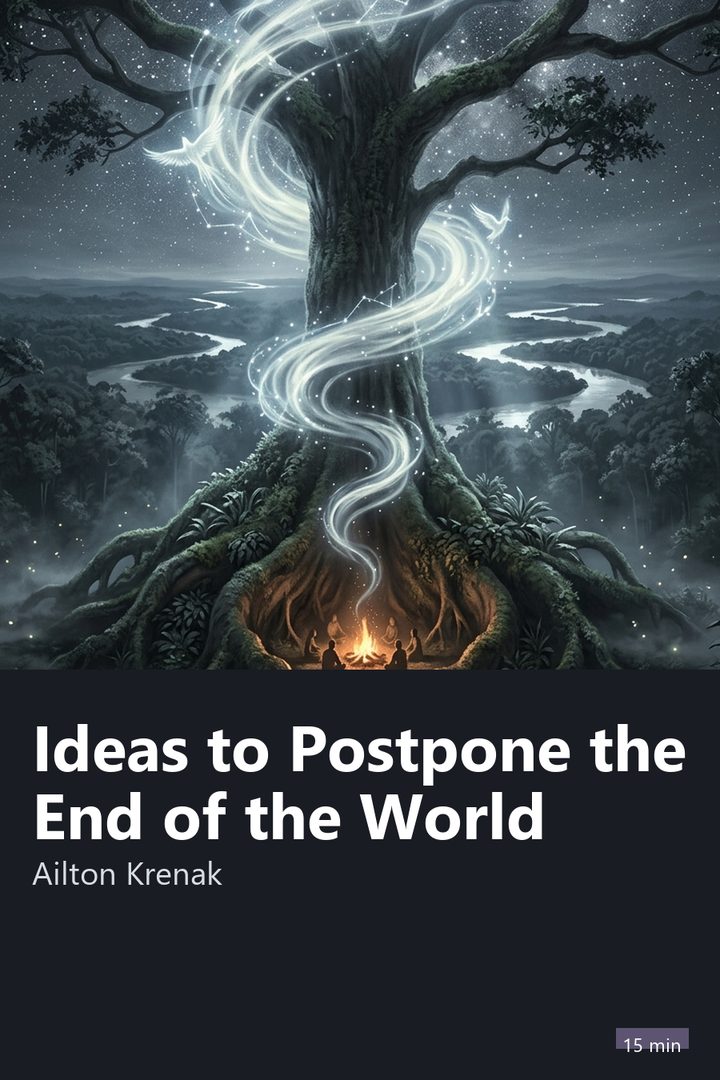
Cover of Ideas to Postpone the End of the World

Philosophy · 17 min

Ideas to Postpone the End of the World

Ailton Krenak · 2019

Who it's for

For anyone feeling the weight of the daily grind who wants to rethink the relationship between lifestyle, consumption, and nature through the voice of Indigenous peoples. It is a powerful reflection for readers looking to slow down and understand the climate crisis beyond conventional economic solutions.

Read it in the app

⚡ Free to download • 🎁 One full book free every day

🎧 Audio coming soon in the app

Narration for the English summaries is on its way. Meanwhile you can read the full summary in the app.

3 ideas to take with you

1

Treating rivers and forests as disposable commodities stems from the illusion that human society can exist detached from the living organism of the Earth.

2

In the view presented by Krenak, dreaming serves as a space for collective reflection and learning, rather than mere mechanical rest so the body can go back to producing.

3

Indigenous peoples have faced the shattering of their worlds for centuries, accumulating a practical wisdom of resistance that modern cities routinely overlook.

“
Reducing the meaning of life to the act of buying turns citizens into exhausted consumers who destroy their own soil to sustain consumption.
An idea from Ideas to Postpone the End of the World, in the words of 15 Minutes

Preview

Start reading now

The myth of a single humanity separate from the planet

Every time the news talks about saving humanity, it is worth asking who exactly they are talking about. Ailton Krenak points out that Western thought invented humanity as an exclusive club, restricted to those who consume and live by the rules of the urban market. This group came to see itself as the pinnacle of creation, separate from nature, treating the Earth as a stage for its whims.

This division gave rise to anthropocentrism, an attitude in which rivers and forests lose their intrinsic value and become disposable raw material. By pulling away from the living web in which all species coexist, our society digs an abyss that threatens life itself in this age of the Anthropocene.

In everyday urban life, this estrangement is obvious. Anyone spending hours on a crowded bus between the outskirts of town and work barely sets foot on fertile soil, surrounded instead by asphalt. That routine reinforces the illusion that food sprouts on supermarket shelves and water is born in the faucet, erasing our dependence on natural cycles.
The transformation of citizens into compulsive consumers

The contemporary machine validates people by how much they produce and spend. Anyone without a good credit score or a steady formal job ends up pushed to the margins of social invisibility. Krenak denounces how the economy has stripped community life of its intrinsic dignity, replacing the concept of the full citizen with the figure of the voracious consumer.

To feed this insatiable machine, unchecked extractivism tears open mountain ranges in search of ore, burns forests, and drains entire watersheds. The goal is not to meet basic needs, but to manufacture artificial scarcities around the clock, generating short-lived goods that turn into trash within a few weeks.

Everyday workers know this cycle firsthand when they buy things on credit in monthly installments just to keep up an artificial standard of living. The commodification of every minute turns rest time into anxiety over productivity, hollowing out warm human connection in exchange for disposable objects.

The Doce River disaster and the poisoned relative

In 2015, the collapse of the Mariana dam dumped millions of cubic meters of toxic mud into the Doce River basin. For government authorities and mining companies, the tragedy was handled in accounting terms: financial losses, environmental fines, and a water resource temporarily suspended for industries and the sanitation systems of neighboring towns.

For the Krenak people, who live along the banks of this waterway and call it Watu, the impact was something else entirely. Watu was never a mere utilitarian channel; he is a revered ancestor, a loving grandfather who taught generations how to fish and dream. The mud represented the criminal poisoning of a living relative, who fell into a coma right before his people's eyes.

This contrast reveals the author's critique. When nature is felt as family, pollution stops being a risk calculation and becomes a moral assault. As long as cities treat waters as tradable inventories, ecological disasters will be seen merely as operating costs calculated on spreadsheets.

11 more sections and the quiz

Continue in the app

Read the whole summary, finish with the Ideas to Postpone the End of the World quiz and follow the guided Journeys. No ads in the app.

About Ailton Krenak

Ailton Krenak is a writer, journalist, philosopher, and one of the most respected Indigenous leaders in Brazil, belonging to the Krenak people of the Doce River valley in the state of Minas Gerais. He gained national prominence in 1987 during the Constituent Assembly when he painted his face with black genipap dye while addressing Congress in defense of Indigenous rights. In 2023, he became the first Indigenous author elected to the Brazilian Academy of Letters. He has also published other widely acclaimed works of contemporary thought, including Life Is Not Useful and Ancestral Future.

Explore

Category:
Philosophy
Part of the Journeys:
Thinking Brazil