15 Minutes
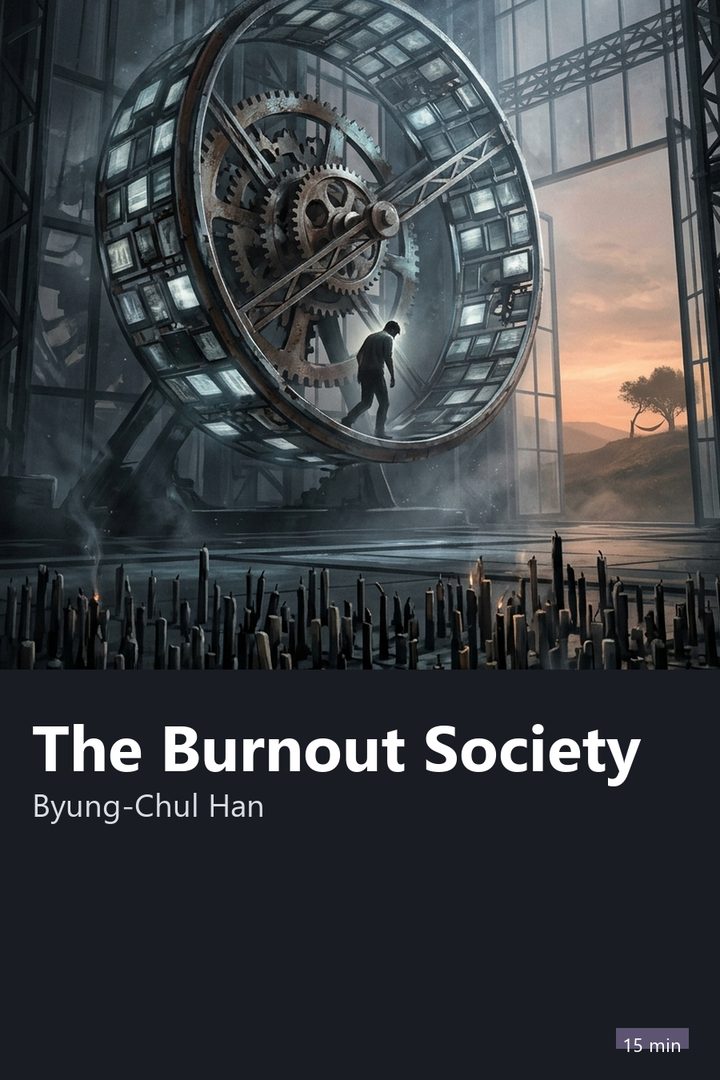
Cover of The Burnout Society

Philosophy · 18 min

The Burnout Society

Byung-Chul Han · 2010

Who it's for

For anyone who feels overwhelmed by workplace demands and guilty whenever they try to rest without being productive. It is an essential reflection on how the relentless pursuit of productivity sickens the mind and fractures our social bonds.

Read it in the app

⚡ Free to download • 🎁 One full book free every day

🎧 Audio coming soon in the app

Narration for the English summaries is on its way. Meanwhile you can read the full summary in the app.

3 ideas to take with you

1

The most exhausting pressure in modern life rarely comes from orders handed down from above, but from the deep-seated inner conviction that we must constantly produce more.

2

Trying to juggle multiple tasks at once does not make you smarter; it merely splinters concentration into shallow slivers of divided attention.

3

Rest only truly restores the spirit when it stops being a mere pit stop to recharge for more work and becomes valuable in its own right.

“
Anyone who believes they work solely for themselves runs the risk of becoming the most ruthless boss they have ever faced.
An idea from The Burnout Society, in the words of 15 Minutes

Preview

Start reading now

The Exhaustion That Does Not Come from Manual Labor

If you end the week feeling like you ran a marathon even though you never lifted anything heavy, that fatigue is not in your head. In the past, tiredness came from physical labor in fields or factories, and a solid night of sleep restored your strength. Today, exhaustion strikes people who spend all day staring at screens, answering urgent pings, and toggling between computer windows.

This mental fatigue does not vanish over the weekend. You ride a crowded bus home, walk through your front door, and keep checking work messages on your phone. There is a persistent sense that any moment of quiet or downtime is wasted time, turning rest into a source of anxiety and guilt.
From Forbidden Rules to Boundless Capability

In the twentieth century, life was structured around what Michel Foucault called the disciplinary society. This system operated through rigid rules and surveillance in schools, barracks, factories, and hospitals. Disciplinary subjects were shaped by duty: they knew what was forbidden, obeyed under threat of punishment, and found relief when the workday ended, since authority stayed behind at the company gates.

Byung-Chul Han argues that this model has been supplanted by the achievement society. Here, the dominant modal verb is 'can' rather than 'should': the relentless message is that you can do anything as long as you take initiative and stay focused. Social media feeds amplify the mantra that the only real limits are the ones inside your head.

Trading discipline for capability sounds liberating. Yet duty comes with clear boundaries, whereas capability knows no limits. When you believe you can always achieve more, no milestone ever feels like enough, and internal pressure turns into endless torment.

The Boss Inside Your Own Head

The breakthrough insight of The Burnout Society lies in explaining how the figure of the exploiter has changed. In the traditional factory, demands came from the outside: a foreman or a time clock watched every minute. Faced with that external authority, workers could organize, negotiate collectively, go on strike, and clearly separate their jobs from their personal lives.

In today's landscape, hetero-exploitation gives way to self-exploitation. Workers operate as independent contractors, rideshare drivers, or freelancers who view themselves as entrepreneurs of the self. They believe they are exercising absolute freedom, yet they work past midnight, give up their days off, and log hours on Sundays entirely by choice.

The self-exploiting subject becomes both victim and tormentor at once. When missing a deadline, individuals blame their own supposed inadequacy rather than questioning the system. This dynamic erases any face-to-face clash with bosses, making rebellion nearly impossible, since no one easily revolts against their own self-imposed demands.

11 more sections and the quiz

Continue in the app

Read the whole summary, finish with the The Burnout Society quiz and follow the guided Journeys. No ads in the app.

About Byung-Chul Han

Byung-Chul Han is a South Korean-born philosopher and essayist based in Germany, where he studied philosophy, German literature, and Catholic theology at the universities of Freiburg and Munich. He taught philosophy and cultural studies at the Berlin University of the Arts and gained international acclaim for his analyses of how speed and technology reshape contemporary life. Among his major works published in dozens of languages are The Agony of Eros, In the Swarm, and The Transparency Society.

Explore

Category:
Philosophy
Part of the Journeys:
Philosophy for Today