15 Minutes
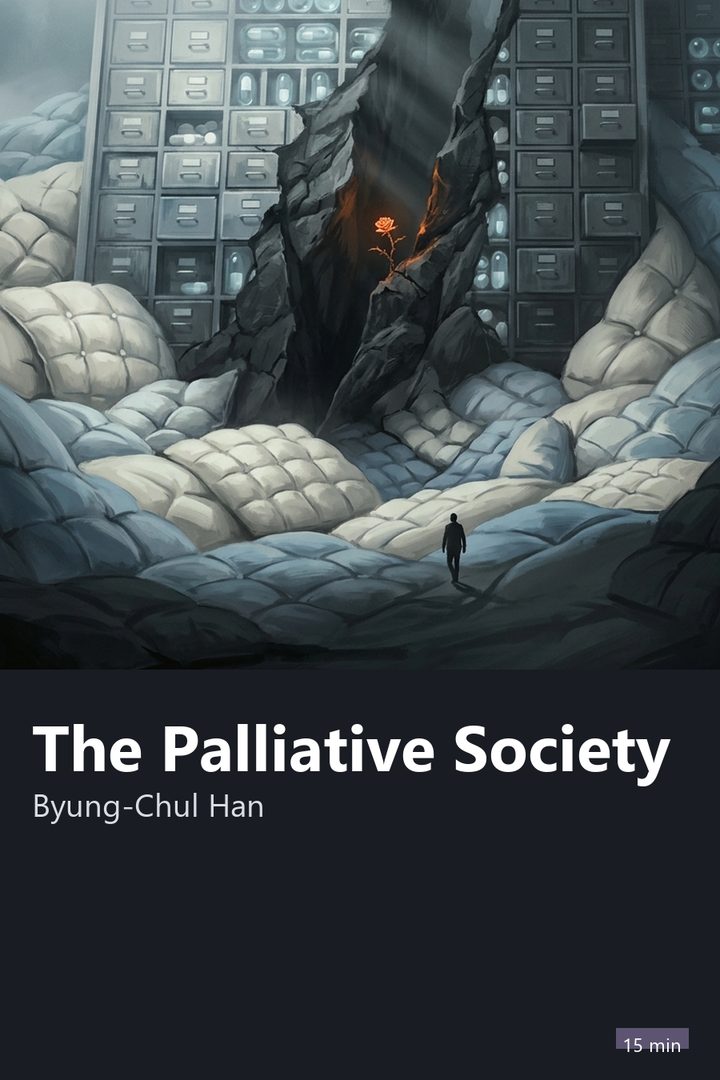
Cover of The Palliative Society

Philosophy · 18 min

The Palliative Society

Byung-Chul Han · 2020

Who it's for

For anyone who feels the daily pressure to always be happy and productive, yet senses that faking wellness takes a heavy toll on mental health. It is a sharp reflection on how our refusal to accept pain sickens our social bonds and hollows out our ability to grow through hardship.

Read it in the app

⚡ Free to download • 🎁 One full book free every day

🎧 Audio coming soon in the app

Narration for the English summaries is on its way. Meanwhile you can read the full summary in the app.

3 ideas to take with you

1

By turning optimism into a moral obligation, positivity culture makes anyone going through a hard time carry the blame for their own suffering.

2

Treating daily distress solely with pills relieves the immediate symptom, but hides the exhausting routine and social pressures that caused the burnout in the first place.

3

Those who flee from any emotional discomfort end up accumulating shallow experiences, since real maturity requires walking through difficult situations.

“
Governments that manage only immediate comfort avoid tough disputes, but fail to tackle essential reforms for society.
An idea from The Palliative Society, in the words of 15 Minutes

Preview

Start reading now

The modern dread of feeling any discomfort

At the slightest sign of a headache during the workday, your hand goes straight to your desk drawer or pocket for a bottle of pills. We cannot stand waiting twenty minutes for the body to recover on its own. This everyday habit exposes a deep cultural shift: we have developed a genuine algophobia, an outsized dread of experiencing any discomfort or friction in our routine. No unease is tolerated; everything must be silenced with maximum urgency.

In major cities, between the crush of the subway commute home and the roar of traffic, feeling unwell has become an unacceptable anomaly. Byung-Chul Han shows that physical pain is no longer understood as a biological warning sign and has instead become a defect harmful to productivity, fueling a constant quest for quick relief at any cost.

By trying to shield daily life against any friction, we create an overly protected yet impoverished existence. The systematic refusal of discomfort makes us fragile in the face of the first setback, unable to cope with the normal frustrations of real life.


The obligation to be happy at any cost

Just open social media during your lunch break and you will find an endless stream of flawless smiles and motivational quotes. The imperative of positivity has turned well-being into a non-negotiable moral duty, forbidding legitimate sadness and honest venting from anyone dealing with packed commutes and a tight paycheck.

This pressure privatizes anguish: if you wake up feeling discouraged, the influencer playbook says your lack of gratitude is to blame. Instead of talking over the crushing workload at a bar with coworkers, the worker shuts down in guilt, believing that suffering stems solely from personal weakness. The exhaustion of daily life stops being a social problem and becomes an individual shame.

This exaggerated positivity acts as a gag on reality. It prevents collective discontent and bans honest grief, forcing people to maintain a radiant facade while quietly falling ill behind their screens.

Pain that has lost its story

In the past, human suffering found safe shelter in myths, rituals, and community narratives. The pain of loss and manual labor carried a shared symbolic purpose: it taught humility, built character, and marked the passage into maturity within the community. Hardships were part of the journey of any respectable person.

Today, that shared horizon has collapsed. Pain has been downgraded to a simple mechanical breakdown in our biological machinery. When the body locks up from burnout, we look only for an immediate palliative fix to silence the alarm and hurry back to the grind, leaving the individual helpless in the face of grief, old age, and personal limits.

When pain no longer fits into a meaningful narrative, it becomes intolerable because it seems entirely useless. Without a language to hold loss, the modern individual grows terrified of their own mortality and seeks refuge in the frantic consumption of novelty.

11 more sections and the quiz

Continue in the app

Read the whole summary, finish with the The Palliative Society quiz and follow the guided Journeys. No ads in the app.

About Byung-Chul Han

Byung-Chul Han is a South Korean-born philosopher and essayist based in Germany, educated in philosophy, German literature, and Catholic theology at the universities of Freiburg and Munich. He served as a professor of philosophy and cultural studies at the Berlin University of the Arts and became one of the most widely read contemporary thinkers on the planet by analyzing the ills of modern society. Among his most influential works are The Burnout Society, The Agony of Eros, and The Transparency Society.

Explore

Category:
Philosophy
Part of the Journeys:
Stoicism in Practice