15 Minutes
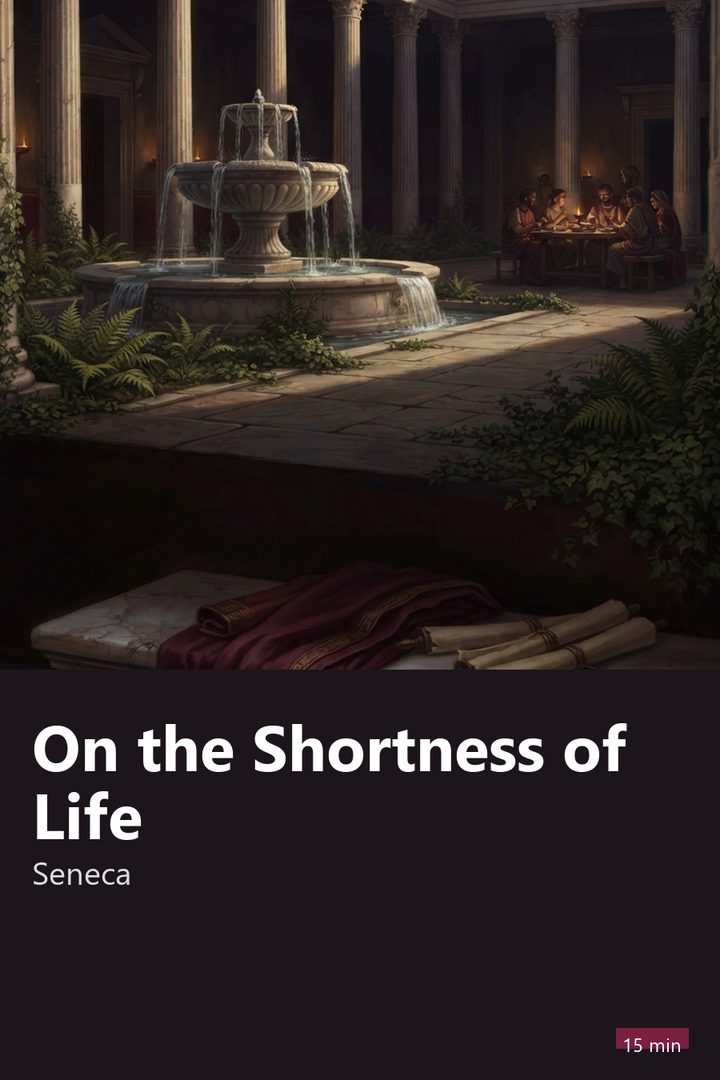
Cover of On the Shortness of Life

Philosophy · 15 min

On the Shortness of Life

Seneca · 49

Who it's for

For anyone who keeps saying they have no time for anything and feels life slipping away between meetings, traffic, and the phone screen. Seneca wrote this text almost two thousand years ago to shake up exactly the people who take pride in always being busy.

Read it in the app

⚡ Free to download • 🎁 One full book free every day

🎧 Audio coming soon in the app

Narration for the English summaries is on its way. Meanwhile you can read the full summary in the app.

3 ideas to take with you

1

We argue over restaurant change and waste an entire afternoon without a second thought, because we treat money as scarce and time as if it were unlimited.

2

For Seneca, a well-lived past is the only part of time that no one can ever take from you, because it has already happened and is secure.

3

According to the book, existing for eighty years busy on autopilot yields less life actually lived than a few years spent paying attention to what you do.

“
For Seneca, chasing a packed schedule gives the feeling of living a lot, when in reality it is living little, just in a hurry.
An idea from On the Shortness of Life, in the words of 15 Minutes

Preview

Start reading now

Life isn't short, it's poorly used

Seneca opens the essay by challenging an old complaint, repeated to this day: that life is too short for anything worthwhile. He writes as one of the central names of Roman Stoicism, a philosophy that taught people to spend energy only on what is within the reach of their own will, and he uses that lens to attack the complaint at its root.

His thesis is direct: we are not given too little time, we waste a lot of it. Life, if we know how to use it, is long enough to accomplish what matters. The problem was never the length of the years, it was the careless way of spending each day of them.

The text was written as an epistle, a long letter addressed to Seneca's father-in-law, Paulinus, in a personal and direct tone, almost a conversation between two men who have noticed the same discomfort: people who complain about lack of time while throwing away afternoon after afternoon without noticing.
Who Seneca calls busy

Seneca reserves the word busy for anyone whose days are taken up by something external: money, position, prestige, other people's opinions. It doesn't matter whether the schedule is full of big things or small ones; what defines the busy person is never having a minute that answers only to themselves.

One example he details is the patronage system of ancient Rome: free men who spent the entire morning standing at the door of someone more powerful, waiting to be received, offering praise and flattery in exchange for a favor or a recommendation. For Seneca, this is one of the worst thefts of time there is, because it is voluntary: the person hands over their own hours willingly, with no one needing to force anything.

Today's version swaps the patron's door for the work group chat after hours, or for the readiness to answer the boss at any time just to look available. The address has changed, but the logic of trading your own time for other people's approval stays the same.

Luxury disguised as leisure

Not all free time is, in practice, time truly lived. Seneca mocks people who call themselves idle but spend the day in superfluous rituals: grooming their appearance hair by hair, organizing elaborate banquets, collecting rare objects just to show off to visitors.

He also mentions those who fill their lives with silly lawsuits, fighting for years in court over a property line or a small inheritance, winning the case and losing along the way a huge piece of their own life that never comes back.

The equivalent today is the hour that vanishes scrolling a feed without paying attention to anything, or the group chat argument that changes no one's mind and only leaves everyone tired. It looks like rest, but it occupies the mind just the way real work would.

11 more sections and the quiz

Continue in the app

Read the whole summary, finish with the On the Shortness of Life quiz and follow the guided Journeys. No ads in the app.

About Seneca

Lucius Annaeus Seneca was born around 4 BC in Corduba, in Roman Hispania, and became one of the leading Stoic philosophers in Rome, as well as a playwright and public figure. He was tutor and later adviser to the emperor Nero, spent years in exile on Corsica by order of the emperor Claudius before being called back to Rome, and ended his life forced to take his own life by order of Nero himself, in AD 65. He wrote On the Shortness of Life around AD 49, in the form of a letter addressed to Paulinus, probably his father-in-law.

Explore

Category:
Philosophy
Part of the Journeys:
Stoicism in Practice