15 Minutes
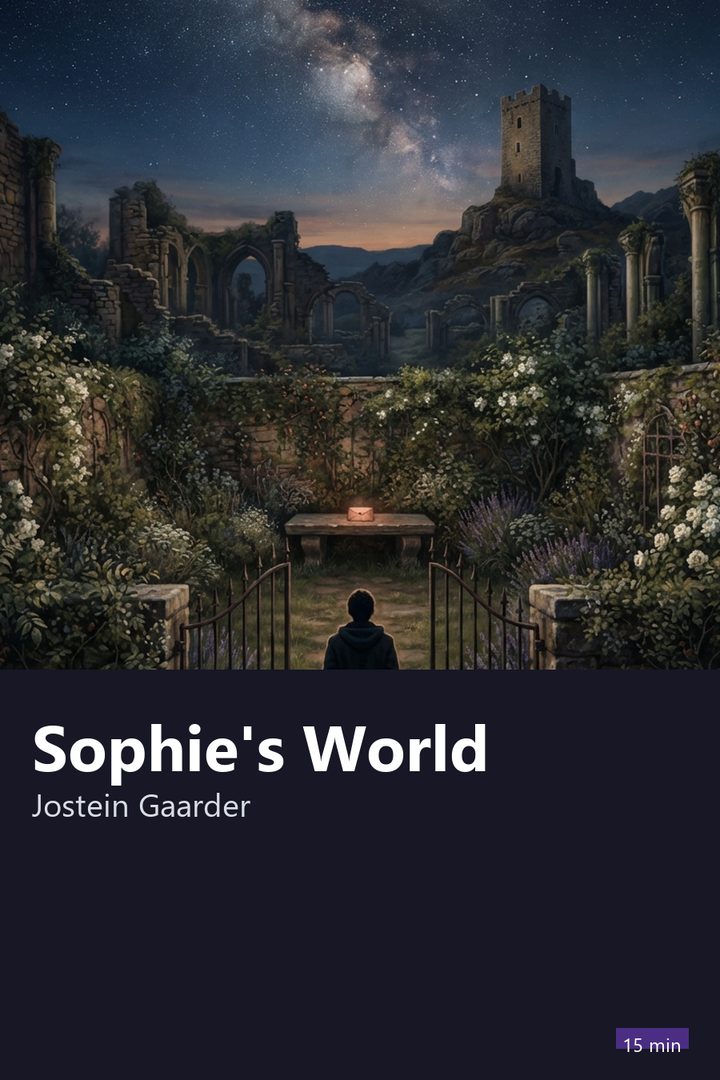
Cover of Sophie's World

Philosophy · 14 min

Sophie's World

Jostein Gaarder · 1991

Who it's for

For anyone who has always been curious about philosophy but figured it was strictly a college subject. Also for people who enjoy a mystery novel and want to understand, in a light way, how Western thought came together.

Read it in the app

⚡ Free to download • 🎁 One full book free every day

🎧 Audio coming soon in the app

Narration for the English summaries is on its way. Meanwhile you can read the full summary in the app.

3 ideas to take with you

1

The allegory of the cave reminds us that what we take for reality may be just the shadow that showed up on the wall, and that looking outside takes courage.

2

Doubting with a method is not giving up on knowing. It's a way of starting to think for yourself, instead of just repeating what you heard.

3

Thinkers like Marx, Darwin and Freud shook up comfortable certainties about wealth, origins and control of the mind, and that usually brings discomfort before it brings a new idea.

“
Asking who you are and where the world comes from is the beginning of philosophy, and you can do it even in line at the bank.
An idea from Sophie's World, in the words of 15 Minutes

Preview

Start reading now

Two Questions in the Mailbox

Sophie Amundsen is fourteen years old and lives in a house in Norway, near a wood. One day she comes home from school, opens the mailbox and finds an envelope with no stamp and no return address. Inside, a short note holds a single question: who are you? She stares at the paper, not knowing what to answer.

The next day another note arrives, with an even bigger question: where does the world come from? The girl, who had never thought about this seriously, starts to find it strange that such basic things go unanswered. It is through these two questions that the book enters philosophy.

Little by little, letters full of ideas begin to arrive, always left in secret. Whoever is writing seems to know Sophie, her house and even the questions she is going to ask. The mystery of the sender is what keeps the story gripping.

Alberto Knox and the Major's Cabin

The sender is Alberto Knox, a middle-aged man, odd and kind, who introduces himself as a philosopher. He sends a correspondence course, then starts meeting the girl in person, in an old cabin near a lake, called the major's cabin. His dog, Hermes, carries the letters to Sophie.

Alberto works like a teacher who speaks plainly, without jargon, and gives everyday examples. When he explains a thinker's ideas, he uses Sophie's room, the garden, a ball, a cup. The fun part is that each lesson comes with a new piece of the mystery.

The relationship between the two is affectionate and a little mischievous. He insists that she think for herself and encourages her to stay amazed by the world. Learning, here, means recovering the ability to ask questions, the way a child does.

Postcards for a Stranger

At the same time, Sophie starts receiving strange postcards from Lebanon, addressed to another girl named Hilde Møller Knag. They are sent by her father, a major serving in a peacekeeping force. The postcards show up in Sophie's mailbox with no explanation, carrying messages that grow more and more intriguing.

Sophie tries to figure out why Hilde's mail ends up at her house. A post office mistake? A coincidence? Or something bigger? The doubts pile up, and she begins investigating who Hilde is, who owns the world behind those cards and what connection exists between the two of them.

It's a very simple suspense device, and it works as the glue of the narrative. While studying the philosophers, the main character also investigates her own existence, and the reader follows both trails at once.

11 more sections and the quiz

Continue in the app

Read the whole summary, finish with the Sophie's World quiz and follow the guided Journeys. No ads in the app.

About Jostein Gaarder

Jostein Gaarder is a Norwegian writer born in 1952. He was a high school philosophy teacher before dedicating himself to literature. He wrote books for young people and adults that blend fiction and reflection, such as The Solitaire Mystery. Sophie's World came out in Norway in 1991, was translated into dozens of languages and became one of the best-selling philosophy novels in the world.

Explore

Category:
Philosophy
Part of the Journeys:
Nietzsche Step by Step