15 Minutes
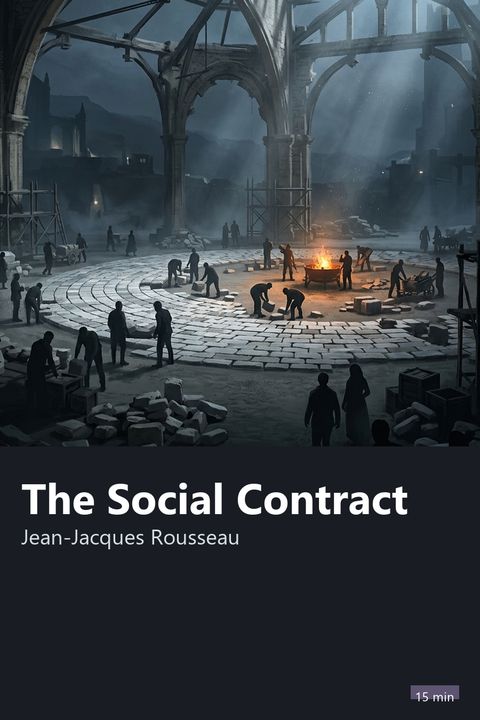
Cover of The Social Contract

Philosophy · 15 min

The Social Contract

Jean-Jacques Rousseau · 1762

Who it's for

For you if you want to understand why we obey laws and what makes a government just. This short classic is ideal for anyone who enjoys politics and debates about freedom and equality.

Read it in the app

⚡ Free to download • 🎁 One full book free every day

🎧 Listen to this summary in the app

Every summary has audio narration. Open the app to read it or listen to it.

3 ideas to take with you

1

According to the book, shared rules can expand freedom when everyone follows them on equal terms, much like a well-run condo community.

2

Freedom that exists only on paper cannot withstand economic dependence, which makes a basic level of equality among citizens part of the pact.

3

A powerful idea of popular sovereignty can be invoked by democrats and by regimes that silence anyone who disagrees.

“
Obedience out of fear is something else: someone who yields only because they are afraid does not recognize the other person as an authority.
An idea from The Social Contract, in the words of 15 Minutes

Preview

Start reading now

The Problem Rousseau Wants to Solve

The Social Contract, published in 1762, opens with a question that still troubles us: if we are all born free, why do we live under rules, laws, and governments? Rousseau does not want to abolish authority. He wants to discover the conditions under which it can be legitimate, meaning genuinely just, rather than simply imposed by whoever has the most power.

The question is how anyone can obey a power without losing their freedom. For him, the answer is not to escape society, which would be impossible, but to build an agreement in which each person ultimately obeys rules they helped create. It is a challenge of political and moral engineering.

The book is short but dense, and organized into four parts. Rousseau writes as both a philosopher and a citizen of Geneva who admired small republics. This summary presents his ideas in simplified form. Remember that this is theory written in the eighteenth century, not a present-day legal handbook.
Might Does Not Make Right

Rousseau begins by challenging two common ideas. The first is that parents' power over their children justifies rulers' power over their subjects. He responds that parental authority ends when children grow up, and that when a government cares for its people like a parent, it should also accept being questioned like one.

The second idea is that whoever has the most force has the right to rule. Rousseau finds this absurd: if obedience lasts only as long as the threat, it is not duty but fear. Someone who obeys an armed robber yields to necessity, without recognizing any moral obligation. Raw power does not become authority simply because it lasts.

Think of a boss who rules through the threat of firing people: employees obey but do not respect the boss. Rousseau's argument is that a government is legitimate only when people accept it by agreement, not through coercion. That agreement needs a structure, and this is where the pact comes in.

The Pact: When Each Person Joins with Everyone

The heart of the book is the social contract. Rousseau imagines a moment, more logical than historical, when free individuals decide to form a political community. Each person gives all their rights to the community on equal terms and, in return, becomes part of the collective body.

At first glance, this looks like a total loss, but the author argues that it is a gain. Since everyone gives everything equally, no one occupies a superior position. And since each person submits to the whole, rather than to one particular person, no one depends on another individual's will. Natural freedom gives way to civil freedom, protected by laws.

It is like a well-run condo community: you give up making noise at two in the morning, but gain the right to sleep peacefully. Shared rules restrict each person while freeing everyone from the rule of the strongest. The idea is that life in society, when properly organized, expands freedom rather than reducing it.

10 more sections and the quiz

Continue in the app

Read the whole summary, finish with the The Social Contract quiz and follow the guided Journeys. No ads in the app.

About Jean-Jacques Rousseau

Jean-Jacques Rousseau was born in Geneva in 1712 and spent much of his life in France. A philosopher, writer, and composer, he belonged to the circle of Enlightenment thinkers, although he broke with several of them. His works include Emile, Julie, or the New Heloise, and Confessions. He died near Paris in 1778.

Explore

Category:
Philosophy