15 Minutes
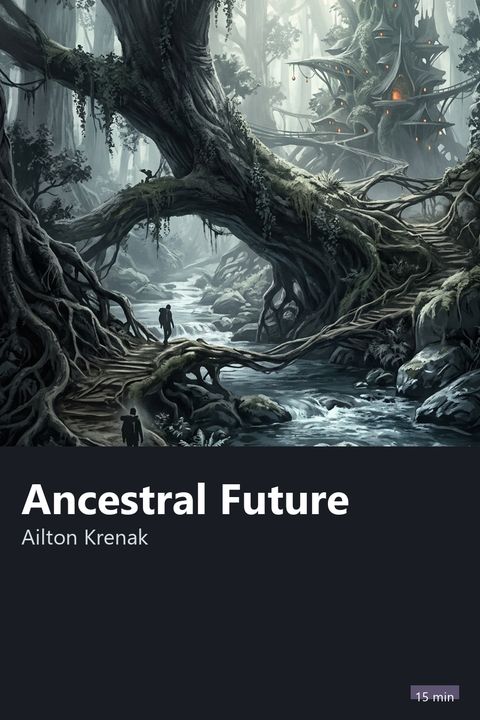
Cover of Ancestral Future

Philosophy · 15 min

Ancestral Future

Ailton Krenak · 2022

Who it's for

For you if you want to hear an Indigenous voice talking about rivers, cities, education, and the future in a short, accessible book. It suits readers open to reflections expressed through images rather than arguments laid out step by step.

Read it in the app

⚡ Free to download • 🎁 One full book free every day

🎧 Listen to this summary in the app

Every summary has audio narration. Open the app to read it or listen to it.

3 ideas to take with you

1

For this book, seeing the future as something that was already here lets us learn from those who knew how to care for the earth, without pretending the past can return unchanged.

2

According to the book, taking people away from land where they had food and independence and moving them to cities can create poverty rather than solve it.

3

When children are seen as people who already arrive with worlds of their own, education stops being a race to the podium and becomes a way of living together.

“
A river buried beneath an avenue is still a river, and it is worth asking where it flows.
An idea from Ancestral Future, in the words of 15 Minutes

Preview

Start reading now

Talks from the Pandemic Years

Ancestral Future is a short book, just over a hundred pages, drawn from seven talks Ailton Krenak gave at events held in 2020 and 2021. Rita Carelli collected and organized this material into five chapters. As in his previous book, the text preserves the feel of someone speaking live, with pauses, stories, and digressions.

The context matters. These talks took place when the COVID pandemic brought entire cities to a halt, and the author used that moment to invite audiences to consider what was at stake. Rather than predicting catastrophes, he wants to open paths toward imagining another way of existing.

The title itself sums up the central proposition: the future this book discusses is not a technological invention, but something that was already here, in peoples' relationships with the earth, and that we can reclaim.

What an Ancestral Future Means

The idea seems contradictory. We usually think of the future as something that comes later and the ancestral as something left behind. Krenak resolves that conflict by suggesting that time does not have to be a straight line, with the past behind us and the future ahead.

For him, if humanity has a possible future, it involves learning again from those who have always known how to live without destroying what sustains them. That knowledge comes from rivers, forests, mountains, and the peoples who have cared for them for millennia. In this sense, the ancestral is a source, not a relic.

This is not about returning to life as it was in the past or romanticizing it. It is an invitation to bring back ways of relating to the earth that the modern world dismissed, and to use them as a guide for deciding what to do next.

Greetings to the Rivers

The first chapter begins with rivers, treated as living beings that existed before us and are essential to life. Krenak reminds us that cities arose near rivers and that flowing water attracts human settlement. Anyone living in a major urban center lives above rivers that have been channeled and buried.

For the Krenak people, the Doce River, which they call Watu, is a relative, almost a grandfather. When mining tailings sludge reached the river in 2015 after the dam collapse in Mariana, the damage was experienced as the death of a family member, not just an environmental disaster.

This relationship with the river makes it possible to speak of a 'we' that extends beyond humans: we-the-river, we-the-mountain. It is a way of feeling that the body does not end at the skin, and that life happens together with everything around it.

11 more sections and the quiz

Continue in the app

Read the whole summary, finish with the Ancestral Future quiz and follow the guided Journeys. No ads in the app.

About Ailton Krenak

Ailton Krenak was born in 1953 in the Doce River Valley region of Minas Gerais and belongs to the Krenak people. He is a writer, environmentalist, and Indigenous movement leader who helped bring together organizations such as the Union of Indigenous Nations and the Alliance of Forest Peoples. In 1987, he addressed the Constituent Assembly while painting his face with genipap dye. Ancestral Future was published in 2022, three years after Ideas to Postpone the End of the World.

Explore

Category:
Philosophy