15 Minutes
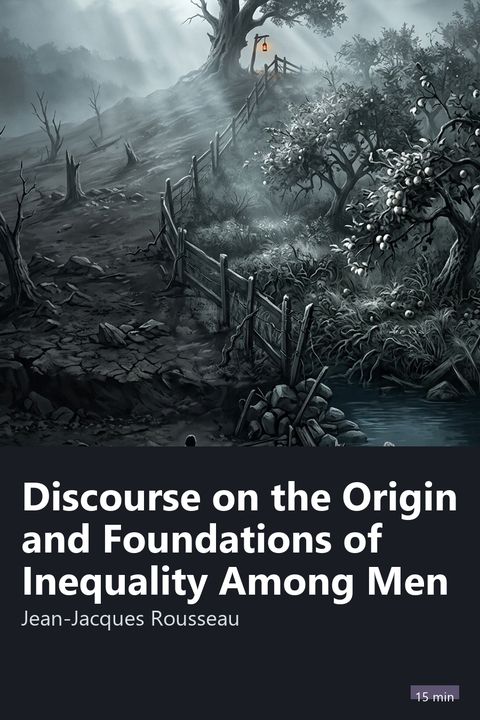
Cover of Discourse on the Origin and Foundations of Inequality Among Men

Philosophy · 15 min

Discourse on the Origin and Foundations of Inequality Among Men

Jean-Jacques Rousseau · 1755

Who it's for

For you if you want to understand why there are rich and poor people, and whether that divide is natural or socially created. It's a passionate classic, ideal for anyone who enjoys philosophy and questioning what seems normal.

Read it in the app

⚡ Free to download • 🎁 One full book free every day

🎧 Listen to this summary in the app

Every summary has audio narration. Open the app to read it or listen to it.

3 ideas to take with you

1

For Rousseau, the natural impulse to help someone who is suffering comes before any moral rule, and the subsequent layers of social life tend to weaken it.

2

According to the book, enclosing land turned what everyone could use into a privilege for a few, and that is where inequality begins to grow.

3

For the author, the ability to learn and accumulate knowledge is the source of both our greatest achievements and our greatest unhappiness.

“
Many differences between people that seem like destiny were actually created by human decisions that could have gone another way.
An idea from Discourse on the Origin and Foundations of Inequality Among Men, in the words of 15 Minutes

Preview

Start reading now

A Contest Question That Became a Classic

In 1754, the Academy of Dijon in France announced a competition with this question: What is the origin of inequality among men, and is it authorized by natural law? Rousseau, already a recognized figure, wrote his response, published in 1755 as Discourse on the Origin and Foundations of Inequality Among Men. It didn't win the prize, but it became a landmark.

His answer was bold: much of the inequality we see comes not from nature but from human decisions and institutions. In other words, it isn't destiny. Behind this argument lies an attack on the idea that the rich and powerful owe their positions to natural merit, and that the social order is inevitable.

The book has a preface, a dedication to the Republic of Geneva, and two parts. Its tone is passionate, almost accusatory, and it blends philosophy, speculative anthropology, and social criticism. Read it knowing that it's an eighteenth-century work, with some brilliant ideas and others that are decidedly dated.
Two Types of Inequality

Rousseau begins by distinguishing two types. Natural, or physical, inequality comes from nature: differences in age, health, physical strength, and talents. Moral, or political, inequality depends on human conventions: wealth, prestige, and the power to give orders. The first is inevitable; the second is socially created.

The central point is that the second has little connection to the first. Being stronger doesn't make someone richer, nor does the most intelligent person necessarily hold power. He asks whether there isn't something absurd about societies where people who work little accumulate a lot, while those who work hard live on little, all in the name of a supposedly natural order.

It's the question many people ask while boarding a crowded bus in the morning: Why do the hardest workers so often earn the least? Rousseau answers not just with numbers but with a hypothetical story about how we got here, one that takes us through an imagined state of nature.

The State of Nature: A Hypothesis, Not a Fact

To explain the origins, Rousseau imagines what human beings would be like before any society existed, in the so-called state of nature. He makes clear that this is a hypothesis, a tool for reasoning, not a historical account. He wants to identify what belongs to human nature by separating out what social life has added.

In this picture, natural human beings are solitary and uncomplicated, living according to basic needs: eating, sleeping, and reproducing. They aren't inherently violent, wise, or moralistic. They have few desires and therefore few occasions for conflict. It's a picture far removed from the war of all against all described by philosophers such as Hobbes.

Rousseau accuses those authors of projecting the vices of their own societies onto the past. It would be like imagining that today's people, with their jealousy and vanity, are how everyone has always been. His analysis is ingenious, but it's worth remembering that modern anthropology shows humans have always lived in groups.

10 more sections and the quiz

Continue in the app

Read the whole summary, finish with the Discourse on the Origin and Foundations of Inequality Among Men quiz and follow the guided Journeys. No ads in the app.

About Jean-Jacques Rousseau

Jean-Jacques Rousseau was born in Geneva in 1712 and spent much of his life in France. He became known as a philosopher, writer, and composer, playing a prominent role in the Enlightenment. He wrote the Discourse in response to a question from the Academy of Dijon, and later published The Social Contract and Emile. He died near Paris in 1778.

Explore

Category:
Philosophy