15 Minutes
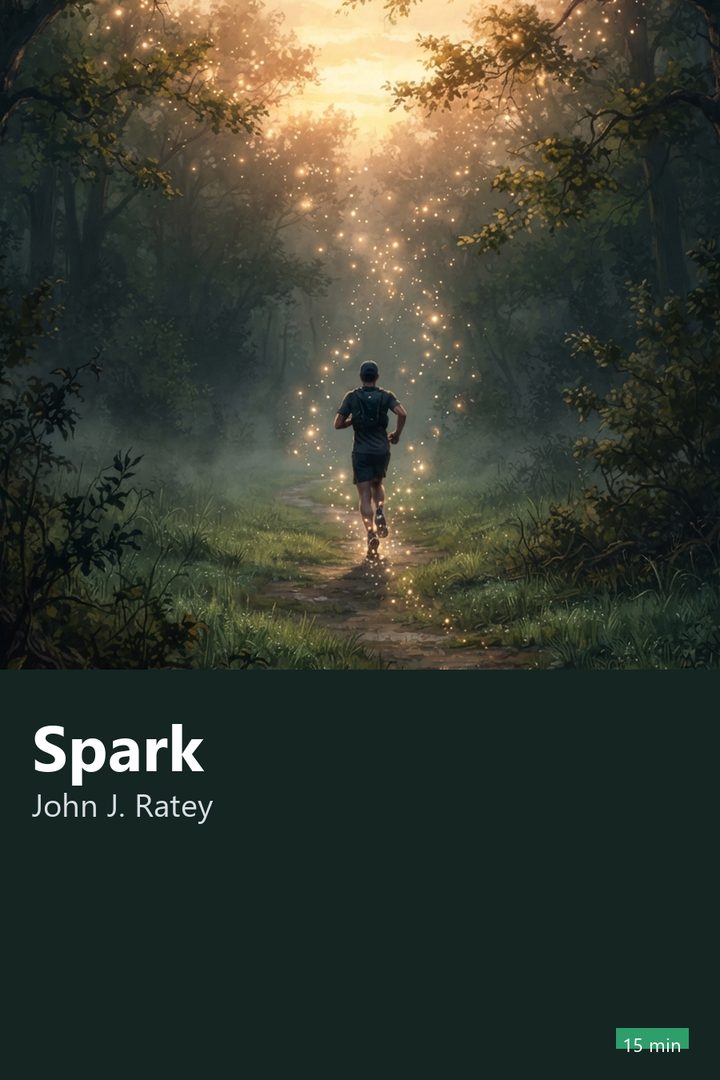
Cover of Spark

Health · 16 min

Spark

John J. Ratey · 2008

Who it's for

For people who sit all day, feel foggy-headed after work, and suspect that a brisk walk makes more of a difference than it seems. Spark is for anyone who wants to understand, with real brain science, why moving your body helps you think better.

Read it in the app

⚡ Free to download • 🎁 One full book free every day

🎧 Audio coming soon in the app

Narration for the English summaries is on its way. Meanwhile you can read the full summary in the app.

3 ideas to take with you

1

In Naperville, putting gym class first thing in the morning went hand in hand with better scores on international tests, according to the book's account of that school district.

2

For Ratey, anxiety keeps your body on alert even while you sit still in a chair, and exercise gives that alert a physical destination, without replacing treatment when treatment is needed.

3

For the author, the secret is not training hard every day, but varying your week between aerobic exercise, more intense days, strength work, and skill-based activities.

“
For the author, each exercise session works like a fertilizer the brain spreads over itself, leaving neurons more ready to grow new connections.
An idea from Spark, in the words of 15 Minutes

Preview

Start reading now

The Naperville experiment: gym class before the test

In Naperville, a city in Illinois, a physical education teacher named Phil Lawler decided to swap the usual dodgeball team and whistle for a different program. Students began taking a demanding aerobic exercise class first thing in the morning, before the hardest subjects, each one wearing a heart rate monitor strapped to the chest to make sure they were really sweating, not just pretending to chase the ball.

The result the book describes is striking: in the following years, students in that school district ranked among the best in the world on international science and math tests, even ahead of countries known for strong education. The idea behind it was not to turn students into athletes, but to use exercise to get the brain ready to pay attention in the next class.

Ratey uses Naperville as the gateway to the book's central argument: body and mind are not two separate boxes, one looking after muscle and the other after thought. For him, moving your body in the morning is also, in a very concrete way, preparing your brain to learn.
The brain is not a fixed part, it keeps rebuilding itself

For a long time, the prevailing idea was that the adult brain came ready-made from the factory and only lost parts as the years went by, gaining nothing new. The book presents a different view, based on neuroscience research: the brain keeps reshaping itself throughout life, creating new cells and connections in some regions.

This process has a name: neuroplasticity, the brain's ability to change its own structure in response to what a person lives and does, creating new synapses between neurons. Learning a new language, practicing an instrument, or memorizing the bus route to work leaves a physical mark on the brain. It is not just a figure of speech.

What the book argues is that physical exercise is one of the strongest triggers for this kind of change. It is not just a nice metaphor: a brain that moves reacts in a measurably different way from a brain that spends the day parked in a chair.

BDNF: the fertilizer exercise spreads over the brain

The complicated name is brain-derived neurotrophic factor, or BDNF, a protein the body makes on its own that helps neurons grow, connect with each other, and survive longer. Ratey likes to compare BDNF to fertilizer: it does not plant the seed by itself, but it makes the soil richer for the seed to grow.

A good share of the studies behind this idea were done with rats running on lab wheels, not with humans on a gym treadmill. The rats that ran a lot produced more BDNF and showed more growth of new cells in the hippocampus, the region of the brain tied to memory and learning.

Ratey's bet is that the same mechanism, on a smaller scale, applies to us. According to the book, a run or a brisk walk releases BDNF in the human brain too, enriching the soil so memory works better in the hours that follow.

11 more sections and the quiz

Continue in the app

Read the whole summary, finish with the Spark quiz and follow the guided Journeys. No ads in the app.

About John J. Ratey

John J. Ratey is an American psychiatrist and associate clinical professor of psychiatry at Harvard Medical School. He is the coauthor, with Edward Hallowell, of Driven to Distraction, a landmark book on ADHD. Spark was written with the journalist Eric Hagerman and gathers neuroscience research on the effects of exercise on the brain.

Explore

Category:
Health
Part of the Journeys:
Study Smarter