15 Minutes
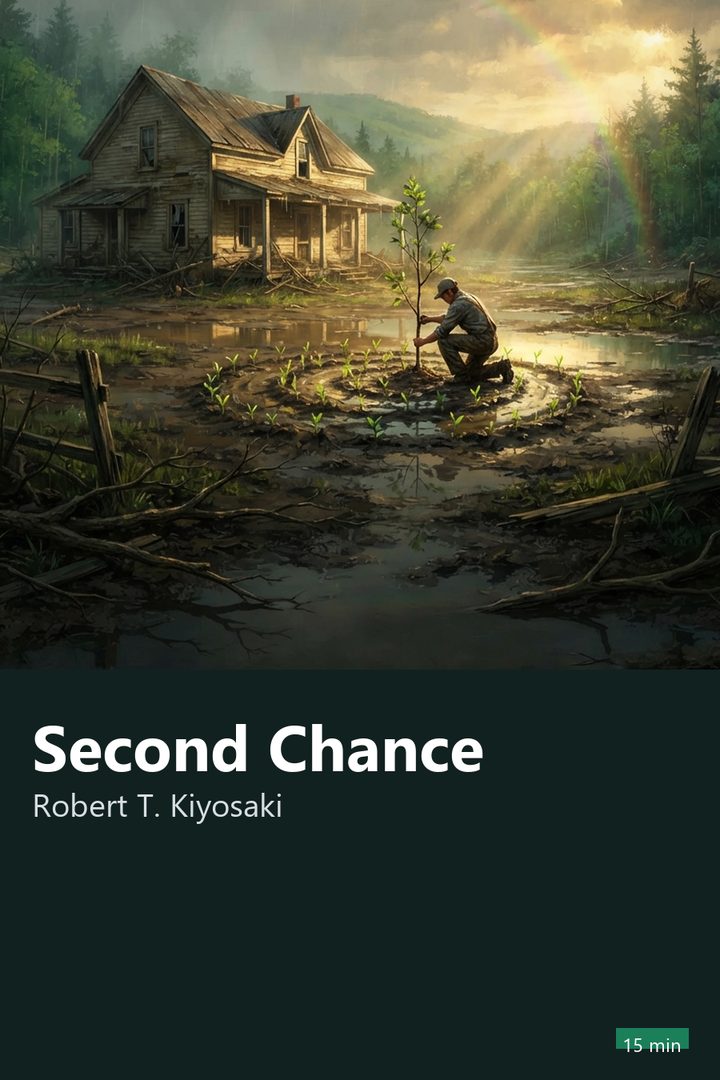
Cover of Second Chance

Personal Finance · 16 min

Second Chance

Robert T. Kiyosaki · 2015

Who it's for

For anyone who has heard of Kiyosaki and wants to understand why he became so worried about money after 2008, and for anyone who wants to separate the real history of the financial system from the author's personal bet on what to do about it.

Read it in the app

⚡ Free to download • 🎁 One full book free every day

🎧 Audio coming soon in the app

Narration for the English summaries is on its way. Meanwhile you can read the full summary in the app.

3 ideas to take with you

1

Swapping a dollar backed by gold for a dollar backed by trust in the government did not change the paper in your pocket. It changed who decides how much of that paper will exist tomorrow.

2

Calling the moment a second chance works as an urgency trigger, suggesting the clock is ticking, even though the same kind of urgency has shown up in the author's other books, decade after decade.

3

The 1971 historical fact can be checked in any economics textbook, but the recommendation to buy gold and silver as protection is the author's personal opinion, and personal opinion is not a guarantee of results.

“
Money backed by nothing but the trust of whoever prints it can lose value in a way your traditional savings never warn you about in advance.
An idea from Second Chance, in the words of 15 Minutes

Preview

Start reading now

A book written in the shadow of the 2008 crisis

Kiyosaki published Second Chance in 2015, almost seven years after the 2008 crisis erupted in the United States and spread around the world. Unlike Rich Dad Poor Dad, which tells the story of his childhood, this book is born as a reaction to a specific moment: banks at risk of bank runs, governments bailing out banks with newly created money, and a generation that saw its own job or its own home at risk.

The title carries an invitation and a warning at the same time. For him, 2008 was a warning most people did not use to change their behavior with money, and now a new opportunity would come before the next stumble, which, according to the author, would be bigger. That countdown tone runs through the entire book.

To support the argument, the book organizes the history of money into three blocks: the past, with real backing in metal; the present, held up only by trust and debt; and the future, what the author believes could happen if nothing changes. That timeline is the thread running through almost every chapter.
The money of the past: when gold backing existed

For much of history, a currency was worth something only because it could be exchanged for a fixed amount of precious metal kept in some vault. That is what we call backing: the guarantee that the paper in your wallet represents a real piece of something scarce, not just a promise.

After World War II, the Bretton Woods agreement tied the U.S. dollar to gold at a fixed rate, and the other currencies of the world anchored themselves to it. In practice, this limited how much money a government could print, because every extra bill needed enough gold stored behind it.

The book uses this period as a reference for what it calls real money: something that does not appear out of thin air by decision of a central bank. For Kiyosaki, that restriction worked as an automatic brake on government overspending, even though it was a system with crises of its own.

1971: the year the dollar stopped promising gold

In 1971, the American government suspended the conversion of the dollar into gold for other countries. The decision, made amid economic pressure and the spending of the Vietnam War, removed once and for all the metal backing of the world's main currency.

From then on, the dollar and practically every currency on the planet became what is called fiat money: paper that is worth something because the law says so and because people trust it, with no metal guaranteeing conversion on the other side of the counter.

Second Chance treats this episode as the watershed for everything that follows: without the brake of gold, central banks gained the freedom to issue money in much larger volumes and to postpone financial problems by pushing them down the road instead of solving them on the spot.

11 more sections and the quiz

Continue in the app

Read the whole summary, finish with the Second Chance quiz and follow the guided Journeys. No ads in the app.

About Robert T. Kiyosaki

Robert Kiyosaki was born in 1947 in Hawaii and served as a helicopter pilot in the United States Marine Corps during the Vietnam War. In 1997 he self-published Rich Dad Poor Dad, which became one of the biggest personal finance bestsellers in the world. Second Chance, published in 2015, arrives almost seven years after the 2008 financial crisis, revisiting the themes of the series in a more urgent tone about the future of money. Kiyosaki also founded the Rich Dad Company, which sells books, games like Cashflow, and financial education courses.

Explore

Part of the Journeys:
Wealth Mindset