15 Minutes
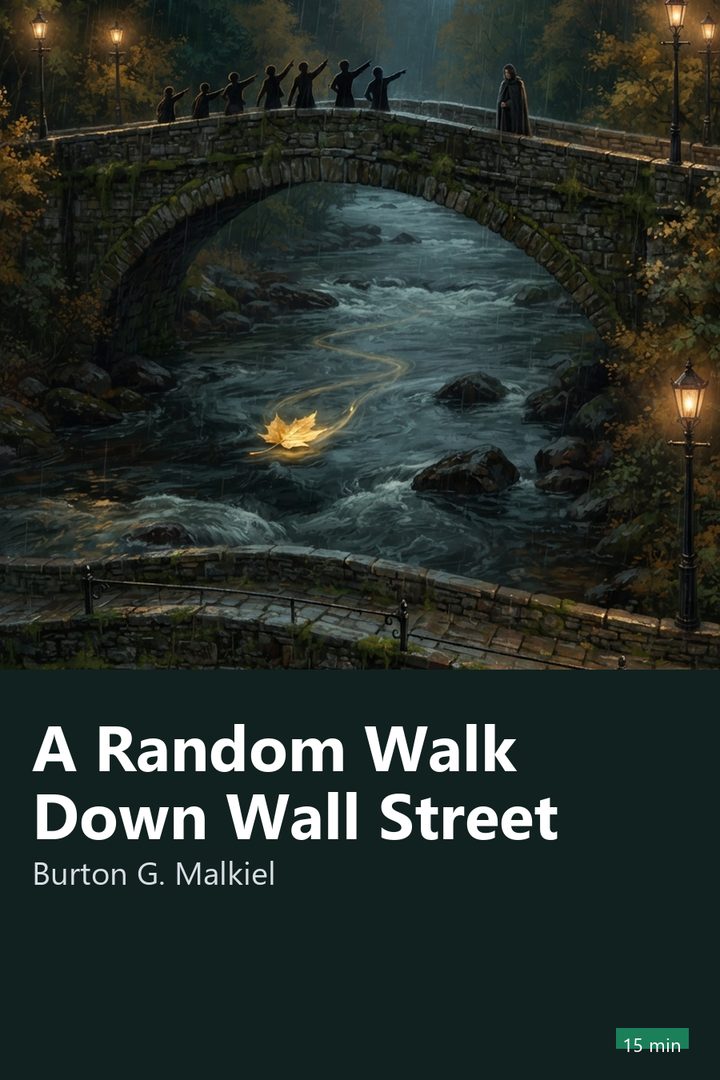
Cover of A Random Walk Down Wall Street

Personal Finance · 16 min

A Random Walk Down Wall Street

Burton G. Malkiel · 1973

Who it's for

For you if you've heard of stocks and index funds, but never quite understood why smart, well-educated people disagree so much about whether anyone can beat the market. A Random Walk Down Wall Street is for anyone who wants to understand the ideas behind investing before deciding where to put their own money.

Read it in the app

⚡ Free to download • 🎁 One full book free every day

🎧 Audio coming soon in the app

Narration for the English summaries is on its way. Meanwhile you can read the full summary in the app.

3 ideas to take with you

1

A price that only rises because it rose yesterday is being held up by other people's expectations, not by any real value behind it.

2

A small management fee, charged every year for decades, usually costs you more than any lucky short-term guess could ever earn back.

3

Getting a market forecast wrong is not a failure of intelligence. It's the natural result of trying to guess a game where everyone is competing over the same information.

“
The neighbor who made money fast rarely mentions the time he lost trying to repeat his luck.
An idea from A Random Walk Down Wall Street, in the words of 15 Minutes

Preview

Start reading now

Why no one can predict tomorrow's price

Malkiel calls it a random walk, an idea that's simple to understand and hard to accept: a stock's price tomorrow follows no hidden pattern that you can uncover today by looking at the past. Every new piece of news, from quarterly earnings to a comment by an economic official, is absorbed by the market almost the moment it appears. That leaves very little room for anyone, just by staring at yesterday's charts, to predict the next move with real confidence.

His comparison is a strong one: following price jumps in search of a pattern is like trying to predict the next step of a drunk stumbling out of a bar, who could go in any direction with no hidden logic. This isn't pointless chaos. It's new information arriving faster than any one person can process it. That relative who swears he sold at exactly the right moment probably got lucky, not skilled, and luck is not a strategy you can repeat.

Why it's so hard to beat the market

The random walk idea comes from a bigger theory, the efficient market hypothesis: the price of a stock on a large, liquid exchange already reflects almost all the public information available about the company. When relevant news appears, thousands of investors rush to act on it before everyone else, and the price adjusts too fast for any edge to be left over.

That helps explain why most actively managed funds, which pay expensive analysts to hand-pick stocks, struggle to beat the market consistently year after year: they compete for the same information, at the same speed, and the results tend to cancel out. One caveat: this hypothesis is a strong consensus among economists, but it isn't a law without exceptions, and its exact strength is still debated among experts.

Reading stock charts like reading tea leaves

Technical analysis is the study of the shape a stock's price has traced in the past, trying to find patterns that repeat: triangles, trend lines, double tops. Malkiel is blunt: if the market behaves like a random walk, those patterns are usually the human brain seeing shapes where there's only noise, the same way we see faces in passing clouds.

The problem isn't the intention of people who use technical analysis. It's the statistical foundation: serious comparisons between chart-based strategies and simply buying and holding show similar results over the long run, once you subtract the brokerage fees that frequent traders pay far more of. For someone saving with a twenty-year horizon, betting on short-term charts carries risk out of proportion to the expected gain.

11 more sections and the quiz

Continue in the app

Read the whole summary, finish with the A Random Walk Down Wall Street quiz and follow the guided Journeys. No ads in the app.

About Burton G. Malkiel

Burton G. Malkiel is an American economist and professor emeritus of economics at Princeton University. He published A Random Walk Down Wall Street in 1973, and the book has been updated and reissued ever since, always with fresh market data. Malkiel is one of the best-known defenders of the efficient market hypothesis and of index funds as a way to invest without trying to predict the market's future.

Explore

Part of the Journeys:
Investing From Scratch