15 Minutes
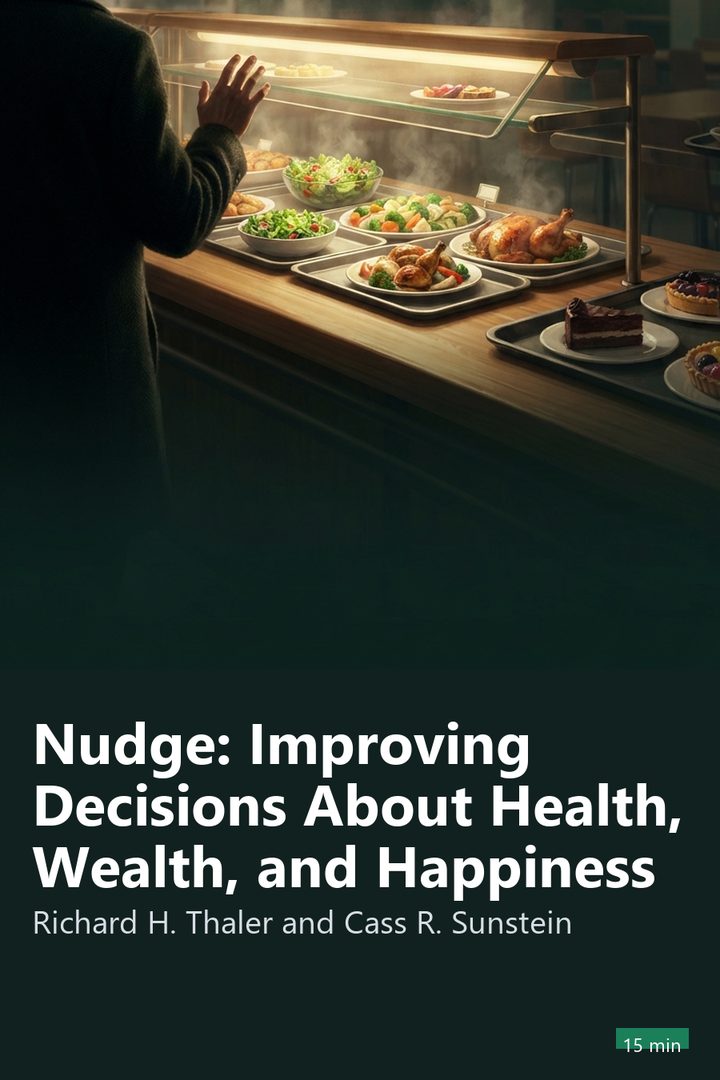
Cover of Nudge: Improving Decisions About Health, Wealth, and Happiness

Personal Finance · 16 min

Nudge: Improving Decisions About Health, Wealth, and Happiness

Richard H. Thaler and Cass R. Sunstein · 2008

Who it's for

For anyone who makes money, health, or work decisions on a kind of autopilot and wants to understand why forms, screens, and contracts push you in one direction without you noticing. Nudge teaches you to recognize that push, both to protect yourself from it and to use it in favor of yourself and the people who depend on you.

Read it in the app

⚡ Free to download • 🎁 One full book free every day

🎧 Audio coming soon in the app

Narration for the English summaries is on its way. Meanwhile you can read the full summary in the app.

3 ideas to take with you

1

According to the book, being asked to save more out of a raise that hasn't arrived yet hurts less than being asked to save more out of the paycheck that's already in your pocket.

2

For the authors, showing someone how much their neighbor is already doing right weighs more in their decision than any speech about what the ideal would be.

3

For the authors, there is no neutral way to arrange options on a screen or a shelf: someone decides what comes first, and that already influences the choice.

“
According to Thaler and Sunstein, the option checked by default on a form tends to decide more choices than awareness campaigns, because most people follow what comes already filled in.
An idea from Nudge: Improving Decisions About Health, Wealth, and Happiness, in the words of 15 Minutes

Preview

Start reading now

Real humans, not spreadsheet robots

For decades, traditional economics worked with an imaginary character: a person who calculates everything correctly, never forgets anything, and chooses exactly what is best for them in the long run. Thaler and Sunstein give this character a playful name: Econ. The problem is that nobody you know is an Econ.

Real people, whom the authors simply call Humans, forget to pay the bill, put off routine checkups, spend their holiday bonus before December is even over, and know they should set aside part of their paycheck every month, but the credit card usually gets there first.

The central thesis of the book comes from there: since the one making decisions in real life is a Human, not an Econ, the way a choice is presented changes the outcome in measurable ways. This isn't a lack of intelligence. It's about how the mind works under rush and distraction, which holds true for the executive as much as for the night-shift worker.

Whoever designs the shelf decides what you buy

Nothing in a store, an app, or a form shows up in a neutral way. Someone decided at what height the product sits on the shelf, or which option comes checked first on a screen. Thaler and Sunstein call this design choice architecture, and it exists even when nobody planned it on purpose.

A classic example from the book is the school cafeteria: putting the fruit at the kids' eye level and tucking the french fries away makes children eat more fruit, without banning any dessert and without a warning poster. The order of things alone changes behavior.

The central idea is simple: since there is no neutral way to arrange options on a grocery shelf or an app screen, someone decides what comes first, and that decision is already a form of influence. Since that influence will exist either way, it's better to design with the well-being of the chooser in mind than to pretend the architecture doesn't exist.

Libertarian paternalism: nudging without locking the door

The term that names the book's central proposal sounds odd: libertarian paternalism. The libertarian part guarantees that every option stays open, and nobody is forbidden from choosing the harder path. The paternalist part assumes the environment can be designed to make it easier to pick what the person themselves, if they stopped to think calmly, would say is best for them.

The difference from a law or a ban is big: a nudge doesn't prohibit fast food, doesn't stop gambling, doesn't block cigarettes. It only makes the option that the most enlightened version of the same person would choose easier, more visible, or cheaper, leaving the exit door always unlocked.

This proposal sits between two extreme positions: on one side, those who argue the state should not interfere in any individual choice, and on the other, those who argue for rules and bans to correct behavior. That middle position is what generates a good part of the debate about the method, as the criticism section further on shows.

11 more sections and the quiz

Continue in the app

Read the whole summary, finish with the Nudge: Improving Decisions About Health, Wealth, and Happiness quiz and follow the guided Journeys. No ads in the app.

About Richard H. Thaler and Cass R. Sunstein

Richard Thaler is an American economist, a professor at the University of Chicago Booth School of Business, and one of the founding names of behavioral economics, a field that earned him the Nobel Prize in Economics in 2017. Cass Sunstein is an American legal scholar, a professor at Harvard Law School, and from 2009 to 2012 he headed the White House office responsible for regulation and information, known by the acronym OIRA. Together they wrote Nudge in 2008 and released a final revised edition of the book in 2021.

Explore

Part of the Journeys:
Think Better