15 Minutes
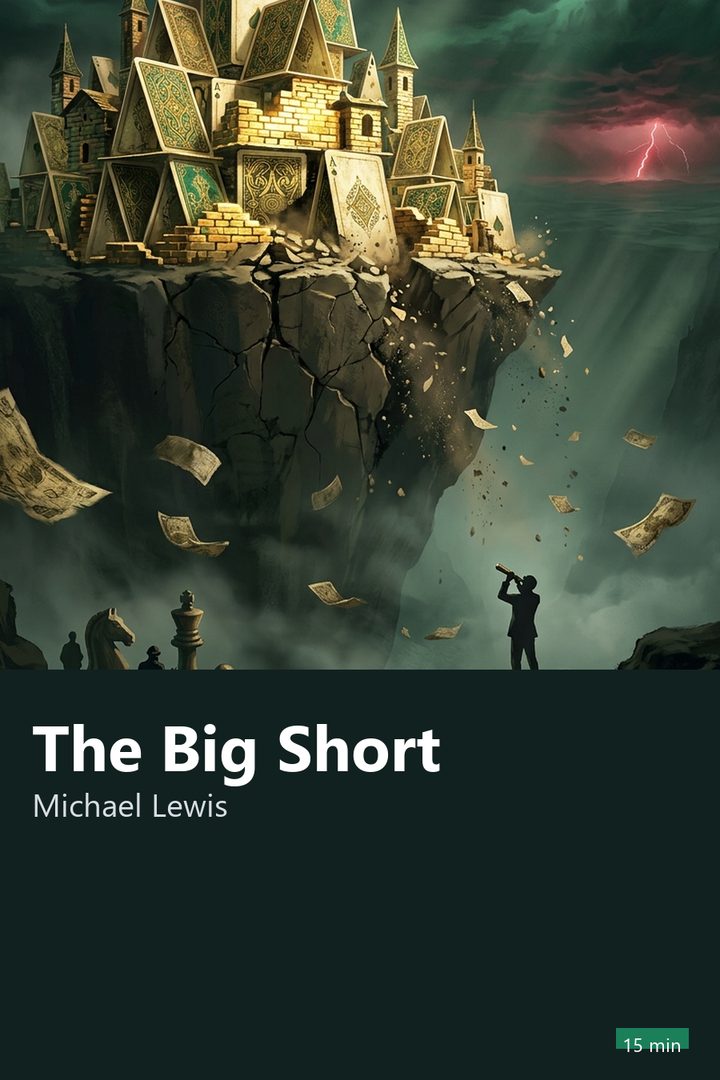
Cover of The Big Short

Personal Finance · 18 min

The Big Short

Michael Lewis · 2010

Who it's for

For anyone who wants to understand how unchecked greed and complex financial contracts nearly destroyed the global economy in 2008. The Big Short is for readers who want to see the hidden machinery of the credit market beyond the official rhetoric of the banks.

Read it in the app

⚡ Free to download • 🎁 One full book free every day

🎧 Audio coming soon in the app

Narration for the English summaries is on its way. Meanwhile you can read the full summary in the app.

3 ideas to take with you

1

Taking the time to examine original contracts and raw numbers reveals severe risks that ready-made market opinions usually disguise.

2

A seal of quality loses its value when the rating organization depends financially on the very party hiring the evaluation.

3

Environments that reward immediate profits and pass future losses on to others encourage recklessness as a deliberate strategy.

“
The collective certainty that an asset will rise in value forever creates illusions that crumble at the first sign of real scarcity.
An idea from The Big Short, in the words of 15 Minutes

Preview

Start reading now

The illusion of easy credit and the debt factory

The financial system loves selling the illusion that anyone can get rich quick by borrowing money. In the United States during the 2000s, that promise exploded in residential mortgage lending with no verification of income, employment, or prior assets. It was the triumph of the subprime loan, a high-risk product granted on a massive scale to borrowers with extremely fragile credit histories.

In everyday terms, it is like financing a luxury imported car with zero down payment and no steady paycheck, simply because the first few monthly installments fit your current budget. The hidden trap was that the contract featured short-term teaser rates, followed by brutal contractual resets that made the monthly payments unaffordable after two years.

The market ignored the danger, betting that home prices would rise forever. If the monthly payment became too heavy, a homeowner could simply sell the house for a profit in a hot market or refinance the debt based on recent appreciation. That euphoria, detached from the real income of working families, fueled a gigantic pyramid of mortgage contracts.

The solitary doctor who read the fine print

While Wall Street executives celebrated billion-dollar annual bonuses, a money manager in California decided to investigate what lay behind the official narrative. Michael Burry, founder of Scion Capital, was a former physician with a glass eye and traits of autism who preferred analyzing balance sheets to attending dinners and social conventions.

Burry did the painstaking work that the rest of the market neglected: he downloaded hundreds of bond-issuance reports and read every technical prospectus for the mortgage-backed securities. He noticed that credit quality had plummeted between 2004 and 2006, with loans granted to borrowers who did not even have steady incomes. He calculated that delinquency would explode as soon as the teaser rates expired, starting in 2007.

The manager's conclusion was terrifying: the heart of the American banking system was rotten from the inside. Nobody noticed the abyss because immediate fees and commissions were generating fortunes for middlemen in the present. To Burry, the collapse was not a remote possibility, but a mathematical certainty with a scheduled date on the payment calendar.

The billion-dollar insurance policy against the end of the world

Predicting the collapse was only half the challenge; profiting from that realization required finding the right trading instrument. There was no simple, liquid way to bet against residential mortgage portfolios. Burry therefore decided to use a derivative contract rarely used for that specific purpose: the Credit Default Swap, widely known as a CDS.

In practice, a CDS worked like an accident insurance policy. The buyer paid modest regular premiums in exchange for a multimillion-dollar payout if the insured bond suffered a default. Burry approached giant banks like Goldman Sachs and Deutsche Bank, offering to pay annual premiums to insure subprime bonds. To the banks, selling insurance on housing looked like free money, generating immediate profitability for their trading desks.

The trade was a perfect asymmetric bet with limited risk and massive upside. If he were wrong, Burry would lose only the small contractual fees accumulated over the months. If he were right, he would collect astronomical sums. The market sold billions in protection, convinced it was pocketing easy premiums from a paranoid investor.

10 more sections and the quiz

Continue in the app

Read the whole summary, finish with the The Big Short quiz and follow the guided Journeys. No ads in the app.

About Michael Lewis

Michael Lewis is an American investigative journalist and bestselling author who holds a master's degree in Economics from the London School of Economics and a bachelor's degree in Art History from Princeton University. He worked as a bond salesman at the investment bank Salomon Brothers during the 1980s, an experience he chronicled in his debut book, Liar's Poker. Over the course of his career, he has published major global bestsellers such as Moneyball, The Blind Side, and Flash Boys, in addition to writing essays for renowned publications like Vanity Fair. His works explore structural flaws, human psychology, and distorted incentives in sports and modern high finance.

Explore

Part of the Journeys:
Money in Brazil