15 Minutes
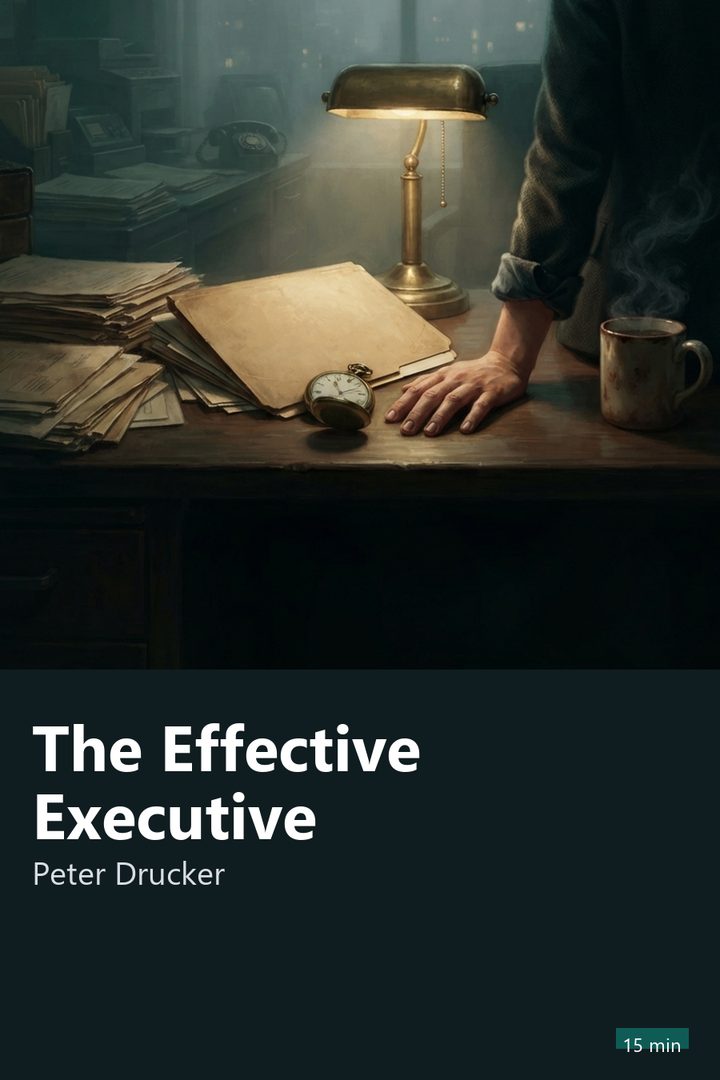
Cover of The Effective Executive

Business · 14 min

The Effective Executive

Peter Drucker · 1966

Who it's for

For anyone who carries the responsibility of making decisions at work, whether you're a manager, self-employed, or a regular employee, and feels the whole day slipping away between meetings and putting out fires, with no time left for what really matters. The Effective Executive is a manual about habit, not talent, for people who want to produce real results with the time they have.

Read it in the app

⚡ Free to download • 🎁 One full book free every day

🎧 Audio coming soon in the app

Narration for the English summaries is on its way. Meanwhile you can read the full summary in the app.

3 ideas to take with you

1

Effectiveness is a set of habits you learn by practicing, not a talent reserved for people who were born with a knack for being the boss.

2

If you don't know where your own time goes, you can't manage anything, because time is the one resource you can't buy, rent, or store.

3

Putting a person in a role that demands a strength they don't have produces a mediocre team; putting each person where their strength pays off is what holds a whole team up.

“
Finishing one important task is worth more than leaving five halfway done: pick one and go all the way.
An idea from The Effective Executive, in the words of 15 Minutes

Preview

Start reading now

Effectiveness is not a gift, it's a habit

Drucker opens the book with a provocation: effectiveness has nothing to do with intelligence, charisma, or a degree. He has seen brilliant people deliver little, and ordinary people with no standout résumé produce solid results month after month. The difference was never raw talent. It was the set of habits a person practiced until they became routine.

This changes the whole conversation: if effectiveness were a gift, only those born with a knack for leadership could develop it. Since it's a habit, any employee, freelancer, or corner-bar owner can learn to practice it, the same way you learn to drive or cook, through repetition and course correction.

The book asks for a bit of self-discipline right from the start: a habit isn't installed by watching a motivational talk. It's installed by testing a new behavior for weeks until it stops requiring conscious effort. It's workbench labor, not a Sunday epiphany.
Who the executive is, in Drucker's definition

The term executive, in the book, doesn't mean a boardroom title with a corner office and a view. It means any knowledge worker whose decisions affect other people's results, whether a store supervisor, an analyst who decides how to present a report, or a teacher who decides how to run the class.

This broad definition changes who should read the book: it isn't a manual for people already at the top of the hierarchy, it's a guide for anyone whose work involves judgment, not just the mechanical execution of a repeated task.

A bank teller who follows a fixed script is not, in this sense, an executive. But the branch manager who decides how to handle an angry customer's case is: she makes the decision, and her decision costs or saves the company money.

The traps that steal a worker's time

The book lists realities that push any professional away from effectiveness without them noticing. The first is that the time of someone who works on a team is never only theirs: in practice it belongs to whoever calls a meeting, whoever messages the group chat, whoever tries to delegate a last-minute task, whoever interrupts to handle an emergency.

The second trap is everyday bureaucracy: spreadsheets to fill out, forms nobody reads, approvals that pass through three people before turning into action. This eats up hours without producing results, and it's easy to confuse being busy with being effective.

The third is staying always inside your own organization, seeing the world through an internal lens: team meetings, department politics, turf wars. Without deliberate effort, the professional loses sight of the customer, the product, and the results that only exist outside the company.

12 more sections and the quiz

Continue in the app

Read the whole summary, finish with the The Effective Executive quiz and follow the guided Journeys. No ads in the app.

About Peter Drucker

Peter Drucker was born in Vienna, Austria, in 1909, and emigrated to the United States before World War II. He taught for decades at Claremont Graduate University in California, whose management school still carries his name today. He wrote dozens of books on management, including The Practice of Management, and many people call him the father of modern management. He died in 2005 at the age of 95, after decades as a consultant to major corporations and nonprofit organizations.

Explore

Category:
Business
Part of the Journeys:
Management Behind the Scenes