15 Minutes
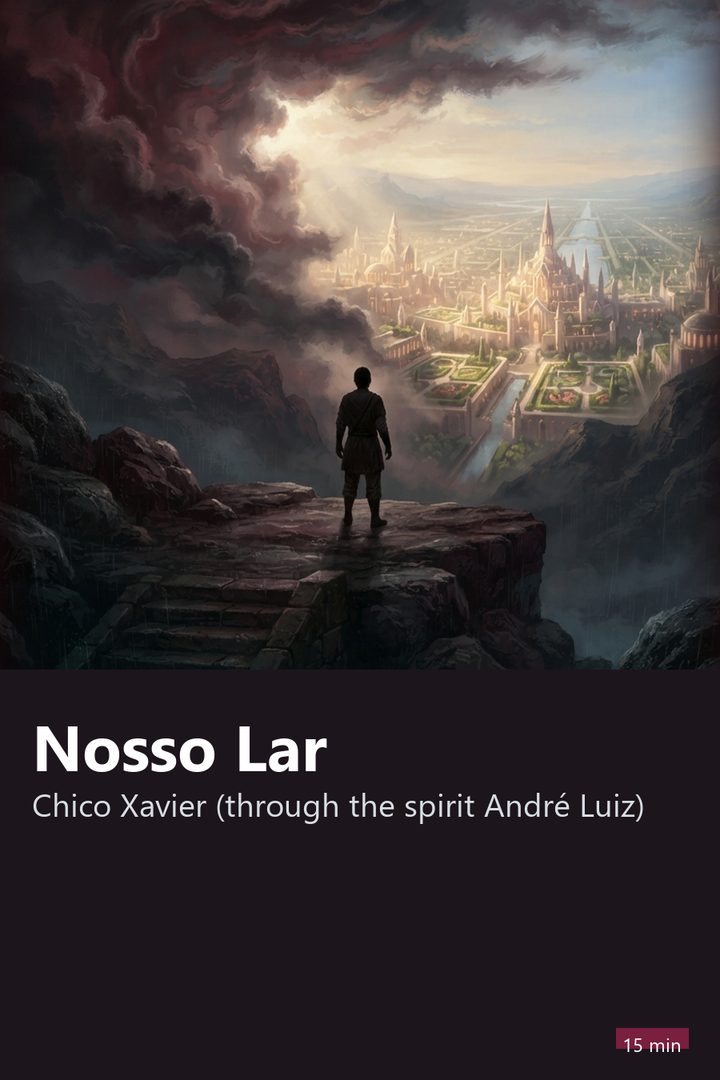
Cover of Nosso Lar

Spirituality · 16 min

Nosso Lar

Chico Xavier (through the spirit André Luiz) · 1944

Who it's for

Original title (Portuguese): Nosso Lar. For anyone who has lost a loved one and is looking for some comfort about what comes after, or for anyone curious about Spiritism who wants to understand why Nosso Lar is still cited almost 80 years after it was published. It's also for people who only saw the 2010 movie and want to know what the book actually says.

Read it in the app

⚡ Free to download • 🎁 One full book free every day

🎧 Audio coming soon in the app

Narration for the English summaries is on its way. Meanwhile you can read the full summary in the app.

3 ideas to take with you

1

For the book's critics, the idea of a spiritual city organized into ministries and work shows how Chico Xavier projected very earthly values, like order and productivity, to explain what comes after death.

2

For the book, work in the spiritual life is neither punishment nor an automatic reward: it's the path each person walks to reorganize inside what material life left in a mess.

3

The scene of the reunion with his mother suggests, for those who believe in it, that the strongest emotional bond of earthly life can also become the first support on the other side.

“
According to Spiritist doctrine, the confusion of someone who has just died is not punishment, it's lack of preparation: no one learned to live without the body while living inside it.
An idea from Nosso Lar, in the words of 15 Minutes

Preview

Start reading now

A doctor who didn't believe in any of this

André Luiz, narrator and central character of Nosso Lar, is presented as a Brazilian doctor from Rio de Janeiro who lived the way a lot of people live: focused on work, skeptical about religion, and convinced that life ends when the heart stops. According to Spiritist doctrine, he is the spirit who supposedly dictated the entire book to Chico Xavier, in a process called psychography.

Before falling ill, he is described as someone who treated the body like a machine and the soul as a subject for people with time to spare. This frank disbelief matters to the story because it is exactly what will collide with what he finds on the other side: an entire organization that presupposes the very thing he never took seriously.

The book uses this contrast as the engine of the whole narrative. The more materialistic the character was in life, the bigger the shock of reorganizing his own mind after death, and this process of relearning is what Nosso Lar follows, chapter by chapter.

The illness he took seriously too late

The narrative says André Luiz falls gravely ill and spends the last phase of his life bedridden, weaker and weaker, no longer able to work or take care of himself. It is during this period that he begins, against his own will, to notice signs that the medicine he studied had no ready explanation for.

The book doesn't spare the reader the physical discomfort of this phase: pain, dependence on caregivers, the feeling that the body that always obeyed his commands now betrays his own will. For anyone who has watched a long illness up close in the family, this stretch feels familiar before any spiritual discussion even begins.

It's important to be clear here: the book is a work of religious belief, not a health manual. No decision about treatment, medication, or medical follow-up should be based on what a Spiritist narrative says about death. That's a conversation for a doctor you trust, not for a book summary.

Dying wasn't the end, just the start of the confusion

Upon dying, André Luiz doesn't wake up directly in an organized city. According to the book, he goes through a phase of darkness and disorientation, not quite understanding what happened, still trying to act as if his body were still there, working.

According to Spiritist doctrine, this period represents the unpreparedness of someone who never stopped to think about their own death while they could. It isn't presented as punishment, but as the natural consequence of a whole life devoted only to what can be seen and held in the hand.

This stretch is one of the strongest in the book precisely because it avoids the cliché of the light at the end of the tunnel. The sensation described is one of confusion, fear, and loneliness, more like waking up lost in a strange city than any peaceful farewell scene.

12 more sections and the quiz

Continue in the app

Read the whole summary, finish with the Nosso Lar quiz and follow the guided Journeys. No ads in the app.

About Chico Xavier (through the spirit André Luiz)

Chico Xavier (1910-2002) was the most widely read medium in his country, born in Pedro Leopoldo and later settled in Uberaba, who psychographed more than 400 books over his lifetime, attributing the authorship to different spirits. Nosso Lar, published by the Brazilian Spiritist Federation in 1944, is the first title in the series about life in the spiritual world credited to the spirit André Luiz. Xavier never collected royalties on the psychographed books, donating the proceeds to charitable institutions. Nosso Lar became a Brazilian film directed by Wagner de Assis, released in 2010, one of the biggest box office hits of national Spiritist cinema.

Explore

Category:
Spirituality
Part of the Journeys:
Great Texts of Faith